
Financial Guidance
401k Loan Repayment Layoff: What You Really Owe

Getting laid off is stressful enough without worrying about what happens to your outstanding 401k loan. If you’ve borrowed from your retirement account and suddenly find yourself without a job, you’re probably wondering exactly what you owe and what your options are. The reality is that most employers require immediate repayment when you leave, but understanding your choices can help you avoid costly mistakes that could impact your financial future.
Key Takeaways
- You typically have 60-90 days after termination to repay your outstanding 401k loan balance in full or face tax consequences
- Unpaid loan balances become taxable distributions subject to income tax and a 10% early withdrawal penalty if under age 59½
- You can potentially roll over the loan offset amount to an IRA or new employer’s 401k plan to avoid immediate taxes
Understanding 401k Loan Repayment After Layoff

When you took out that 401k loan, the repayment terms seemed manageable with steady payroll deductions. But if you leave your employer for any reason, you will need to pay off your remaining loan balance, or it will be treated as a taxable distribution. This is where things get complicated fast.
The Termination Timeline
You must pay off the loan in full no later than 90 days from the termination date. However, some plans may give you as little as 60 days, while others might be slightly more generous. The “termination date” is either your last day of employment or the date your employer designates as the final day the plan remains active.
I can’t stress this enough: check your specific plan documents immediately after receiving notice of termination. Every plan has different rules, and some may allow you to continue making payments even after you leave the company, though this is uncommon.
What Happens When You Can’t Repay
If you can’t come up with the full loan balance within the specified timeframe, the outstanding amount becomes what’s called a “loan offset.” The total outstanding balance will be considered a loan offset, with the remaining loan amount reported on a 1099-R and treated as a taxable event.
Here’s a practical example: Let’s say you have a $50,000 401k account balance and owe $15,000 on your loan. If you can’t repay the $15,000, your account balance drops to $35,000, and you’ll receive a Form 1099-R showing the $15,000 as a distribution.
The Tax Bite
The tax consequences of defaulting on your 401k loan can be severe. The loan offset balance may also be subject to an early distribution penalty of 10% if you are under the age of 59½. This means you’ll owe:
- Income tax on the full loan amount at your regular tax rate
- 10% early withdrawal penalty if you’re under 59½ (with some exceptions)
- Potential state taxes depending on where you live
Using our $15,000 example, if you’re in a 24% federal tax bracket and under 59½, you could owe:
- Federal income tax: $3,600
- Early withdrawal penalty: $1,500
- Plus any state taxes
That’s over $5,000 in taxes and penalties on a $15,000 loan default.
Your Options When Facing 401k Loan Repayment After Layoff
Option 1: Pay Off the Loan in Full
If you have the cash available, paying off the loan completely is usually your best option. This keeps your 401k balance intact and avoids any tax consequences. You can typically make payments online through your plan’s website or mail a check, though remember that checks can take up to 14 days to process.
Option 2: Use Emergency Savings or Liquid Assets
Tapping into your emergency fund isn’t ideal, but it might be better than facing the tax penalties. Remember, you’re not just avoiding taxes – you’re also preserving your retirement savings for their intended purpose.
Option 3: Rollover Strategy
Here’s where things get interesting. If your employment was terminated, you have until the tax filing deadline, including extensions, to put loan offset funds into a rollover account to avoid taxes. This gives you significantly more time than the original 60-day rollover rule.
If your loan was in good standing when you were terminated, the distribution will be a qualified plan loan offset (QPLO), and you will have until your tax return due date (plus any requested extensions) for the year of the offset to rollover that amount to another qualified retirement plan or IRA.
Option 4: Take Out a New 401k Loan
If your new employer offers a 401k plan that allows loans, you might be able to take out a new loan to pay off the old one. This strategy requires careful timing and favorable plan rules, but it can work if you land a new job quickly.
Option 5: Alternative Financing
Consider these alternatives before defaulting on your 401k loan:
- Personal loans from banks or credit unions
- Home equity line of credit (HELOC) if you own a home
- Borrowing from family or friends
- Credit cards as a last resort (though interest rates are typically much higher)
Special Circumstances and Exceptions
Military Service
If the employee is in the armed forces, the employer may suspend the loan repayments during the employee’s period of active duty and then extend the loan repayment period by this period. This protection ensures service members aren’t penalized for deployment or active duty service.
Leave of Absence
Some plans allow for loan repayment suspension during unpaid leave, though this typically doesn’t extend the original loan term. A plan also may suspend loan repayments during a leave of absence of up to one year.
Plan-Specific Exceptions
While most plans require immediate repayment upon termination, there are some plans that let you continue to repay the loan even after termination. These are exceptions rather than the rule, but it’s worth checking with your plan administrator.
Strategies to Protect Yourself
Before a Layoff
If you suspect your job might be at risk, consider these proactive steps:
- Build your emergency fund to cover potential loan repayment
- Review your plan documents to understand your specific terms
- Consider paying down the loan if possible
- Explore refinancing options while you still have steady income
After a Layoff
Once you’re facing termination, act quickly:
- Contact your plan administrator immediately to understand your timeline
- Calculate the total amount you’ll owe including taxes and penalties
- Explore all repayment options before the deadline
- Consider professional financial advice given the complexity of the situation
The Long-Term Impact on Your Retirement
Beyond the immediate tax consequences, defaulting on a 401k loan can have lasting effects on your retirement security. When you default:
- You lose that money from your retirement account permanently
- You miss out on potential compound growth over time
- You may struggle to rebuild your retirement savings, especially if you’re older
The average balance on those loans is $9,900 and is most common among workers with income from $30,000 to $100,000. For many people, this represents a significant portion of their retirement savings.
Working with Financial Professionals
Given the complexity of 401k loan rules and tax implications, consider working with:
- A financial advisor to evaluate your options and create a repayment strategy
- A tax professional to understand the full tax implications
- Your plan administrator to clarify specific plan rules and deadlines
The cost of professional advice is often minimal compared to the potential taxes and penalties you could face.
Planning for the Future
Once you’ve navigated the immediate crisis of 401k loan repayment after layoff, take steps to protect yourself in the future:
Build a Robust Emergency Fund
Aim for 3-6 months of expenses in easily accessible savings. This reduces the likelihood you’ll need to borrow from your 401k in the first place.
Reconsider 401k Loans
While 401k loans can seem attractive because you’re borrowing from yourself, they come with significant risks, especially job loss. Consider other financing options for major expenses.
Prioritize Retirement Contributions
Once you land a new job, make rebuilding your retirement savings a priority. If you had to default on a loan, you’ll need to work extra hard to get back on track.
Common Mistakes to Avoid
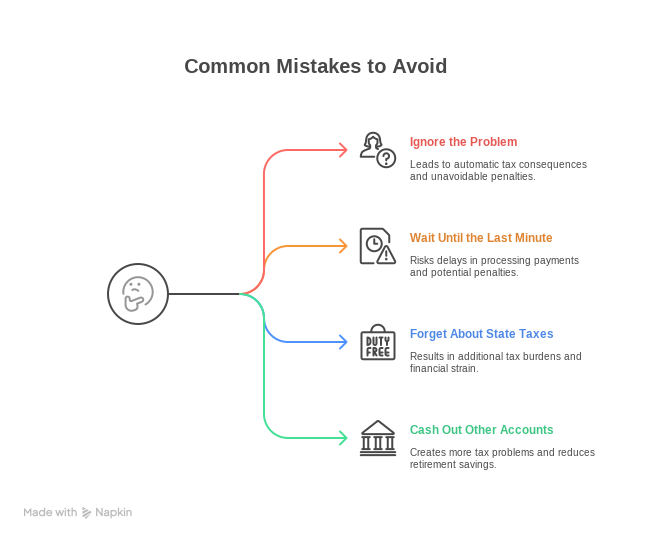
Don’t Ignore the Problem
Some people hope the issue will resolve itself or that their former employer will be lenient. A participant who does not repay an outstanding loan will be taxed on the loan as if it were a cash distribution. The tax consequences are automatic and unavoidable without action.
Don’t Wait Until the Last Minute
Processing payments, especially by check, takes time. Check payments can take up to 14 days to receive and process. Start the repayment process as soon as possible.
Don’t Forget About State Taxes
While much focus is on federal taxes and penalties, don’t forget that most states will also tax the distribution as ordinary income.
Don’t Cash Out Other Retirement Accounts
Raiding other retirement accounts to pay off the loan often just creates more tax problems. Evaluate all options carefully.
Real-World Scenarios
Scenario 1: The Quick Rebound
Sarah was laid off but found a new job within 45 days. Her new employer’s 401k plan allowed incoming rollovers, so she was able to take a new loan to pay off her old one and keep her retirement savings intact.
Scenario 2: The Emergency Fund Save
Mike had built up a substantial emergency fund and was able to pay off his $12,000 401k loan immediately after his layoff. While it depleted his savings, it preserved his retirement account and avoided thousands in taxes and penalties.
Scenario 3: The Rollover Strategy
Jessica couldn’t come up with the cash to repay her $18,000 loan but used the extended rollover timeline to gradually fund an IRA over several months, ultimately avoiding the tax consequences.
FAQs
Can my employer require immediate repayment of my 401k loan if I’m laid off?
Yes, most plans require repayment within 60-90 days of termination. Plan sponsors may require an employee to repay the full outstanding balance of a loan if he or she terminates employment. However, check your specific plan documents for exact terms.
What happens if I can’t repay my 401k loan after a layoff?
If the employee is unable to repay the loan, then the employer will treat it as a distribution and report it to the IRS on Form 1099-R. You’ll owe income taxes and potentially a 10% early withdrawal penalty if you’re under 59½.
Can I roll over my defaulted 401k loan to avoid taxes?
Yes, in many cases. The employee can avoid the immediate income tax consequences by rolling over all or part of the loan’s outstanding balance to an IRA or eligible retirement plan by the due date (including extensions) for filing the Federal income tax return for the year in which the loan is treated as a distribution.
How long do I have to repay my 401k loan after being laid off?
You must pay off the loan in full no later than 90 days from the termination date, though this can vary by plan. Some plans may give you as little as 60 days, so check your plan documents immediately.
Will defaulting on my 401k loan affect my credit score?
Unlike traditional bank loans, these loans are typically made without a credit check. The debt also isn’t reported to credit bureaus, and neither are defaults. However, you’ll still face significant tax consequences.
Conclusion
Dealing with 401k loan repayment after a layoff isn’t easy, but understanding your options can help you make the best decision for your financial future. Whether you can repay the loan in full, need to explore rollover strategies, or must accept the tax consequences, the key is acting quickly and getting professional guidance when needed.
Remember, this setback doesn’t have to derail your retirement plans permanently. With careful planning and the right support, you can navigate this challenge and get back on track. If you’re feeling overwhelmed by your options or need help creating a comprehensive financial recovery plan, consider scheduling a consultation with Layoff Lifeline. Our experts understand the unique challenges you’re facing and can help you explore all your options to make the best decisions for your financial future.
Keep Reading
More practical guidance for the financial, career and emotional side of a layoff.


