
Financial Guidance
401k Rollover Layoff at 55: Your Financial Recovery Guide

Getting laid off at 55 can feel like the rug’s been pulled out from under you. I’ve seen countless people in this situation, wondering what happens to their hard-earned 401k savings. The good news? You have more options than you might think, and some of them might actually work in your favor. Let me walk you through everything you need to know about managing your 401k rollover after layoff at 55.
Key Takeaways
- The Rule of 55 allows penalty-free withdrawals from your current employer’s 401k if you separate from service at age 55 or later, but you lose this benefit if you roll over to an IRA
- Four main rollover options exist after a layoff: keep funds with the former employer, roll to new employer’s plan, transfer to an IRA, or cash out (with significant penalties under age 59½)
- Strategic planning is essential for early retirement bridge strategies, healthcare coverage, and tax optimization when transitioning retirement accounts after an unexpected job loss
Understanding the Rule of 55: Your Early Access Advantage

The Rule of 55 is an IRS provision that allows penalty-free withdrawals from your employer-sponsored retirement plan if you separate from service during or after the year you turn 55. This rule can be a financial lifesaver if you’re facing unexpected job loss.
Here’s what makes the Rule of 55 special:
Timing Requirements: You must leave your job during the calendar year you turn 55 or after to qualify. If you’re a public safety employee like a police officer, firefighter, or EMT, this age requirement is lowered to 50.
Current Plan Only: You can only withdraw funds from your most recent employer’s 401k or 403b account under the Rule of 55. Previous employers’ plans don’t qualify for this exception.
Tax Implications: While you avoid the 10% early withdrawal penalty, you’ll still owe ordinary income taxes on distributions from traditional 401k accounts. For Roth 401k accounts, penalties are waived under the Rule of 55, but taxes on earnings may still apply if the account hasn’t met the 5-year rule.
Critical Rule of 55 Considerations
Withdrawal Restrictions: Many plans don’t offer partial withdrawals once you’ve left your job, potentially requiring you to withdraw the entire account balance at once. Check with your plan administrator about available options.
Rollover Impact: If you roll your money into an IRA, you can no longer avoid the penalty and lose access to the Rule of 55 benefits. This decision is irreversible for that money.
Long-term Consequences: Withdrawing significant amounts could reduce your portfolio’s growth potential and affect your future financial security.
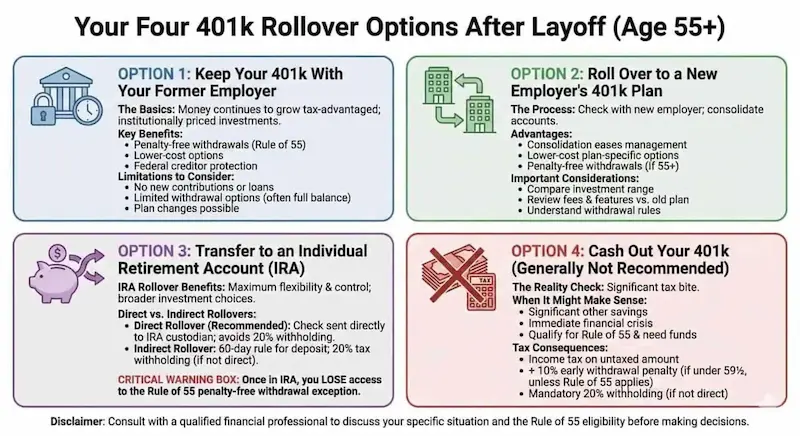
Your Four 401k Rollover Options After Layoff
When you’re laid off at 55, you have four primary paths for your 401k savings. Each comes with distinct advantages and potential drawbacks.
Option 1: Keep Your 401k With Your Former Employer
The Basics: Most companies allow you to keep your retirement savings in their plans after you leave, and your money continues to have the chance to grow tax-advantaged.
Key Benefits:
- You can take penalty-free withdrawals from a plan sponsored by your former employer if you left your job with them at age 55 or older
- Many offer institutionally priced (lower-cost) or unique investment options
- Federal law provides broad protection against creditors
Limitations to Consider:
- You won’t be able to add any more money to the account, or in most cases, take a 401k loan
- Withdrawal options may be limited—you may not be able to take a partial withdrawal and may have to take the entire balance
- Plan changes by your former employer could impact available services
Option 2: Roll Over to a New Employer’s 401k Plan
The Process: Not all employers will accept a rollover from a previous employer’s plan, so check with your new employer before making any decisions.
Advantages:
- Consolidating your 401ks can make it easier to manage your retirement savings
- Many plans offer lower-cost institutionally priced plan-specific investment options
- You can take penalty-free withdrawals if you leave your job with the new employer at age 55 or older
Important Considerations:
- Consider the range of investment options available in the new plan
- Review plan fees and features compared to your former employer’s plan
- Understand the new plan’s withdrawal rules and restrictions
Option 3: Transfer to an Individual Retirement Account (IRA)
Rolling over to an IRA is often the most popular choice, offering maximum flexibility and control over your retirement savings.
IRA Rollover Benefits:
- You may be able to get a broader range of investment choices than is available in an employer’s plan
- You can consolidate all of your retirement savings in one place by rolling in any savings from past employers
- You can keep contributing money to the account up to annual limits
- If you’re under age 59½, you can withdraw money penalty-free if you meet one of the IRS’s exceptions, including a qualifying first-time home purchase or higher education expenses
Direct vs. Indirect Rollovers:
Direct Rollover (Recommended): Consider a direct rollover—that’s when one financial institution sends a check directly to the other financial institution. Make sure your old employer does a direct rollover, signing your money over to the IRA management company, rather than to you, so you can avoid paying the 20% tax withholding.
Indirect Rollover: If you want to do an indirect rollover—cash out the money and then deposit it into another tax-advantaged account yourself—you have 60 days from the time you cash out to deposit the money. However, the taxable portion of your withdrawal that is eligible for rollover is subject to 20% mandatory federal income tax withholding unless it’s directly rolled over.
Critical Warning About IRA Rollovers: Remember, once you roll that money into an IRA, you can no longer avoid the penalty for early withdrawals and lose access to the Rule of 55. This is a crucial consideration if you think you might need early access to these funds.
Option 4: Cash Out Your 401k (Generally Not Recommended)
The Reality Check: You will likely have to pay income tax on any previously untaxed amount that you receive, and may have to pay an additional 10% early distribution tax if you aren’t at least age 55.
When It Might Make Sense:
- You have significant other retirement savings
- You have immediate financial needs that can’t be met otherwise
- You qualify for the Rule of 55 and need the funds for early retirement
Tax Consequences: In most cases, you’d have to pay the 20% tax on your cashed-out 401k, plus a 10% early withdrawal penalty if you’re under age 59½.
Building Your Early Retirement Bridge Strategy
If you’re considering early retirement after your layoff at 55, you’ll need to bridge the income gap until Social Security and other benefits kick in.
Understanding Bridge Strategies
Bridge strategies can be complex and are designed to generate income from savings until you can claim Social Security at your full retirement age or age 70 when benefits top out. The assumption is that you withdraw the same amount you would receive in Social Security benefits at your retirement age, but you can withdraw and spend any amount you choose.
Key Bridge Strategy Components
Healthcare Coverage Planning: If you’re retiring before age 65, won’t have retiree coverage from your employer, and aren’t yet eligible for Medicare, figuring out health care coverage can be a tall order. You’ll likely need to decide between numerous options, including your spouse’s employer-provided plan, COBRA, an Affordable Care Act marketplace plan, or a private insurance plan.
Income Sources to Consider:
- Severance packages that may pay your previous salary and could extend your employer’s health insurance and other benefits
- Unemployment benefits if you plan to reenter the workforce
- Penalty-free 401k withdrawals under the Rule of 55
- Other personal savings and taxable investment accounts
Social Security Timing: A key way to maximize your Social Security income is timing when you start claiming your benefits. Everyone’s situation is unique, but if you can delay taking your Social Security, it can add up to 8% per year in increased payment amounts until age 70.
Tax Optimization Strategies
Managing taxes becomes crucial when you’re dealing with early retirement and 401k rollovers.
Understanding Required Minimum Distributions
For those born prior to 1960, once you reach age 73, you’ll have to take annual required minimum distributions (RMDs). For those born in 1960 or later, RMDs will start at age 75. The IRS imposes a 25 percent tax penalty on RMDs not withdrawn from your 401k on time.
Roth Conversion Opportunities
Early retirement can provide an excellent opportunity for Roth conversions during lower-income years. If you choose to convert some or all of your savings in your employer-sponsored retirement plan directly to a Roth IRA, the conversion would be subject to ordinary income tax, but future qualified withdrawals would be tax-free.
State Tax Considerations
State income tax may also apply to your retirement account withdrawals, depending on where you live and your state’s treatment of retirement income. Some states fully tax 401k withdrawals, while others offer partial exemptions or don’t tax retirement income at all.
Navigating Severance and Stock Options
Severance Package Considerations
If you were laid off, you may be offered a severance package that pays your previous salary and could extend your employer’s health insurance and other benefits for a specified number of weeks, months, or even longer. This breathing room can help you make more strategic decisions about your 401k rollover.
Employee Stock Plans
Sometimes employers provide access to stock grants, which can be complicated to understand. If you were granted restricted stock units, or nonqualified stock options or incentive stock options, in most cases, vesting stops once you’ve been terminated and you’ll have no more than three months to exercise your options.
If you hold appreciated company stock in your workplace savings account, consider the potential impact of net unrealized appreciation (NUA) before choosing between staying in the plan, taking the stock in kind, or rolling over the stock to an IRA or another employer’s plan.
Special Circumstances and Exceptions
Other Early Withdrawal Exceptions
The Rule of 55 isn’t the only way to get money from your retirement plan early. You won’t have to pay the penalty-free early withdrawal penalty for these reasons:
- You become totally and permanently disabled
- You’re taking distributions to pay deductible medical expenses that exceed 7.5% of your adjusted gross income
- Your distributions are the result of an IRS levy
- You’re receiving qualified reservist distributions
Substantially Equal Periodic Payments (72t)
For IRAs, you can avoid the early withdrawal penalty by arranging to take “substantially equal periodic payments,” sometimes referred to as Rule 72t, from the account. The amounts of your withdrawals are based on your age and account balance, and you must take them for 5 years or until you reach age 59½, whichever is longer.
Making Your Decision: A Strategic Framework
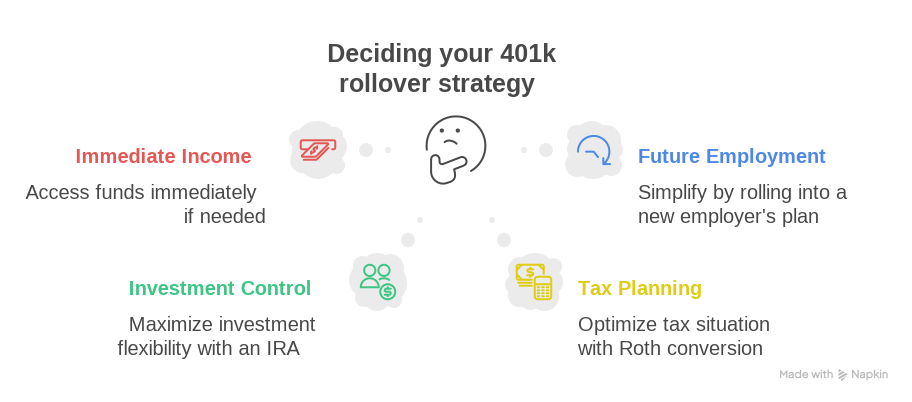
When deciding on your 401k rollover strategy after layoff at 55, consider these key factors:
Immediate Income Needs: If you need access to funds immediately and qualify for the Rule of 55, keeping money with your former employer might be your best option.
Future Employment Plans: If you’re planning to find another job with a 401k plan, rolling into a new employer’s plan could make sense for simplicity.
Investment Control: If you want maximum investment flexibility and don’t need early access to funds, an IRA rollover provides the most options.
Tax Planning: Consider your current and future tax situation, including potential Roth conversion opportunities during lower-income years.
Professional Guidance: When to Seek Help
The complexity of 401k rollover decisions at 55, especially after an unexpected layoff, often warrants professional guidance. Consider consulting with a financial advisor when:
- You’re balancing multiple retirement accounts from different employers
- You’re considering early retirement and need a comprehensive bridge strategy
- You have company stock in your 401k with potential NUA benefits
- You need help with tax optimization strategies
- You’re dealing with other complex financial considerations like severance packages or stock options
FAQs
Can I roll over my 401k to an IRA and still use the Rule of 55?
No. Once you roll that money into an IRA, you can no longer avoid the penalty and lose access to the Rule of 55 benefits. This is why it’s crucial to understand your options before making any rollover decisions.
What happens if I get laid off at 54 but turn 55 later that year?
You must leave your job during the calendar year you turn 55 or after to qualify for the Rule of 55. If you’re laid off at 54, even if you turn 55 later that year, you won’t qualify for penalty-free withdrawals until age 59½.
How long does a 401k rollover typically take?
Rollovers typically take 2–4 weeks to complete. Direct rollovers are generally faster and more straightforward than indirect rollovers.
Can I roll over just part of my 401k balance?
Yes, you can typically roll over a portion of your 401k balance while keeping the rest with your former employer. However, check with your plan administrator about any restrictions or minimum balance requirements.
What’s the difference between a rollover and a transfer?
A trustee-to-trustee transfer occurs when you’re getting a distribution from an IRA and ask the financial institution to make the payment directly to another IRA or retirement plan. No taxes will be withheld from your transfer amount. Rollovers typically refer to moving money from employer plans to IRAs or between employer plans.
Conclusion
Facing a layoff at 55 doesn’t have to derail your retirement plans. With the right strategy, you might even find yourself in a better position than before. The key is understanding your options and making informed decisions that align with your long-term financial goals.
I know this feels overwhelming right now, but you’re not facing this alone. At Layoff Lifeline, I’ve helped hundreds of professionals navigate exactly this situation. Your 401k rollover decision is just one piece of your financial recovery puzzle. Ready to take control of your transition? Let’s schedule a consultation to create your personalized roadmap forward, because your next chapter deserves expert guidance.
Keep Reading
More practical guidance for the financial, career and emotional side of a layoff.


