
Financial Guidance
401k Rollover Mistakes That Could Cost You Thousands

Losing your job is hard enough without watching your retirement savings slip away because of a rollover mistake. When you’re navigating layoff recovery, the last thing you want is to discover that a wrong move with your 401k has cost you thousands in penalties and taxes. I’ve seen it happen too often—people in career transition make rushed decisions about their retirement accounts because they’re overwhelmed, stressed, or simply don’t understand the rules. The good news? Most 401k rollover mistakes are completely preventable. Understanding what to avoid can mean the difference between a smooth financial transition and years of regret.
Key Takeaways
- The 60-day rollover window is non-negotiable—missing it triggers permanent tax penalties and early withdrawal taxes that can wipe out thousands in retirement savings
- Indirect rollovers create withholding traps where the IRS automatically holds 20% of your money, forcing you to cover the gap or face tax bills later
- Mixing pre-tax and after-tax contributions incorrectly can trigger unexpected tax consequences that complicate your financial recovery during an already stressful transition
Why Your 401k Matters During Career Transition

After a layoff, your retirement account becomes even more critical to your financial stability. Unlike a regular savings account, your 401k represents years of your contributions, employer matches, and investment growth. It’s often one of the largest assets you control during this vulnerable period. But here’s the challenge: you’re suddenly faced with rollover options at a time when you’re emotionally drained, potentially uncertain about your next move, and possibly anxious about your financial future.
This emotional weight often leads to poor decisions. Some people rush through the process. Others freeze and do nothing, missing critical deadlines. A few make choices without fully understanding the tax implications. All of these scenarios can derail your recovery plan before you’ve even started rebuilding.
The 60-Day Rollover Window: Your Most Critical Deadline
Let me be direct: the 60-day rollover window is absolute. When you leave your job, your old employer’s plan provider typically sends you a distribution of your retirement account. You then have exactly 60 days to move that money into a new retirement account without triggering penalties and taxes.
This sounds simple, but the emotional stress of a layoff can make you lose track of time. If you miss this deadline—even by one day—the IRS treats the money as a taxable distribution. You’ll owe income tax on the full amount, plus a 10% early withdrawal penalty if you’re under 59.5. On a $100,000 rollover, that’s potentially $30,000 or more in taxes and penalties. That’s not a small mistake; that’s a financial crisis on top of job loss.
The best way to protect yourself is to mark your calendar immediately. If your employer gives you a distribution check, don’t put it aside to handle later. Set reminders. Contact your new plan provider or financial advisor the same week you leave your job. Don’t let the emotional fog of transition cause you to miss this deadline.
The Indirect Rollover Trap: That 20% Withholding Problem
Here’s where many people get caught off guard. There are two types of rollovers: direct and indirect. A direct rollover is the safest route—your old plan provider sends money directly to your new account or retirement plan. No tax bill. No complications.
An indirect rollover is different. Your old employer sends you a check for the distribution, and you’re responsible for depositing it into a new account within 60 days. Sounds reasonable, right? But here’s the trap: the IRS requires your old plan to withhold 20% of the money for federal income taxes. If your rollover was $50,000, you only receive $40,000. The other $10,000 goes to the IRS.
Now you’re in a bind. To avoid taxes and penalties, you need to deposit the full $50,000 into your new retirement account within 60 days. But you only have $40,000 from your employer. To complete the rollover properly, you’d need to come up with that missing $10,000 from your own pocket. If you don’t, the $10,000 is treated as a taxable distribution, and you’ll owe income tax on it—plus that 10% early withdrawal penalty.
Many people in career transition don’t have an extra $10,000 lying around after a layoff. This is exactly why a direct rollover is almost always the better choice. Contact your old employer’s plan provider and request a direct rollover to your new account or a rollover IRA. This eliminates the withholding problem entirely and keeps your entire retirement savings intact.
Pre-Tax vs. After-Tax Money: The Complication You Need to Avoid
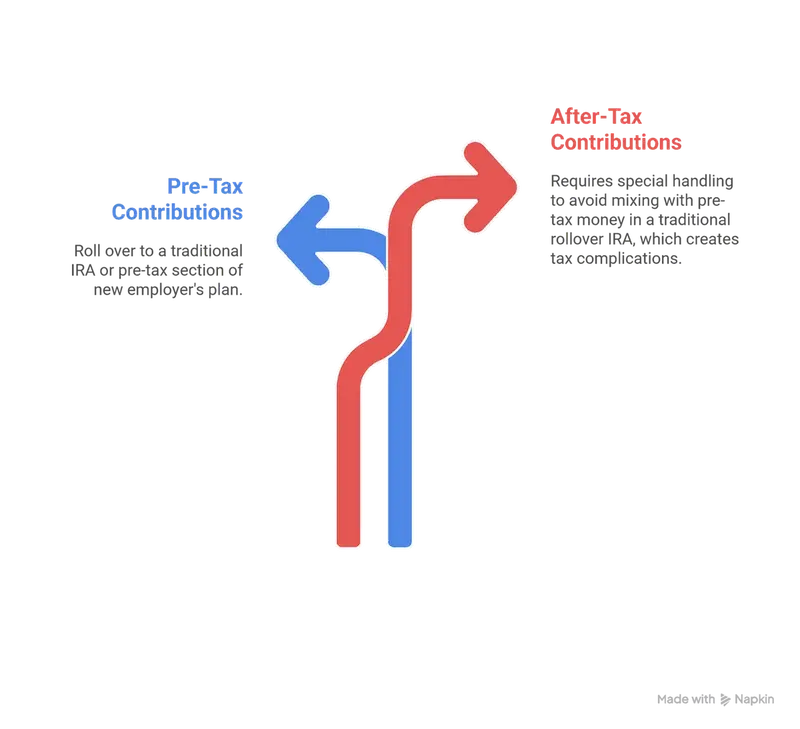
Most of your 401k contributions are likely pre-tax, meaning they reduced your taxable income in the years you contributed. When you roll over pre-tax money, it goes into a traditional IRA or a pre-tax section of your new employer’s plan. This is straightforward.
But some employer-sponsored plans allow after-tax contributions. This is less common, but it matters. After-tax contributions have already been taxed, so rolling them over requires special handling. If you mix after-tax money with pre-tax money in a traditional rollover IRA, you create a tax mess that complicates your filing for years.
The solution? Keep it simple. If your old plan has after-tax contributions, ask your plan provider to separate them. Roll the pre-tax money to a traditional IRA and discuss after-tax options—possibly a Roth IRA conversion—with a financial advisor. During career transition, simplicity is your friend.
Missing the Rollover Options: Why Your Choices Matter
When you leave your job, you typically have several rollover options:
- Roll to your new employer’s plan (if they offer one and allow incoming rollovers)
- Roll to a rollover IRA (an IRA specifically for money from employer-sponsored plans)
- Roll to a traditional IRA (if you’re just consolidating retirement savings)
- Roll to a Roth IRA (if you’re willing to pay taxes now for tax-free growth later)
Each option has different tax implications, investment choices, and required minimum distributions rules. Missing this decision or making it carelessly can limit your investment options or lock you into higher fees. During layoff recovery, you want maximum flexibility and the lowest fees possible so your money can grow without obstacles.
Don’t let confusion stop you from choosing. If you’re unsure, a direct rollover to a rollover IRA is typically the safest, most flexible option while you figure out your next career move. You can always move the money later if your situation changes.
The Emotional Recovery Side: Your Financial Plan Matters Now More Than Ever
Here’s what I want you to understand: making smart rollover decisions isn’t just about avoiding penalties. It’s about reclaiming control during a time when everything feels uncertain. After a layoff, your retirement savings represent stability and possibility. Protecting that money is an act of self-care and resilience.
When you make thoughtful rollover decisions—even if they feel small—you’re actively building your financial future. You’re saying to yourself, “I can navigate this. I can make smart choices. I can protect what matters.” That mindset shift is powerful during career transition. It reminds you that you have agency and options, even when job loss feels disempowering.
FAQs
What happens if I miss the 60-day rollover deadline?
The money is treated as a taxable distribution. You’ll owe income tax on the full amount plus a 10% early withdrawal penalty if you’re under 59.5. This can result in a significant tax bill. Some exceptions exist (like hardship distributions), so contact a tax professional immediately if you miss the deadline—there may be options.
Can I do multiple rollovers in a year?
The IRS allows only one indirect rollover per 12-month period across all your IRA accounts. Direct rollovers don’t have this limitation. If you need to move money from multiple accounts, use direct rollovers to avoid triggering this restriction.
Should I take a loan from my 401k instead of rolling it over?
A 401k loan might feel easier during layoff recovery, but it can backfire. If you can’t repay the loan within 60 days after leaving your job, it’s treated as a distribution, triggering taxes and penalties. A rollover preserves your money for retirement rather than creating debt you’d need to repay.
What’s the difference between a rollover and a transfer?
A transfer moves money directly between retirement accounts (like from one IRA to another). A rollover takes a distribution and moves it into a different account type (like from a 401k to an IRA). Transfers are usually simpler and don’t trigger withholding issues.
Can I roll my 401k into a Roth IRA?
Yes, but it’s a Roth conversion, and you’ll owe income taxes on the pre-tax money converted. During layoff recovery, when your income is lower, this might actually be a good year to convert—but discuss it with a financial advisor first.
Conclusion
Your 401k rollover after a layoff doesn’t have to be complicated. By avoiding these common mistakes—missing the 60-day deadline, choosing an indirect rollover without accounting for withholding, and failing to understand your rollover options—you protect the retirement savings you’ve worked hard to build. These decisions matter because they directly impact your financial recovery and your ability to move forward with confidence.
The emotional weight of job loss shouldn’t dictate your financial choices. If you’re feeling overwhelmed or unsure about your 401k options, that’s completely normal. You don’t have to navigate this alone. Layoff Lifeline offers personalized guidance to help you make smart rollover decisions aligned with your financial goals and career transition timeline. Schedule a consultation to explore your options and create a rollover strategy that works for your situation.
Keep Reading
More practical guidance for the financial, career and emotional side of a layoff.


