

If you’ve recently left a job or been laid off, you’re probably wondering what to do with the retirement account you built at your former employer. The 401k rollover process might sound intimidating, but I’m here to walk you through it in plain language. Moving your retirement savings doesn’t have to be complicated, and understanding your options now can save you from costly mistakes down the road. Let’s break down exactly how to roll over your old 401k step by step.
Key Takeaways
- The 401k rollover process involves moving your retirement savings from a former employer’s plan to an IRA or new employer’s plan without triggering taxes or penalties when done correctly
- You have multiple rollover options including traditional IRA, Roth IRA, and rollover IRA, each with distinct tax advantages and considerations for your retirement account
- Direct rollovers are simpler and safer than indirect rollovers, helping you avoid the 60-day deadline and mandatory 20% withholding that can complicate your rollover funds transfer
Introduction
- Understanding Your Rollover Options
- Step-by-Step Guide to Rolling Over Your 401k
- Common Pitfalls to Avoid When Rolling Over Your 401k
- Rollover IRA vs. Traditional IRA: Does It Matter?
- What About Rolling Over to Your New Employer’s Plan?
- FAQs
- Conclusion
Understanding Your Rollover Options

When you leave a job, you typically have four main paths forward with your retirement plan assets. You can leave your money with your former employer (if allowed), roll over funds into your new employer’s 401k, rollover into an IRA, or cash out (though this usually means taxes and penalties).
A traditional IRA maintains the tax-deferred status of your 401k contributions—you won’t pay taxes until withdrawal. A Roth IRA works differently: you’ll pay income taxes on the rollover amount now, but qualified distributions in retirement are tax-free. A rollover IRA is essentially a traditional IRA designed to hold assets from employer-sponsored retirement plans.
The choice depends on your current tax situation, retirement timeline, and whether you expect your tax rate to be higher or lower in the future. If you’re in a lower tax bracket now, converting to a Roth might make sense. If you want to avoid paying taxes now, a traditional or rollover IRA keeps your money tax-deferred.
Step-by-Step Guide to Rolling Over Your 401k
Let me walk you through the 401k rollover process in 3 easy steps—well, technically six, but they’re straightforward.
Step 1: Review Your Current Retirement Account
Log into your former employer’s retirement plan and review your balance, investment holdings, and any company stock. Note any outstanding loans, as these typically need repayment before rolling over your assets. Contact your plan administrator and request information about their rollover process, including any fees and expenses or restrictions.
Step 2: Choose Between IRA Options
A traditional IRA maintains your tax-deferred status—simple and no immediate tax consequences. A Roth IRA conversion means paying taxes now for tax-free growth later, which can be smart if you’re early in your career or believe tax rates will rise. Keep in mind the rollover amount will be added to your taxable income for the year. You may also be able to roll over to a SEP IRA if you’re self-employed.
Step 3: Decide Between Direct and Indirect Rollover
A direct rollover means money moves straight from your old 401k into your new IRA without you touching it. This is almost always the better choice—it’s simpler and avoids tax risks.
An indirect rollover means the check is made payable to you, and you must deposit the funds into another retirement account within 60 days. Your former employer will withhold 20% for taxes, and you’ll need to make up that amount from your own pocket. If you don’t complete the transfer within 60 days, the entire distribution becomes taxable and may trigger an early withdrawal penalty if you’re under 59½.
Go with the direct option unless you have a specific reason not to.
Step 4: Open Your New Account
Research IRA providers and compare investment options, fees, and customer service. Companies like Fidelity and Vanguard are popular choices. Opening an IRA is usually straightforward—you can complete the process online in 15-30 minutes. Choose between traditional or Roth IRA and select initial investment preferences. Don’t worry too much about investment choices right now; you can adjust them after your rollover funds arrive.
Step 5: Initiate the Rollover Process
Contact your former employer’s plan administrator and request a direct rollover. They’ll send paperwork or direct you to an online portal. Provide your new IRA information, including account number and financial institution’s address. Be specific that you want a direct rollover—the check or transfer should go to your IRA provider, not to you personally.
Most institutions complete electronic transfers in 5-10 business days, though paper checks may take longer.
Step 6: Confirm the Transfer and Invest Your Funds
Once your money arrives, confirm the full amount transferred correctly, then invest the funds according to your retirement strategy. Don’t let it sit in cash—this is a common mistake that costs people potential growth. If you’re unsure about investment options, most IRA providers offer target-date funds that automatically adjust as you approach retirement.
Common Pitfalls to Avoid When Rolling Over Your 401k
Missing the 60-day window: With indirect rollovers, you must deposit funds into another retirement account within 60 days to avoid taxes. Miss this deadline, and you’ll face a taxable distribution plus potential 10% early withdrawal penalty if you’re under 59½.
Forgetting about the 20% withholding: Indirect rollovers trigger automatic 20% withholding. To complete a full rollover, you’ll need to add money from your own funds to make up that difference.
Not considering Roth conversion taxes: Converting to a Roth IRA means paying taxes now. Make sure you can afford the tax bill without dipping into retirement funds. Consider consulting a tax professional regarding your specific situation.
Rolling over company stock incorrectly: If your 401k includes appreciated company stock, you might benefit from special net unrealized appreciation (NUA) tax treatment. Moving this stock to an IRA eliminates this option. Talk to a tax professional regarding your specific situation if you have significant company stock holdings.
Ignoring required minimum distributions: If you’re 73 or older, take your required minimum distributions for the year before completing a rollover to avoid tax complications.
Leaving money uninvested: After your rollover, make sure funds are actually invested, not sitting in cash earning almost nothing.
Rollover IRA vs. Traditional IRA: Does It Matter?
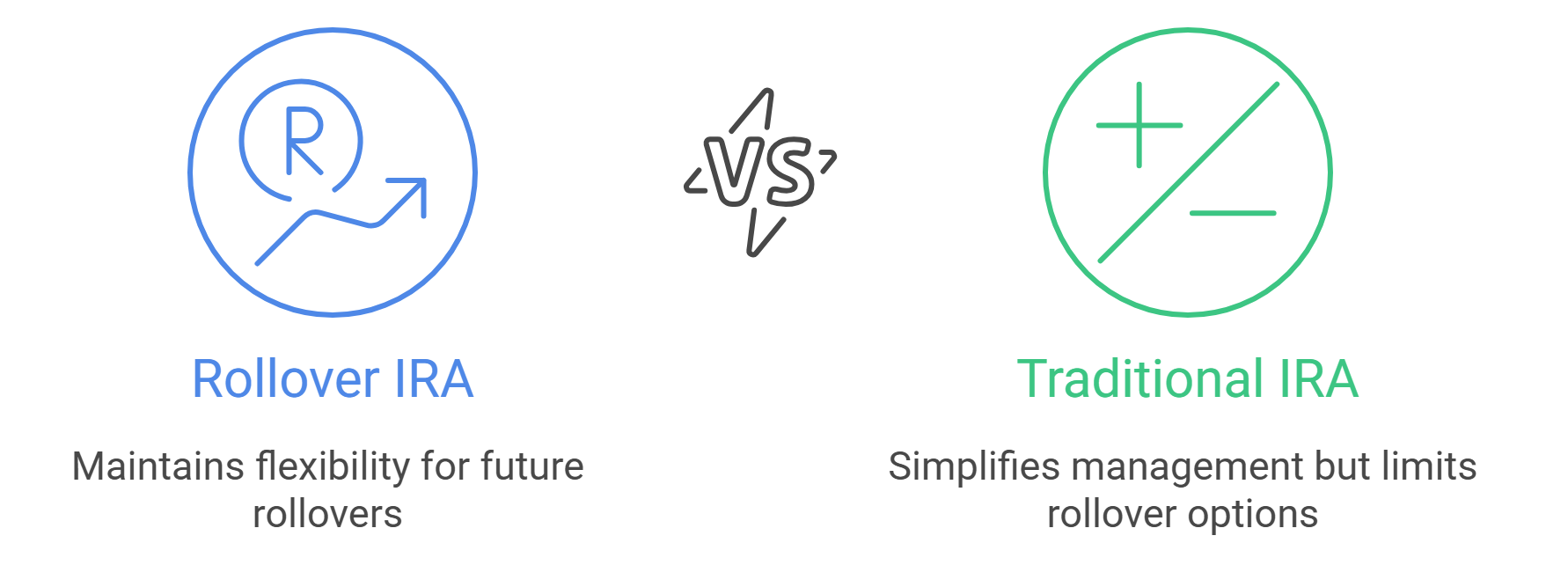
A rollover IRA is just a traditional IRA designated to hold rollover funds from an employer-sponsored retirement plan. They follow the same IRS rules and offer the same tax advantages.
The main reason to keep rollover funds separate is flexibility. If you keep rolled-over assets separate from regular IRA contributions, you may be able to roll that money into a new employer’s 401k later. Once you mix rollover funds with regular contributions, you lose this option.
Some prefer consolidating everything into one existing IRA for simplicity. Others like keeping things separate for tracking or to maintain future rollover options. It depends on your situation.
What About Rolling Over to Your New Employer’s Plan?
If your new employer offers a 401k with good investment options and low fees, rolling your old 401k into the new plan keeps all your retirement plan assets in one place. You may get access to institutional investment funds with lower expense ratios than retail IRAs.
However, not all plans accept rollovers. Check with your new plan administrator about their policies and consider the plan’s quality—if it has limited investment options or high fees and expenses, an IRA might serve you better.
One advantage: employer-sponsored retirement plans generally have stronger creditor protection than IRAs. If you’re in a high-liability profession, this might factor into your decision.
FAQs
How long does the 401k rollover process typically take?
Direct rollovers usually take 5-10 business days for electronic transfers or 2-4 weeks for mailed checks. Open your new IRA account before initiating the rollover to avoid delays.
Can I roll over my 401k while still employed?
Some plans allow “in-service rollovers” once you reach 59½, but most don’t permit rollovers until you separate from the company. Check your plan documents or contact HR.
Will I pay taxes or face a penalty for rolling over my 401k?
Direct rollovers from traditional 401k to traditional IRA incur no taxes or penalties. Converting to Roth IRA means paying income taxes on the amount. Indirect rollovers must be completed within 60 days to avoid taxes and penalties.
What happens if I have a loan against my 401k when I leave?
Most plans require full repayment within 60-90 days of leaving. If you don’t repay, the outstanding balance becomes a taxable distribution, plus a 10% penalty if you’re under 59½.
Should I roll over my entire 401k balance or just part of it?
Rolling over your entire balance usually makes sense for simplicity. Consider partial rollovers only if you need cash for expenses or have company stock with special tax treatment considerations. Consult a tax professional regarding your specific situation for complex cases.
Conclusion
The 401k rollover process doesn’t have to be overwhelming. By understanding your rollover options and following these steps, you can move your retirement savings smoothly and position yourself for long-term financial success. Whether you choose a traditional IRA, Roth IRA, or your new employer’s plan, the most important thing is making an informed decision that aligns with your retirement goals.
If you’re navigating this transition after an unexpected job loss, you’re not alone—and you don’t have to figure everything out by yourself. At Layoff Lifeline, we help people like you turn career challenges into opportunities. Ready to create your personalized financial recovery plan? Schedule a consultation with us today and let’s map out your next steps together.