
Job Assistance
Career Pivot After Layoff: Opportunities

Getting laid off can feel like the ground has shifted beneath your feet. One day, you’re building your career, and the next, you’re facing an uncertain future. But here’s something that might surprise you: many successful professionals describe their layoff as the best thing that ever happened to their careers. While the initial shock and stress are undeniably real, a career pivot after layoff can become a powerful catalyst for the transformation you’ve been secretly wanting but never dared to pursue.
Key Takeaways
- A layoff can become a strategic opportunity for career transformation when approached with the right mindset and resources
- Effective salary research using platforms like Glassdoor and Salary.com is crucial for successful job negotiations in your new field
- Building a comprehensive pivot strategy that includes skill assessment, networking, and personal rebranding leads to better career outcomes
Understanding the Career Pivot Opportunity

A career pivot involves making a strategic shift to a new industry, role, or function that leverages existing skills and experiences. After a layoff, you’re not just looking for any job—you’re positioned to make intentional choices about your professional future.
The modern job market rewards adaptability and diverse skill sets. About 74% of workers recently hired after losing or leaving a job at a tech company remained in the industry, according to a ZipRecruiter survey in October 2022. The remaining switched to companies in industries such as retail, financial services, and healthcare. This shows that career pivots after layoffs are not only possible but increasingly common.
When you’re forced to step back from your routine, you gain perspective that’s impossible to achieve while you’re deeply embedded in day-to-day work responsibilities. This breathing room allows you to assess what truly matters to you professionally and personally.
The Psychology of Turning Disruption into Opportunity
In the immediate aftermath of a layoff, emotions generally run high. You might feel some combination of disbelief, anger, betrayal, and embarrassment, even if you are part of a larger wave of layoffs. These feelings are completely normal and healthy—acknowledging them is the first step toward productive action.
The key is recognizing that these emotions contain valuable information. Your frustration might be telling you that you weren’t fulfilled in your previous role. Your anxiety about the future might be highlighting your desire for greater job security or work-life balance. Your excitement about new possibilities, once it emerges, can guide you toward opportunities that align with your values and aspirations.
Professional resilience isn’t about bouncing back to where you were—it’s about bouncing forward to where you want to be. This mindset shift transforms a layoff from a setback into a strategic pause that allows you to recalibrate your career trajectory.
Assessing Your Transferable Skills
One of the biggest mistakes professionals make during a career transition is underestimating the value of their existing skill set. Your experience hasn’t disappeared just because your job title has changed. If you are making a career pivot after a government layoff, start by looking at your old job description or performance evaluations. Highlight the duties and responsibilities, then compare them with job postings in the private or nonprofit sector.
Start by creating a comprehensive inventory of your skills, divided into three categories: technical skills (specific software, methodologies, or industry knowledge), transferable skills (project management, communication, problem-solving), and leadership skills (team building, strategic thinking, stakeholder management).
To identify the best skills to learn after a layoff for a career change, I scoured job boards like Indeed, LinkedIn, and Glassdoor, analyzing postings for roles like software engineer, financial analyst, product manager, and more. This type of market research helps you understand which of your existing skills are most valuable in your target industry and which gaps you might need to fill.
Consider creating a skills-to-jobs matrix where you map your abilities against various role requirements. This exercise often reveals career paths you hadn’t previously considered and helps you articulate your value proposition to potential employers in new industries.
Using Glassdoor and Salary.com: Salary Research Guide
Accurate salary research is critical when pivoting careers, especially when you’re entering a new industry where compensation structures might differ significantly from your previous field. Understanding market rates helps you negotiate confidently and avoid accepting below-market offers during a vulnerable period.
Glassdoor salary information may or may not be accurate, as the website offers users an opportunity to enter salary information anonymously. While Glassdoor provides valuable insights, it’s important to understand its limitations. Wired tested samplings of self-reported Glassdoor salaries against Option Impact — a robust database of salaries reported directly by employers — and found glaring discrepancies.
For more accurate salary research, use a multi-source approach:
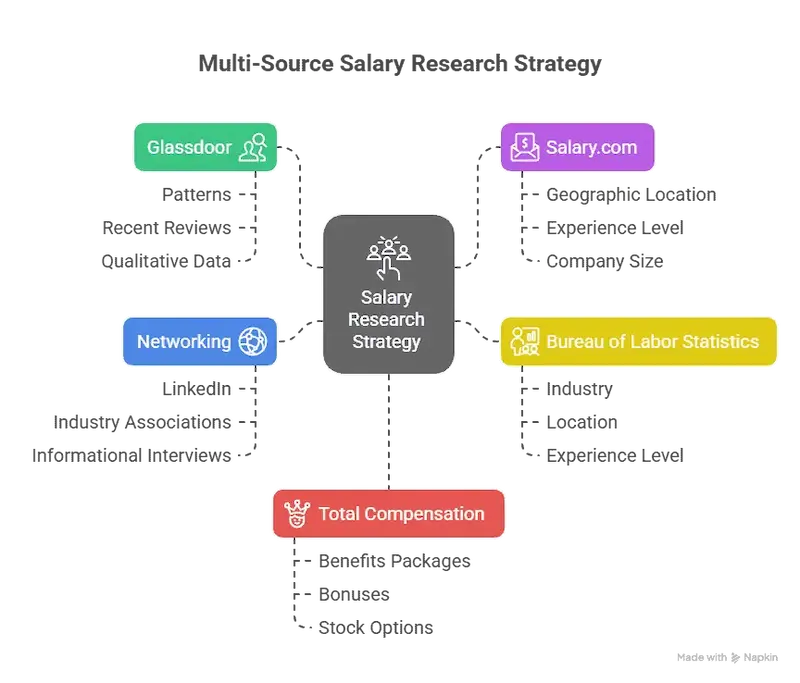
Start with Glassdoor for market overview: Use Glassdoor to understand salary ranges, company culture, and interview processes. Look for patterns across multiple reviews rather than focusing on individual data points. Pay attention to recent reviews, as compensation can change rapidly in dynamic industries.
Cross-reference with Salary.com: Salary.com often provides more conservative, research-based salary ranges that account for geographic location, experience level, and company size. Their data tends to be more reliable for establishing baseline expectations.
Leverage Bureau of Labor Statistics: For government-verified data, the BLS provides comprehensive salary information by industry, location, and experience level. While not as current as private platforms, this data offers solid foundational research.
Network for real-world insights: Connect with professionals in your target roles through LinkedIn, industry associations, or informational interviews. People are often willing to share general salary ranges, especially when approached respectfully with specific questions.
Consider total compensation: Don’t focus solely on base salary. Research typical benefits packages, bonuses, stock options, and other perquisites in your target industry. Some fields offer lower base salaries but significant additional compensation.
When using salary research for negotiations, present ranges rather than specific numbers, and always tie your compensation expectations to the value you bring to the organization.
Building Your Pivot Strategy
Create a 90-day action plan that balances immediate job search activities with longer-term skill development and networking. Your first 30 days should focus on emotional processing, initial market research, and reaching out to your existing network. Days 31-60 can emphasize skill gap analysis, targeted learning, and expanding your network in new industries. The final 30 days should concentrate on active job searching, interviewing, and final decision-making.
Pick 1-2 Skills: Start with data analysis and prompt engineering—they are broadly applicable and quick to learn. Use Free Resources: YouTube, Coursera, and Google’s Skillshop are gold mines. Practice Daily: Spend 30 minutes tweaking your resume or testing AI tools.
Set specific, measurable goals for each phase of your pivot. Rather than “improve my LinkedIn profile,” commit to “connect with 20 professionals in my target industry and publish two industry-relevant articles.” This specificity creates accountability and momentum.
Networking During Career Transitions
One potentially uncomfortable aspect of reentering the job market is activating the network that you have cultivated over your career. Many professionals feel awkward reaching out after a layoff, but remember that most people have experienced job displacement and are often eager to help.
Taaffe has a few simple rules for contacting people you may not have talked to for a long time: acknowledge the gap and explain that you’d like to reconnect, then share that you’ve been laid off and that you would like to hear how their story and career moves might behelp figureut your next steps.
Effective networking during a career pivot involves three distinct activities: reactivating dormant connections, building new relationships in target industries, and providing value to others. Don’t just reach out when you need something—share interesting articles, make introductions between contacts, and offer assistance where possible.
You will have more success asking someone in your network for a 30-minute meeting to hear about their transition from sales to marketing—and how you can learn from it—than to use meetings to rehash where things went wrong at your last job.
Focus your networking conversations on learning rather than asking for jobs directly. People are much more comfortable sharing insights about their industry than they are making hiring recommendations for someone they haven’t worked with recently.
Reassessing Yourself for New Opportunities
A successful career pivot requires more than just updating your resume—it demands a complete personal rebrand that positions you as a credible candidate in your new target field. This process involves updating all your professional materials, online presence, and elevator pitch to reflect your new direction.
Swap out terms like “adjudicated” with “evaluated” or “approved.” Consider using tools like JobScan or engaging a career coach to tailor your résumé to private-sector language. Your resume should tell a coherent story about how your past experiences have prepared you for your new career direction.
LinkedIn becomes particularly important during a career pivot. Update your headline to reflect your target role rather than your previous position. Use your summary section to explain your transition and highlight transferable skills. Share content related to your new industry to demonstrate knowledge and engagement.
Just like in any job application situation, Castrillon recommends that you first scan the job description and pull out any words describing specific job requirements. This will help you determine which keywords to integrate into your resume.
Mapping Transferable Skills to High-Demand Industries
Audit your resume for skills like project management, data analysis, or communication that transfer across sectors. Tech, healthcare, and green energy lead 2025 hiring with 15-20% growth projections. Use tools like LinkedIn’s skills insights and O*NET to match your expertise to emerging roles—many pivots succeed by repositioning existing strengths rather than starting over. Target “adjacent pivots” where 70% of your skills apply, reducing learning curves and boosting hireability. This approach lands roles 30% faster than full career switches.
Managing the Financial Transition
Career pivots often involve temporary income reductions as you establish yourself in a new field. Planning for this financial reality prevents you from accepting the first offer that comes along, regardless of fit or compensation.
Calculate your minimum viable income—the absolute lowest amount you need to cover essential expenses. This number gives you negotiating power and helps you evaluate whether a lower-paying opportunity in your target field is financially feasible.
Consider interim strategies like consulting, part-time work, or project-based roles in your new field. These arrangements provide income while you build experience and expand your network in the new industry.
If you received severance pay, use it strategically rather than simply extending your current lifestyle. Invest in skill development, professional coaching, or networking activities that accelerate your pivot timeline.
The Role of Professional Support
Outplacement services can be a vital resource for employees navigating a career pivot after a layoff, providing structure, support, and clarity during what can be an uncertain time. Many companies provide outplacement services as part of layoff packages, but these services are also available for individual purchase.
Professional career coaches bring objectivity and structure to your pivot process. They can help you identify blind spots, develop targeted strategies, and maintain momentum during challenging periods. Some individuals may have a clear focus for their pivot, while others may desire a change but not have a determined direction.
Consider joining career transition support groups, either virtual or in-person. These communities provide accountability, shared resources, and emotional support from others navigating similar challenges.
Measuring Success in Your Career After A Layoff

Success in a career pivot extends beyond landing a new job—it involves finding work that aligns with your values, utilizes your strengths, and provides growth opportunities. Define what success looks like for you before you begin interviewing, so you can evaluate opportunities against your criteria rather than simply accepting whatever is offered.
Track both quantitative metrics (salary, benefits, commute time) and qualitative factors (company culture, growth opportunities, work-life balance). Your pivot is successful when your new role provides both financial stability and personal fulfillment.
Remember that career pivots are often iterative processes. Your first role in a new field might not be your dream job, but it can be a strategic stepping stone that provides industry experience and new networking opportunities.
Common Pivot Pitfalls to Avoid
Many professionals sabotage their career pivots by making emotional decisions during vulnerable periods. Avoid the temptation to accept the first offer you receive, especially if it doesn’t align with your pivot goals. Similarly, don’t pivot so dramatically that you can’t leverage any of your existing experience and network.
Getting laid off is not personal, and it does not negate all of the wonderful contributions you’ve made. Don’t let the layoff undermine your confidence or cause you to undervalue your skills and experience.
Resist the urge to completely reinvent yourself. The most successful pivots build upon existing strengths while strategically adding new skills and experiences. You’re not starting over—you’re redirecting your career trajectory.
Long-term Career Resilience
Use your layoff experience to build long-term career resilience. Diversify your skill set, maintain an active network even when employed, and regularly assess your career satisfaction. After you have gone through a layoff, you tend not to let your network go dormant again.
Consider developing multiple revenue streams or maintaining expertise in several areas. This diversification provides options during future career transitions and increases your overall job security.
Document your career pivot process, including what worked, what didn’t, and lessons learned. This documentation becomes invaluable for helping others and for your own future career decisions.
Frequently Asked Questions
How long should I expect a career pivot to take after a layoff?
Should I take a pay cut when pivoting to a new field?
How do I explain my career pivot to potential employers?
What if I don’t know what career direction I want to pursue?
How important is additional education or certification for a successful pivot?
Conclusion
A career pivot after a layoff isn’t just about finding another job—it’s about creating the professional life you want. While the initial shock and uncertainty are challenging, they also create space for honest self-reflection and strategic planning that’s difficult to achieve while maintaining a demanding work schedule.
At Layoff Lifeline, we understand that this journey requires both practical resources and emotional support. We believe that with the right guidance and commitment to the process, you can emerge from this experience not just employed, but genuinely excited about your professional future. Your layoff might just be the catalyst for the career transformation you never knew you needed. Ready to turn your career disruption into your biggest opportunity? Let’s start building your pivot strategy today.
Keep Reading
More practical guidance for the financial, career and emotional side of a layoff.


