
Job Assistance
Smart Career Pivot From Engineering Manager After AI Layoffs

I’ve been watching this unfold for months now, and if you’re reading this, chances are you’re seeing it too. The org chart is getting flatter. Your team of twelve engineers is now six, and AI agents are handling what used to be junior developer work. IBM replaced 8,000 HR employees with an AI chatbot last year. Microsoft’s CEO openly stated that AI tools like GitHub Copilot are writing 30% of new code, reducing the need for “layers of support teams.” This isn’t a future problem anymore—it’s happening right now, and engineering managers at the L6-L8 level are finding themselves in a precarious position when the teams they manage are being replaced faster than headcount can be backfilled.
Key Takeaways
- AI coding agents are reducing engineering headcount by 60% at early adopter companies, with 30% of Microsoft’s code now AI-generated, forcing mid-to-senior managers to pivot quickly
- Engineering managers have highly transferable skills in complex problem-solving, stakeholder management, and project coordination that translate directly to product management, technical program leadership, and senior consulting roles
- Successful career pivots require 6+ months on average, with 88% of professionals facing multiple setbacks, making it essential to build financial runway and strategic networks before organizational restructuring hits
Understanding the AI-Driven Restructuring Wave

The Reality of Autonomous Coding Agents
We’re not talking about code completion tools anymore. Agentic AI systems can understand requirements, architect solutions, write comprehensive applications, test their own code, and deploy to production. What traditionally required a team of 6-8 developers over 2-3 months can now be accomplished by a single AI agent in an afternoon, according to demonstrations from companies like Anthropic.
The statistics from early 2026 are stark: tech sector layoffs reached 30,700 just six weeks into the year, with at least 1,430 confirmed AI-related job cuts. Companies adopting advanced AI agents report development velocity increases of 340% alongside 60% reductions in human developers.
Which Roles Are Actually Disappearing
The pattern is clear across the industry:
- Junior developers handling entry-level coding tasks
- QA engineers performing automated quality assurance
- DevOps engineers managing infrastructure and deployment pipelines
- Technical writers creating documentation
- Project managers coordinating timelines and deliverables
As an engineering manager, when your direct reports in these categories are systematically replaced by autonomous agents, your role fundamentally changes. You’re no longer managing a team of people—you’re potentially managing AI systems, or worse, you’re managing nobody at all.
Assessing Your Position as an Engineering Leader
The Uncomfortable Truth About Middle Management
Here’s what I’ve learned from watching this transition: engineering managers who came up through hands-on coding often fare better in restructuring than those who specialized purely in people management. Organizations are increasingly expecting engineering leaders, even at VP levels, to maintain deep technical involvement—reviewing code, owning system architecture, and staying current with emerging technologies.
If your strength has always been around people, teams, ways of working, and building sustainable engineering cultures rather than hands-on technical work, this shift creates genuine vulnerability. When the people you manage disappear, your value proposition needs to evolve rapidly.
Conducting Your Skills Inventory
Engineering managers possess a versatile skill set that extends far beyond managing developers. Your core competencies likely include:
- Complex problem-solving and decision-making under uncertainty
- Coordination across cross-functional teams and stakeholders
- Project management and delivery oversight
- Communication with technical and non-technical audiences
- Business intelligence and data analysis
- Enterprise resource planning and systems thinking
The question isn’t whether you have valuable skills—you do. The question is how to reposition those skills when the context that made them relevant (managing a team of engineers) is being automated away.
Career Path Options for Displaced Engineering Managers
Transitioning to Product Management
This is one of the most natural pivots for engineering leaders, and I’ve seen it work repeatedly. Engineering managers already collaborate extensively with product teams, understand product development cycles, and can translate between technical constraints and business requirements.
The key differentiator: product managers need to deeply understand what’s technically possible with AI agents, not just human developers. Your experience managing engineering teams gives you insight into how to scope work, define requirements, and make tradeoffs—skills that remain valuable even when the execution happens through autonomous systems rather than human engineers.
Returning to Senior Individual Contributor Roles
Moving from a manager role back to individual contributor work is increasingly common and socially acceptable. Companies that handle this transition well don’t cut salaries and recognize that management experience actually enhances individual contributor performance.
However, there’s a critical requirement: you need to keep your technical skills sharp. If you’ve been away from hands-on coding for years, this transition requires intensive upskilling. The positive side? You’re not competing against junior developers anymore—you’re positioning yourself as a senior engineer who can orchestrate AI agents, review AI-generated code, and make architectural decisions.
Moving Into Technical Program Management
Engineering managers naturally possess the coordination, stakeholder management, and delivery skills that technical program managers need. This path allows you to leverage your project management experience and technical understanding without requiring deep hands-on coding.
The landscape is shifting here too, though. Technical program managers increasingly need to understand how to plan and coordinate work that’s split between human engineers and AI agents, manage dependencies in hybrid teams, and set realistic timelines for agentic AI development cycles.
Exploring Platform Engineering Roles
Platform engineering has emerged as one of the growth areas in 2026. As companies adopt AI agents for application development, they still need robust platforms, infrastructure, and developer experience—areas where experienced engineering leaders can add significant value.
Platform engineering roles require understanding both the technical side and the product vision for internal tools. Your background in engineering management gives you the perspective to build platforms that actual engineering teams (human or AI-augmented) need to use.
Leadership Pivot to Director or VP Roles
Some engineering managers successfully move up rather than sideways, transitioning into director of engineering, head of engineering, or VP roles. This path works when you can demonstrate value in areas like:
- Strategic technology decisions and alignment with broader business goals
- Building relationships with C-suite stakeholders and translating technical concepts
- Navigating organizational change and restructuring
- Developing engineering leadership frameworks and best practices
The caveat: these roles are also being scrutinized in AI-driven restructuring. Organizations are flattening hierarchies and reducing “layers” of management. Moving up only works if you can clearly articulate how you drive business outcomes beyond just managing people.
Building Your Transition Strategy
Creating Your Six-Month Roadmap
Career pivots take time—on average six months, not three. Understanding this timeline is crucial for both practical planning and emotional resilience. Here’s what a realistic transition looks like:
Months 1-2: Assessment and exploration
- Conduct thorough skills inventory and identify transferable competencies
- Research target roles and companies actively hiring in your desired direction
- Begin conversations with former colleagues and industry contacts
- Document your accomplishments with specific metrics and outcomes
Months 3-4: Skill development and positioning
- Address skill gaps through targeted learning (AI agent orchestration, emerging frameworks, product strategy)
- Create thought leadership content demonstrating expertise in your target area
- Seek advisory roles or project-based work to gain relevant experience
- Refine your narrative about why you’re making this transition
Months 5-6: Active pursuit and negotiation
- Engage with decision-makers and “kingmakers” in target organizations
- Participate in technical decision-making forums and architecture discussions
- Leverage your network for warm introductions rather than cold applications
- Negotiate compensation and role scope based on your full skill set, not just previous job title
Managing the Financial Reality
With 88% of professionals facing three or more major setbacks during career transitions, you need financial runway. This means:
- Building 6-12 months of living expenses before making voluntary moves
- Understanding severance packages and negotiating when possible
- Considering contract or interim executive roles as bridge income
- Evaluating startup equity carefully—it’s rarely worth the discount in salary for mid-career professionals
Developing Specialized Knowledge
One of the most effective positioning strategies is developing specialized knowledge in emerging areas where talent is scarce. For engineering managers in 2026, this might include:
- AI agent orchestration and management
- Hybrid team structures (human + AI)
- Platform product management for AI-augmented development
- Engineering efficiency metrics in AI-driven organizations
- Risk management and quality assurance for autonomous coding systems
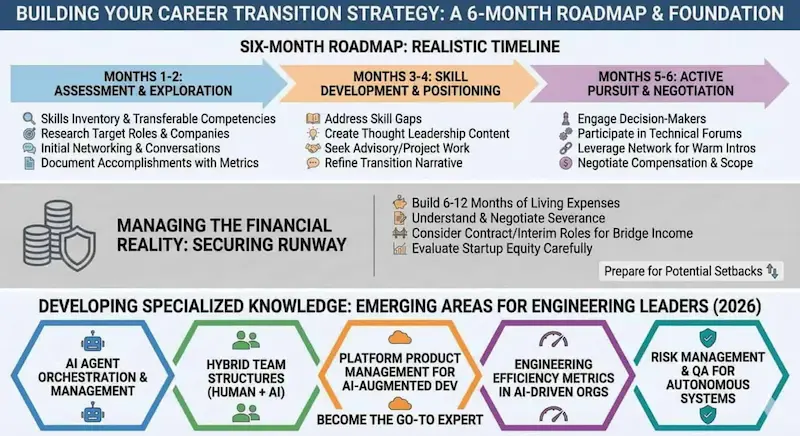
Becoming the go-to person in a specific technical domain creates inbound opportunities when companies need that expertise.
Avoiding Common Pivot Mistakes
Don’t Wait for the Layoff Notice
I’ve watched too many talented engineering managers wait until the reorganization is announced to start planning their next move. By that point, you’re competing with everyone else who got laid off in the same round, and you’re doing it from a position of stress rather than strength.
Start building relationships and exploring options while you’re still employed. Join advisory boards, speak at industry events, write about your expertise, and make your pivot intentions known to your network.
Don’t Dismiss Your Management Experience
Some engineering managers panic and try to erase their management years, repositioning themselves as if they’d been coding full-time all along. This is a mistake. Your management experience provides valuable perspective on systems thinking, organizational dynamics, and cross-functional collaboration.
Don’t Neglect the Soft Skills Story
Technical expertise matters, but at the L6-L8 level, what really differentiates candidates is leadership capability, communication skills, and strategic thinking. When positioning yourself for your next role, emphasize:
- How you’ve navigated difficult conversations and organizational change
- Your track record of aligning engineering work with business outcomes
- Specific examples of building relationships with stakeholders and translating complex technical concepts
- Your ability to mentor others and elevate team performance
Don’t Ignore Industry Context
Engineering managers sometimes assume their skills transfer equally well to any industry. In reality, some sectors are embracing AI agents faster than others, and some have regulatory or safety constraints that limit autonomous coding adoption.
Research which industries align with your risk tolerance and career goals. Moving from a consumer tech company to healthcare technology or industrial engineering might offer more stability precisely because those sectors are slower to replace human engineers with AI systems.
Preparing for the Interview Process
Articulating Your Transition Narrative
You need a clear, confident explanation for why you’re making this move. Avoid framing it as “my team got replaced by AI and I’m desperate.” Instead:
“I’ve spent the last X years building and scaling engineering teams, and I’ve developed a deep understanding of [product strategy/platform development/technical program management]. As the industry shifts toward AI-augmented development, I’m excited to apply my skills in [target role] where I can [specific value you’ll bring]. My engineering leadership background gives me unique insight into [relevant perspective].”
Demonstrating Current Technical Knowledge
If you’re pivoting to any role that requires technical credibility, you need to prove you understand the current landscape, not just the technologies from when you were an individual contributor five years ago.
Stay current on AI development tools, agentic AI platforms, and emerging frameworks. Contribute to open source projects, write technical blog posts, or build side projects that demonstrate hands-on engagement with modern technologies.
Addressing the “Why Not Stay in Management?” Question
Interviewers will ask why you’re moving away from management, especially if you’ve been successful in that role. Frame this proactively:
“I’ve loved building and developing teams, but I’m energized by [technical problems/product challenges/strategic initiatives] and want to focus my next chapter there. My management experience gives me skills in [coordination/communication/stakeholder alignment] that make me effective in this new role.”
Building Long-Term Career Resilience

The Portfolio Career Approach
Rather than relying solely on one full-time employment relationship, consider building a portfolio of income streams and professional engagements. This might include:
- Primary role (full-time, contract, or fractional executive work)
- Advisory board positions with startups
- Consulting or fractional CTO work for small companies
- Technical writing or speaking engagements
- Investment or angel advising if you have capital
This approach provides financial diversification and professional resilience if any single engagement ends unexpectedly.
Continuous Learning as a Non-Negotiable
The engineers who survive industry disruption are those who treat learning as continuous rather than episodic. This means:
- Regularly dedicating time to exploring new technologies and methodologies
- Participating in technical communities and knowledge-sharing forums
- Seeking feedback and coaching from peers and mentors
- Experimenting with AI tools and understanding their capabilities and limitations firsthand
Building and Maintaining Your Network
Seventy-seven percent of career pivoters found better opportunities than they initially expected, often through unexpected connections. Your network isn’t just for job searching—it’s for learning about emerging opportunities, understanding industry trends, and finding collaborative projects.
Commit to connecting with at least one new person each week and maintaining relationships with former colleagues, team members, and industry peers.
FAQs
How long does an engineering manager career pivot typically take?
A successful career pivot from Engineering Manager typically takes approximately six months from initial exploration to landing a new role, not the three months many people expect. This timeline includes skills assessment, targeted learning, networking, interviewing, and negotiation. Having realistic expectations about this duration helps you plan financially and emotionally for the transition.
Should I take a pay cut when transitioning from engineering management to a different role?
Not necessarily. Companies that understand the value of transferable skills recognize that engineering managers bring unique perspectives even in individual contributor or alternative roles. Your management experience enhances your ability to collaborate, communicate, and think strategically. Negotiate based on your complete skill set and the value you bring, not just your previous job title.
Can I transition back to an individual contributor role after years in management?
Yes, and this transition is becoming increasingly common and accepted. The key requirement is keeping your technical skills current through continuous learning, side projects, or hands-on involvement in technical decisions during your management tenure. Companies increasingly value engineers who combine deep technical skills with management experience and organizational perspective.
What roles are most viable for engineering managers affected by AI-driven restructuring?
The most common successful pivots include product management, technical program management, platform engineering, senior individual contributor roles, and strategic consulting positions. The best fit depends on your specific skill set—whether you lean more technical or more strategic, prefer hands-on work or coordination, and how much you want to engage with AI technologies versus other domains.
How do I explain my career transition without sounding desperate or negative about AI?
Frame your transition as an intentional evolution toward work that aligns with your strengths and interests, not as a reaction to circumstance. Focus on what you’re moving toward rather than what you’re moving away from. Acknowledge industry changes matter-of-factly (“As development workflows evolve with AI augmentation…”) while emphasizing the specific value you bring to your target role based on your complete experience.
Conclusion
The engineering management landscape is fundamentally changing, and pretending otherwise doesn’t help anyone. AI agents are replacing functions that entire teams used to perform, and organizational structures are flattening in response. If you’re an L6-L8 engineering manager watching your team shrink or your role become ambiguous, you’re experiencing a real industry shift, not an isolated incident. The good news: your skills are transferable, your experience is valuable, and there are viable paths forward. The challenge: you need to act strategically rather than reactively. Assess your unique strengths, identify where you can add value in an AI-augmented world, build the specific skills your target role requires, and start networking before you’re forced to.
This transition won’t happen overnight, and it probably won’t be comfortable. But engineering managers who approach this pivot with clear strategy, realistic timelines, and genuine skill development can find roles that are more aligned with their strengths than the management position they’re leaving behind.
If you’re navigating this transition and need personalized guidance on your specific situation, book your free 15-minute strategy session with Layoff Lifeline. We’ll help you assess your transferable skills, identify viable career paths, and create a financial runway plan that gives you the breathing room to make this pivot successfully. Your next chapter doesn’t have to be a step backward—let’s figure out how to move forward strategically.
Keep Reading
More practical guidance for the financial, career and emotional side of a layoff.


