
Job Assistance
Master Creating Your Job Search Schedule!

Losing your job isn’t just a career disruption—it’s a chance to reimagine your professional journey. But without structure, your job search can quickly become overwhelming and ineffective. Creating a purposeful job search schedule transforms what feels like chaos into an organized strategy, helping you maintain momentum while protecting your wellbeing. By establishing daily routines and weekly objectives, you’ll not only manage your time more effectively but also position yourself for opportunities that align with your career goals.
Key Takeaways
- Implementing a structured job search schedule increases productivity and reduces overwhelm by breaking the process into manageable daily tasks.
- Tailoring your application materials with relevant keywords from job descriptions significantly improves your chances of finding a new job through Applicant Tracking Systems (ATS).
- Balancing active search time with rest and self-care prevents burnout and maintains the mental resilience needed for a successful job transition.
Why a Job Search Schedule Matters
A job search without a schedule is like navigating without a map—you might eventually reach your destination, but the journey will be longer and more frustrating than necessary. According to career transition experts, job seekers who maintain structured schedules are significantly more likely to land positions faster than those who approach their search haphazardly.
Creating a job search schedule provides numerous benefits:
- Maintains momentum: Consistent daily actions prevent the stagnation that often leads to extended unemployment periods.
- Reduces overwhelm: Breaking down the complex process into manageable daily tasks makes the entire journey feel less daunting.
- Improves application quality: Dedicated time for customizing applications results in stronger materials that speak directly to employers’ needs.
- Creates accountability: A schedule establishes personal benchmarks to measure progress and adjust strategies accordingly.
- Preserve mental well-being: Structured breaks and boundaries prevent burnout during what can be an emotionally challenging transition.
Building Your Weekly Job Search Schedule
The most effective job search schedules distribute different activities throughout the week, allowing you to focus on specific tasks each day rather than attempting to juggle everything simultaneously. Here’s a framework you can adapt to your personal circumstances:
Monday: Search and Research Day
Dedicate Mondays to finding job posts and researching potential employers. This approach aligns with hiring managers’ typical workflow, as they often sort through applications accumulated over the weekend.
Activities for Monday:
- Set weekly application targets (quality over quantity)
- Search job boards using industry-specific keywords and your desired job titles
- Create a tracking system for opportunities (spreadsheet or job search platform)
- Note application deadlines and key requirements
- Research company cultures and values for targeted opportunities
- Identify recurring keywords and skills in job descriptions for your field
Tuesday: Resume and Cover Letter Customization
Use the intelligence gathered on Monday to tailor your application materials for each opportunity.
Activities for Tuesday:
- Customize your resume with relevant keywords from each job description
- Update your skills section to highlight competencies requested in postings
- Create targeted cover letters that address specific company needs
- Ensure your application materials pass ATS screening by incorporating exact terminology
- Review application materials for grammar and formatting consistency
Wednesday: Application Submission and Networking
Wednesdays combine active applications with strategic networking efforts.
Activities for Wednesday:
- Submit applications prepared on Tuesday
- Update your LinkedIn profile with relevant keywords
- Engage with industry content on professional social platforms
- Schedule informational interviews with connections at target companies
- Follow up on previous networking interactions
- Attend virtual or in-person networking events
Thursday: Skills Development and Preparation
Dedicate Thursdays to enhancing self-marketability and qualification through skills development and interview preparation.
Activities for Thursday:
- Take online courses relevant to your target positions
- Practice interview responses to common questions
- Research salary expectations and negotiation strategies
- Develop portfolio materials or work samples
- Update professional certifications if applicable
- Prepare questions to ask potential employers
Friday: Application Follow-up and Assessment
Use Fridays to close loops from the week and evaluate your progress.
Activities for Friday:
- Send follow-up emails for applications submitted earlier in the week
- Review job search metrics (applications submitted, responses received, interviews scheduled)
- Assess what’s working and what needs adjustment
- Update your job search tracking system
- Schedule any upcoming interviews
- Plan the following week’s targets
Weekend: Rest and Strategic Activities
Job searching can quickly become all-consuming, making your approach to weekends particularly important. While maintaining some momentum can be beneficial, these days should primarily focus on rejuvenation and indirect progress.
Your weekends represent valuable time for mental reset and perspective-gaining. Rather than scheduling intensive application sessions, shift to a gentler pace. Light industry reading keeps you current without the pressure of immediate application—perhaps enjoying relevant newsletters or articles with your morning coffee. This passive engagement maintains your momentum while giving your mind space to process information differently.
Weekends naturally lend themselves to informal networking opportunities. Community events, social gatherings, and recreational activities create organic settings for connections that might never happen in formal environments. These relaxed conversations often lead to unexpected insights or introductions. The key is being present without forcing professional agenda into every interaction.
Sunday evenings provide an ideal window for preparation rituals that set you up for success. A brief 30-minute session reviewing your calendar, identifying priority opportunities for the week ahead, and setting clear intentions creates valuable structure. This preparation reduces Monday morning decision fatigue and helps you hit the ground running.
Above all, weekends should prioritize mental and physical self-care activities that sustain your energy for the search ahead. Whether through exercise, creative pursuits, time in nature, or meaningful connections with loved ones, these activities aren’t luxuries—they’re essential components of a sustainable job search strategy. The candidate who arrives at Monday morning interviews refreshed and centered has a distinct advantage over those showing signs of burnout.
By thoughtfully balancing strategic activities with genuine rest, your weekends become powerful allies in your overall job search success.

Optimizing Your Schedule for ATS Success
Most large companies and many smaller organizations now use Applicant Tracking Systems (ATS) to screen candidates before human eyes ever see your application. Your job search schedule should include a specific time for optimizing materials to pass these digital gatekeepers.
Keyword Research and Implementation
When examining job descriptions during your Monday research, identify both:
- Hard skill keywords: Technical abilities, software proficiencies, certifications
- Soft skill keywords: Communication styles, team dynamics, leadership approaches
- Industry-specific terminology: Jargon and acronyms unique to your field
- Action verbs: Terms that demonstrate accomplishment (achieved, implemented, transformed)
Keep a running list of these keywords to incorporate into your materials during your Tuesday customization sessions. Remember that exact matches matter—if the job description mentions “project management,” don’t just write “managing projects.”
Resume Formatting for ATS Compatibility
Part of your Tuesday customization should include ensuring your resume format doesn’t confuse ATS systems:
- Use standard section headings (Education, Experience, Skills)
- Avoid tables, graphics, headers/footers, and text boxes
- Utilize standard fonts (Arial, Calibri, Times New Roman)
- Submit files in the requested format (usually PDF or .docx)
- Incorporate keywords naturally throughout the document, not just in a skills section
Creating a Sustainable Schedule
The most effective job search schedule is one you can maintain consistently over time. Unemployment periods vary significantly by industry and economic conditions, so create a schedule that prevents burnout.
Time Blocking Strategies
Rather than viewing your job search as a traditional 9-to-5 commitment, consider implementing time blocks:
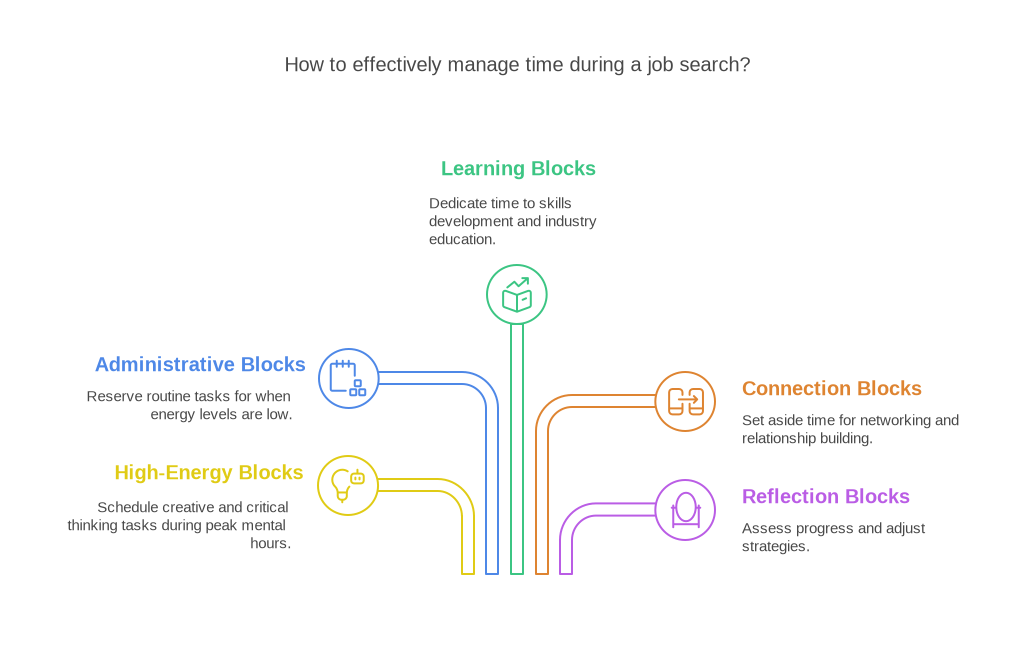
- High-energy blocks: Schedule tasks requiring creativity and critical thinking during your peak mental hours
- Administrative blocks: Reserve routine tasks for when your energy naturally dips
- Learning blocks: Dedicate specific times to skills development and industry education
- Connection blocks: Set aside time specifically for networking and relationship building
- Reflection blocks: Schedule periods to assess progress and adjust strategies
Preventing Job Search Burnout
Your schedule should explicitly include:
- Physical activity breaks
- Designated “no job search” days or half-days
- Social connection opportunities
- Progress celebration milestones
- Hobby and personal interest time
Remember that maintaining your mental and emotional wellbeing isn’t just self-care—it’s essential to presenting yourself confidently during interviews and networking opportunities.
Adapting Your Schedule to Different Job Search Phases
Your job search journey evolves through distinct phases, each requiring a different focus and allocation of your time. By recognizing which phase you’re in, you can strategically adjust your schedule to maximize effectiveness.
Early Phase: Exploration and Positioning
During this foundational stage, you’re setting the groundwork for a successful search. The majority of your time should be dedicated to understanding the landscape and positioning yourself effectively within it.
Focus on deep market immersion by researching industries, companies, and roles that align with your career aspirations. This is also when you’ll develop your personal brand by refining your LinkedIn profile and digital footprint. A strategic skills assessment will help identify gaps that might need addressing before you begin applying.
Your foundational materials require thoughtful development during this phase. Rather than rushing to apply for positions, invest time crafting a master resume and versatile cover letter templates that you can later customize.
Middle Phase: Active Job Application
As you transition to actively pursuing opportunities, your schedule shifts to emphasize action and outreach. Customization becomes critical as you tailor each application to highlight the specific value you bring to that role.
Networking naturally shifts to high gear during this phase. A balanced approach might look like:
| Activity | Weekly Time Allocation | Focus |
|---|---|---|
| Application customization | 40% | Tailoring materials to specific opportunities |
| Networking | 30% | Informational interviews, events, reaching out |
| Job search | 20% | Finding new relevant opportunities |
| Follow-up | 10% | Maintaining contact with application targets |
Your daily routine should include consistent time blocks for identifying and applying to relevant positions, while ensuring each application receives the attention it deserves.
Late Phase: Job Interview and Decision
When you begin receiving interview requests, your schedule transforms again. Interview preparation naturally dominates your calendar as you research common questions, prepare compelling stories, and practice your delivery.
Company-specific deep dives become essential during this phase. Take time to thoroughly understand each organization’s challenges, culture, and needs before interviews. As opportunities progress, develop comparison frameworks to help evaluate multiple offers against your priorities.
If you reach the offer stage, negotiation strategy requires thoughtful planning. Research compensation benchmarks and prepare for these important discussions. Your schedule during this phase should prioritize preparation for specific opportunities rather than generating new applications.
Technology Tools to Enhance Your Schedule
The right digital tools can dramatically improve your job search efficiency without adding complexity to your process. Job search platforms with intelligent filters can save hours of manual searching, while application tracking systems help visualize your pipeline and maintain momentum.
Consider implementing a simple technology ecosystem that might include:
A keyword optimization tool to analyze alignment between your materials and specific job descriptions, a calendar management system with time blocking features, and a networking management tool to ensure consistent follow-up with contacts.
By thoughtfully adapting your schedule to your current search phase and leveraging appropriate technology, you’ll maintain momentum while focusing your energy where it matters most at each stage of your job search journey.
How We Can Help
At Layoff Lifeline, we understand that job loss creates both practical challenges and emotional strain. Our comprehensive support system meets you wherever you are in your transition journey. Whether you’re seeking immediate guidance after receiving notice, navigating complex insurance decisions, or rebuilding your professional identity, our resources provide clear direction and genuine support.
Our platform combines practical tools like severance negotiation guides and application trackers with essential emotional support through our crisis-inspired assistance model.
Unlike traditional job boards, we offer a complete ecosystem designed specifically for professionals in transition. Our approach recognizes that successful career navigation requires both tactical expertise and emotional resilience—and we’re here to provide both.
FAQs
How many hours per day should I dedicate to my job search?
Should I apply to jobs on weekends?
How can I tell if my resume is optimized for ATS systems?
What if I’m currently employed but looking for a new position?
How do I prevent feeling discouraged when my schedule doesn’t immediately produce results?
Conclusion
Creating an effective job search schedule isn’t about filling every hour with applications—it’s about strategically allocating your energy to the activities that yield the best results while maintaining your wellbeing. By treating your job search as a structured project with defined activities, measurable outcomes, and built-in sustainability measures, you transform what could be a challenging period into an opportunity for focused professional development.
Ready to transform your job search from overwhelming to organized? Start by implementing this weekly framework, then refine it based on your unique circumstances and goals. Remember that at Layoff Lifeline, we’re here to support you with additional resources, personalized coaching, and community connection throughout your journey. Take the first step toward structure today—your future career self will thank you.
Keep Reading
More practical guidance for the financial, career and emotional side of a layoff.


