
Legal Assistance
FAANG Non-Compete Negotiation Strategy Gets You Paid to Wait

If you’re an L7+ or senior tech leader, you’ve probably been told non-competes are just “standard.” You sign, you leave, you sit. But at your level, that non-compete is not just a restriction—it’s an asset. In the right FAANG non-compete negotiation, you can get paid $150K+ to sit on the sidelines while you plan your next move.
This article walks through the exact leverage points most senior executives miss—garden leave, non-compete buyouts, and deferred compensation and equity acceleration—so you can turn a stressful transition into a strategic, well-compensated pause.
Key Takeaways
- Garden leave and non-compete buyouts can pay L7+ executives well into six figures to sit out their non-compete period instead of rushing into the next role.
- Deferred compensation and equity acceleration clauses are often negotiable and can unlock hundreds of thousands of dollars if you know how to ask.
- Enforceability, state law, and your seniority level dramatically change your non-compete negotiation strategy and the money you can walk away with.
What Your Non-Compete Really Is

When I look at how big tech structures a typical non-compete agreement for senior roles, one thing stands out: it’s not just about keeping you from working for a competitor. It’s about controlling timing and leverage.
A non-compete clause usually tries to limit:
- Where you can work (specific companies or competitors)
- What you can do (your usual area of expertise or business line)
- How long you’re restricted (often 6–18 months)
At L7+ and C-level, employers may tie these restrictions to other clauses in the employment contract: equity vesting, deferred compensation, bonuses, and sometimes garden leave. That’s where the money is.
Instead of treating your non-compete as a one-way restriction, think of it as a tradeable term. If a new company badly wants to hire you, and your former company wants to keep you from working for a competitor, that tension is exactly where you can negotiate real cash and acceleration.
Garden Leave: Paid to Do Nothing
Garden leave is one of the most powerful tools in FAANG non-compete negotiation, and yet most executives barely mention it until HR brings it up. In a garden leave arrangement, you’re technically still employed, but you’re told not to work—no client work, no real responsibilities, often no access to internal systems. You’re literally paid to stay home.
For senior tech leaders, garden leave often looks like:
- A defined non-compete period (commonly 3–12 months)
- Full or partial salary during that time
- Continued benefits and sometimes bonus or partial equity vesting
In practical terms, this can easily work out to $150K+ for an L7+ or director-level leader, and much more for C-level. In some high-demand roles, companies have paid big money just to keep top talent from immediately joining a direct competitor.
How I’d Negotiate Garden Leave
If I were negotiating a non-compete clause or separation package, I’d focus on making garden leave explicit and generous:
- Duration and clarity
- Define exact dates: when garden leave starts and ends.
- Tie the non-compete period directly to paid garden leave whenever possible.
- Compensation level
- Aim for 100% of base salary during the non-compete period.
- Push to keep health benefits, retirement contributions, and other perks intact.
- Bonus and equity treatment
- Clarify whether you’ll still be eligible for prorated bonuses.
- Ask whether vesting continues during garden leave, especially if you’re near a vest date.
- Scope of restriction
- Narrowly define “competitor” and “competitive activity.”
- Make sure the clause doesn’t block you from consulting, advising startups in a different niche, or working in non-overlapping product areas.
Garden leave turns a “you can’t work” problem into “you’re being paid to rest, regroup, and re-strategize.” When structured well, you get breathing room, cash flow, and time to plan your next move.
Non-Compete Buyouts: Turning Paper Into Cash
Some noncompete agreements are written so that if your former company actually enforces them, they must pay you during the non-compete period. In other situations, your new employer might agree to compensate you for lost income or pay your former employer to waive or shorten the non-compete.
This is what I mean when I say your non-compete is an asset. In practice, non-compete buyouts can work in a few ways:
- Your current employer pays you a lump sum or monthly salary to enforce the non-compete.
- Your new employer pays a fee to your former employer to release or shorten the restriction.
- Your new employer “tops up” your income while you sit out a non-compete period, effectively buying your time.
At L7+ levels, a reasonable starting expectation for a serious non-compete might be in the mid–five figures to low six figures. With equity, bonuses, and seniority, total non-compete-related compensation can quickly cross $150K.
How I’d Push on the Buyout Terms
In a FAANG non-compete negotiation, I’d press on these levers:
- You’re not just asking for severance
- Frame part of the package specifically as consideration for the non-compete clause, not just a generic departure payout.
- That makes it clearer that if they want to enforce the non compete, they must pay for it.
- Base plus bonus, not just base
- When calculating any buyout payment, push to use your total compensation—base salary plus a realistic average bonus and/or equity value—not just base.
- Health and legal costs
- Ask for continued health coverage during the non-compete period.
- Don’t be shy about requesting coverage or reimbursement for legal fees relating to the separation and contract review.
- New employer contributions
- If a new company really wants to hire you, they may be willing to fund a portion of your garden leave or buy out your non-compete entirely.
- You can often negotiate a signing bonus structured to offset the risk or gap from your previous agreement.
Your job is to transform “I’m blocked from working” into “If you want to block me, you’re going to pay fairly for that privilege.”
Deferred Compensation: Hidden Money in the Fine Print
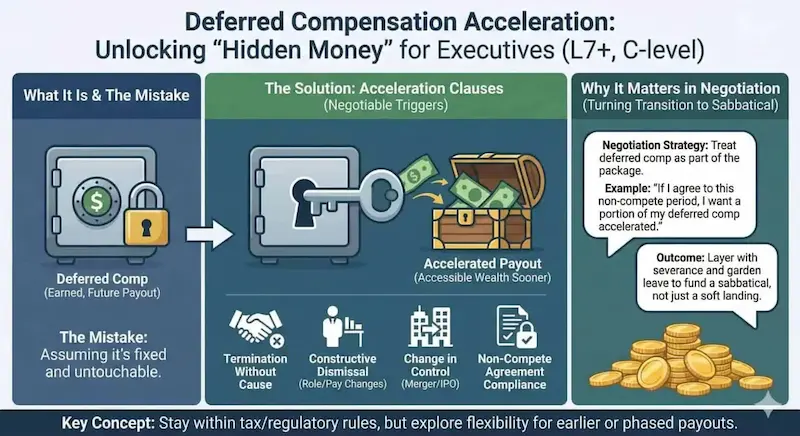
At L7+ and C-level, a big chunk of your wealth may be sitting in deferred compensation plans—income you’ve earned but agreed to receive later. The mistake many execs make is assuming these deferred amounts are fixed and untouchable.
In reality, the triggers for paying out deferred compensation are negotiable. That’s where deferred comp acceleration clauses enter the picture.
What Acceleration Really Does
Acceleration clauses specify events that cause your deferred compensation to pay out sooner than originally scheduled. Common triggers might include:
- Termination without cause
- Constructive dismissal (role materially changes, pay is cut, or you’re forced out)
- Change in control (merger, acquisition, IPO)
- Sometimes, agreeing to or complying with a non-compete clause
You still need to stay within tax and regulatory rules, but there is often more flexibility than executives realize. For example, you might negotiate:
- Payments that begin after separation rather than far in the future
- Certain performance-based deferrals becoming payable because agreed milestones have been met
- Phased payouts instead of one lump sum, while still moving money sooner
Why This Matters in a Negotiation
If you’re being asked to sit out a non-compete period or accept a restrictive clause, you can treat deferred compensation as part of the negotiation package. Instead of only talking about severance, you can say:
- “If I agree to this non-compete period, I want a portion of my deferred comp accelerated.”
- “If you’re treating this as a termination without cause, the deferred plan should treat it as a separation event for payout.”
When you layer that on top of garden leave and non-compete buyout money, you’re no longer just negotiating a “soft landing.” You’re turning a forced transition into an aggressively funded sabbatical.
Equity and Vesting Acceleration: The Biggest Line Item
For FAANG leaders and senior software engineers, restricted stock units (RSUs) are often the largest piece of total compensation. That means your non-compete negotiation should always include a serious look at vesting and acceleration.
Many executives assume equity is “take it or leave it” based on the original grant schedule. In reality, vesting rules are often negotiable at three key moments:
- When you join (signing and offer stage)
- When your role changes or you get promoted
- When you leave, especially if there’s tension, a reorg, or a non-compete at play
Ways to Accelerate Vesting
In separation or non-compete negotiations, I’d focus on:
- Time credit
- Asking for 6–12 months (or more) of additional vesting as if you had continued working.
- This alone can unlock huge value if you were close to big vest dates.
- Partial or full acceleration
- Requesting that all equity scheduled to vest over the next 12–24 months vest immediately.
- For very senior roles, sometimes a larger portion or even full acceleration is possible under certain circumstances.
- Cash equivalents
- If your new employer is considered a competitor and you’d otherwise forfeit equity, ask for a cash payout pegged to the current or average equity value to compensate for that loss.
- Relaxed conditions
- Ask to remove conditions like “you must still be employed on the vest date” when you’re being pushed out or asked to comply with a non-compete.
For FAANG-level compensation, even “modest” adjustments here can mean hundreds of thousands of dollars. It’s not uncommon for an executive to add mid–six figures to a separation package simply by negotiating vesting acceleration more aggressively.
Enforceable vs. Unenforceable: Your Secret Leverage
Not every non-compete clause is actually enforceable, and that matters a lot. Enforceability depends on:
- The state you work in or are employed under
- The wording of the clause (how narrowly it’s drafted)
- Your role and seniority
- Whether you received real consideration (something of value) for signing it
For example, non-competes are heavily restricted or basically unenforceable in some places, such as California, except in specific situations like selling a business. In other states, non-competes are enforceable but must be reasonable in scope, geography, and duration. Overly broad clauses—like “you can’t work in any tech company anywhere for two years”—are often judged unreasonable.
How to Use Enforceability as a Lever
If a non-compete is obviously excessive or you’re in a state that strongly limits noncompete agreements, you hold more cards than you think. In that situation, a company may:
- Prefer to negotiate a reasonable, paid restriction rather than risk losing outright in court.
- Be willing to soften the clause in writing in exchange for you agreeing not to challenge it.
- Lean more heavily on NDAs, IP protection, and trade secret clauses instead.
This is why it’s worth it to have a lawyer who truly understands employment contracts and, ideally, tech and IP law. A good attorney can look at your noncompete clause and say, “Here’s where it’s too broad, here’s what’s likely unenforceable, here’s what we can push back on, and here’s what you can trade for better compensation.”
Alternatives to Broad Non-Competes
Sometimes the best move isn’t to accept or reject a non-compete, but to replace it with smarter, narrower protections that are fair to both sides. If an employer wants to avoid conflicts of interest or protect confidential information but you want to avoid a career freeze, you can propose:
- Non-solicitation instead of non-compete
- You agree not to poach employees or clients for a set period, but you’re free to work for competitors in other ways.
- Strong confidentiality and NDA language
- You commit not to misuse trade secrets or sensitive data from your former company.
- This is reasonable and often more aligned with what companies actually care about.
- Narrowly defined non compete clauses
- Limit the restriction to specific competitive products, regions, or business units.
- Shorten the duration to something reasonable, like 6–9 months instead of 18–24.
When you present these alternatives, you show you’re acting in good faith rather than trying to gain an unfair advantage. That often makes hiring managers, in-house counsel, and HR far more willing to negotiate.
The Executive Negotiation Playbook

At the L7+ or C-level, you’re not just negotiating a job offer or exit package. You’re negotiating a complex economic arrangement that touches salary, bonus, equity, deferred comp, legal risk, and your ability to work.
Here’s how I’d approach a FAANG non-compete negotiation as a senior exec:
- Understand the full picture
- Gather your employment contract, non-compete agreement, equity docs, and any deferred compensation plans.
- List vesting schedules, potential acceleration triggers, and how your non-compete is drafted.
- Assess your leverage
- How badly does your new company want to hire you?
- How enforceable is your existing non-compete?
- How senior are you and how specialized is your area of expertise?
- Decide what you want most
- More cash now (buyout, garden leave, severance)?
- More equity (vesting acceleration)?
- Faster freedom to work (shorter non-compete period)?
- Reduced legal risk and clarity on what you’re allowed to do?
- Sequence the conversation
- Let the new employer show their hand on total compensation before bringing up non-compete problems.
- Then, once you see how serious they are, start discussing how to offset or buy out your restrictions.
- Bring in an expert at the right time
- Use an employment attorney or negotiation coaching to sanity-check your strategy, identify opportunities, and keep everything compliant.
- Don’t wait until after you’ve already agreed verbally to the big points.
The biggest difference between executives who walk away with “standard” packages and those who walk away with an extra six figures is usually preparation and willingness to negotiate each clause instead of just the headline salary.
FAQs
Are non-compete agreements always enforceable?
No. Enforceability varies by state, role, and how narrowly the clause is written. Some states heavily restrict non-competes, especially for regular employees, and overly broad clauses are more likely to be challenged.
Can I negotiate a non-compete after I’ve already signed it?
Yes, especially at separation or when a new job comes into play. When you leave or are laid off, you can negotiate modifications, buyouts, garden leave, or releases as part of a broader exit package.
How do I get paid during my non-compete period?
You can negotiate garden leave, non-compete buyout payments, deferred compensation acceleration, and equity vesting acceleration. The key is tying payment directly to the non-compete restrictions so you’re compensated for the time you’re sidelined.
Do I really need a lawyer for this?
For senior roles with big equity and deferred comp at stake, consulting with an employment attorney is usually worth it. The cost is often tiny compared to the additional value they can help you unlock or the problems they can help you avoid.
What if a recruiter says the non-compete is “just standard”?
“Standard” doesn’t mean non-negotiable. It just means that’s what they offer by default. At your level, companies regularly make exceptions or adjustments for the right hire—especially when you know exactly what to ask for.
Conclusion
If you’re staring down a non-compete, a layoff, or a shiny new offer that conflicts with your current agreement, you don’t have to guess your way through it. With the right strategy, that non-compete can become a funded runway, not a dead end.
If you want help unpacking your specific non-compete, equity, and compensation situation, let’s talk it through. Book your free 15-minute strategy session to discuss your specific situation here in Layoff Lifeline. Layoff Lifeline gives you the roadmap, support, and expert advice you need to turn this career challenge into your next opportunity. Your financial recovery plan is just one click away—explore your options now.
Keep Reading
More practical guidance for the financial, career and emotional side of a layoff.


