
Job Assistance
How Senior ICs Can Make Working for a Younger Boss Work

You’ve spent years climbing. You’ve shipped products, led initiatives, mentored people, and survived at least two rounds of “organizational restructuring.” And now, your new boss is 26. Maybe 28. Definitely younger than the car you drove in your first job.
Here’s the honest truth: this situation is more common than ever—and it doesn’t have to be a problem. But it does require some real self-awareness.
Key Takeaways:
- Reporting to a younger manager doesn’t diminish your value—your years of experience are an asset, not a threat to your new boss.
- Managing your ego and reframing the power dynamic early on sets the tone for a high-performing, collaborative working relationship.
- Senior ICs who adapt their mindset and work style under younger leaders often become the most trusted voices on the team.
The Reality of Working for a Younger Boss Today

The workforce has shifted. Younger managers are being promoted faster, especially in tech, startups, and companies obsessed with “high performers” over tenure. So if you’re a Senior IC stepping into a new job and find yourself reporting to someone 10 years younger—or more—you’re not alone, and you’re not being demoted by proxy.
What is happening, though, is that your ego is being tested. And that’s worth acknowledging upfront.
Working for a younger boss can trigger real feelings: being overlooked, undervalued, or even condescended to. Sometimes those feelings are valid. Other times, they’re preconceived perceptions we carry in before the relationship even starts. Either way, the way you handle the age difference in those first few weeks sets the tone for everything that follows.
Why the Generation Gap Feels Bigger Than It Is
Let’s be honest about what’s actually happening when we feel friction with a younger manager. Most of the time, it’s not really about age—it’s about work style, leadership styles, and different assumptions about how things should get done.
A millennial or Gen Z boss may prefer async communication over meetings. They might lean heavily on social media platforms for brand strategy or move faster than you’re comfortable with. They might not have the same reverence for process that you’ve developed over a decade. That can feel like inexperience. Sometimes it is. But sometimes it’s just a different generational approach to problem-solving and getting things done.
The generation gap becomes a real issue only when both sides stop being curious about each other. When you stop asking questions and start making assumptions—or when your new boss stops seeing you as a resource and starts seeing you as resistance—the working relationship breaks down fast.
Managing Your Ego Without Losing Your Identity
This is the part no one wants to talk about, so let’s go there.
When someone is younger than you and has your career in their hands, it can feel like a quiet humiliation—especially if you’ve held VP-level influence in a past role, or if you’ve literally coached people at your boss’s current level. The instinct to over-explain your résumé, offer unsolicited advice, or subtly remind everyone of your work experience is strong. Resist it.
The Reframe That Changes Everything
Your knowledge and experience are not threatened by your boss’s authority. They’re amplified by it—if you let them be.
Senior ICs who walk in with a willingness to contribute rather than a need to dominate become indispensable. You’re not the manager. You’re not trying to be. But you can be the person your younger boss trusts most to execute, to push back thoughtfully, and to bring institutional knowledge they genuinely don’t have yet. That’s a position of enormous influence.
| The Ego Trap (What Hurts You) | The Reframe (What Works) |
|---|---|
| Over-explaining your past titles | Letting your contributions speak for themselves |
| Offering unsolicited advice constantly | Sharing insights when context is relevant |
| Withholding valuable knowledge | Being the person your boss can rely on |
| Bickering internally about decisions | Addressing concerns through the right channel |
| Needing to “win” every conversation | Building trust through consistency |
The ego trap looks like this: you start to bicker internally (or externally) about decisions, you withhold valuable insights because “they didn’t ask,” or you let bitterness quietly erode your morale and your output. None of that helps you. None of it helps your team members. And none of it changes the org chart.
What Reporting to a 26-Year-Old Actually Looks Like Day-to-Day
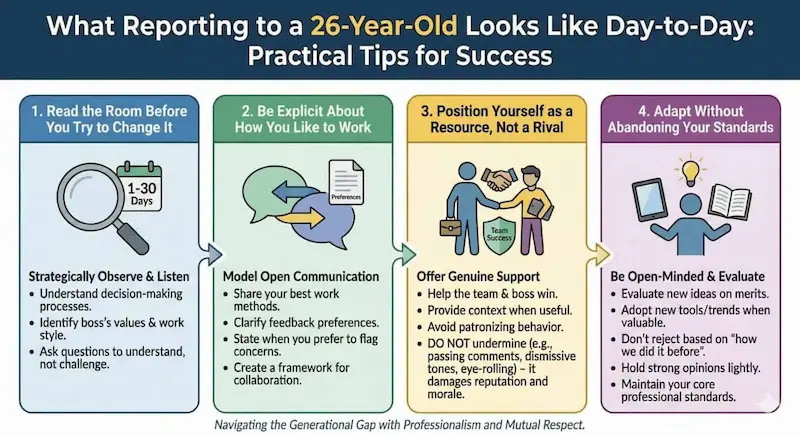
Let’s get practical. You’ve accepted the role. You like the company. The compensation works. Now you’re in week two and realizing your new boss is younger than your LinkedIn account. Here’s how to actually make it work.
Read the Room Before You Try to Change It
Every workplace has its own culture, and every manager has a work style they’ve already established with their direct reports. Before you try to share ideas or suggest a better way of doing things, spend your first 30 days observing. Ask questions. Seek to understand how decisions get made and what your boss actually values. This isn’t passive—it’s strategic.
Be Explicit About How You Like to Work
One of the best ways to bridge the generational gap early on is through open communication about preferences. Tell your boss how you do your best work, when you prefer to flag concerns, and how you like to receive feedback. This models the professionalism you want to see reflected back at you, and it creates a framework for working together before a misunderstanding has a chance to fester.
Position Yourself as a Resource, Not a Rival
Your younger boss may feel some pressure knowing they’re managing someone with 15 or 20 years more experience. You can help or hurt that dynamic. Help your boss succeed—not in a patronizing way, but in a genuine “I want this team to win” way. Offer context when it’s useful, not just when you want to prove a point. The supervisor who feels supported by their senior IC is the supervisor who gives that IC more autonomy, visibility, and advancement opportunity.
Don’t undermine—ever. Whether it’s a passing comment to a coworker, a slightly dismissive tone in a meeting, or rolling your eyes at a decision you disagree with, subtle forms of undermining your boss will always come back to you. It tanks team morale, damages your reputation, and makes you look like the problem regardless of who’s technically right.
Adapt Without Abandoning Your Standards
Working with a younger boss doesn’t mean pretending to love every new tool, trend, or framework they introduce. It means being open-minded enough to evaluate new ideas on their merits rather than rejecting them because “that’s not how we did it before.” You’ve earned the right to have strong opinions. Just hold them lightly enough to actually hear something new.
When the Age Difference Actually Matters
Sometimes the friction isn’t about ego or preconceived perception—it’s about a legitimate gap in management skills or judgment that affects your ability to do your job. A younger boss may make decisions without enough context. They may not yet know how to manage a high-performing senior employee. They may be figuring out how to empower their team while also meeting expectations from above.
That’s real, and it’s worth naming—carefully.
If you’re facing a genuine management issue, the path forward isn’t to make it about age. It’s to address the specific behavior or decision through the right channel, with the right framing. Focus on the impact to the work, not the person’s level of experience. Lead with curiosity rather than critique. And if the work environment is truly not working, it’s okay to be honest with yourself about that too—before it costs you more than just morale.
The Hidden Advantage No One Talks About

Here’s what actually happens when a senior IC builds a strong working relationship with a younger boss: both of them win.
Your younger boss gets a trusted advisor with deep work experience, pattern recognition they haven’t earned yet, and a steady hand when things get uncertain. You get a manager who’s often more willing to experiment, move fast, and give you meaningful problems to solve—without the political baggage of more entrenched leadership.
Working for someone younger isn’t a step backward. It’s a different configuration of the same goal you’ve always had: doing great work with people worth working with. The senior ICs who figure that out early don’t just survive this dynamic—they tend to become the most valued, most trusted people in the room.
FAQs
Is it normal to feel resentful when reporting to a younger manager?
Yes, and it’s worth examining honestly. Resentment usually signals something about unmet expectations or ego—not necessarily that the situation is unfair. Give yourself space to process it, then decide how you want to show up.
How do I share ideas with a younger boss without sounding like I’m undermining them?
Frame your ideas as questions or possibilities rather than corrections. “Have you considered…” lands better than “What you should do is…” Tone and timing matter as much as content.
What if my younger boss genuinely lacks the experience to lead well?
Focus on specific behaviors and their impact on the work, not on their age or years of experience. Address concerns through direct, respectful conversation—or, if necessary, through appropriate channels.
How do I stay visible and advance my career when I’m not the manager?
Senior ICs advance through the quality of their work, the strength of their relationships, and their reputation as someone who makes the team better. Your title doesn’t determine your influence—your impact does.
Should I disclose that I’ve held more senior roles in the past?
Only if it’s relevant to the work. Casually dropping past titles or authority signals insecurity, not confidence. Let your contributions speak, and your background will naturally surface in context.
Conclusion
Navigating a new role under a younger boss is one thing. Navigating it while also recovering from a layoff—or figuring out whether this opportunity is even the right next move—is another challenge entirely. That’s where having the right support in your corner makes a real difference.
At Layoff Lifeline, we work with senior professionals who are in exactly this kind of transition: experienced, capable, and trying to figure out the smartest path forward. Whether you’re weighing a new offer, processing a job loss, or just trying to get clear on what you actually want next, we can help you think it through without the noise.
Keep Reading
More practical guidance for the financial, career and emotional side of a layoff.


