
Financial Guidance
How The Rule of 55 Withdraws Early 401k Access Penalty-Free

If you’re facing an unexpected layoff or considering early retirement, accessing your 401k before age 59½ might seem impossible without hefty penalties. But there’s a little-known IRS provision called the rule of 55 that could be your financial lifeline. I’ll walk you through exactly how this rule works and whether it might be the right strategy for your situation.
Key Takeaways
• The Rule of 55 allows penalty-free withdrawals from your 401k if you leave your job during or after the year you turn 55
• This provision only applies to your current employer’s retirement plan—not IRAs or previous employer plans
• You’ll still owe ordinary income tax on withdrawals, but you avoid the harsh 10% early withdrawal penalty
What is the Rule of 55?

The rule of 55 is an IRS provision that allows you to withdraw money from your employer-sponsored retirement plan without the typical 10% early withdrawal penalty. If you leave your job—whether voluntarily or involuntarily—during or after the calendar year you turn 55, you may be able to take penalty-free withdrawals from that specific 401k or 403b plan.
This rule exists because the IRS recognizes that life doesn’t always follow neat timelines. Sometimes you need to retire early due to layoffs, health issues, or other circumstances beyond your control. The rule of 55 provides a bridge for those critical years between leaving your job and reaching age 59½.
How the Rule of 55 Works
When you use the rule of 55, you’re essentially getting early access to your retirement savings without the crushing 10% penalty that typically applies to early withdrawals. Here’s how it functions in practice:
Timing Requirements You must leave your job during or after the year you reach age 55. If you’re 54 when you leave your employer, you can’t start taking withdrawals penalty-free when you turn 55 later. The separation from service must happen in the same calendar year you turn 55 or later.
Current Employer Only
The rule of 55 only applies to your current employer’s retirement plan. If you have old 401k accounts with previous employers, those funds remain locked until age 59½ unless you roll them into your current plan before leaving your job.
Public Safety Exception If you’re a public safety employee—such as a police officer, firefighter, EMT, or air traffic controller—you may be able to use this rule starting at age 50 instead of 55.
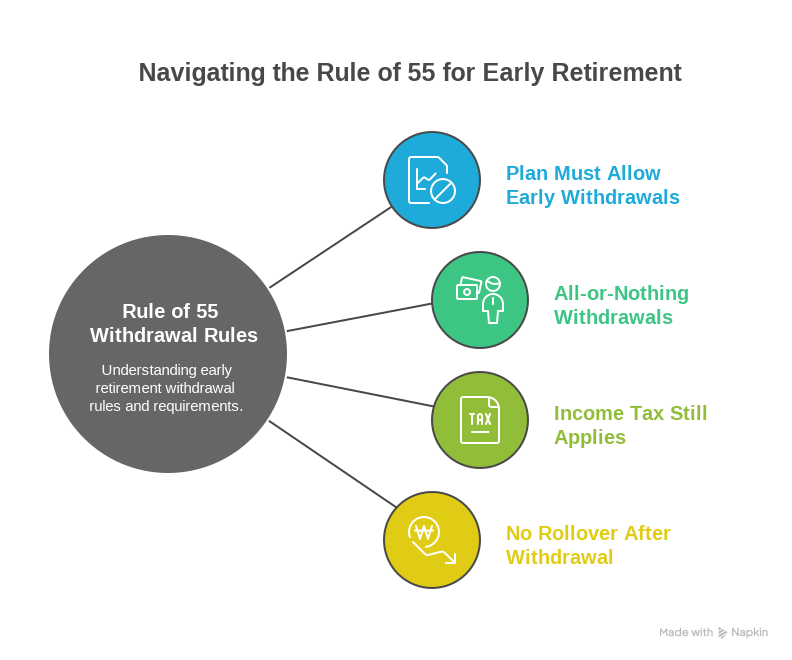
Rule of 55 Withdrawal Rules and Requirements
Before you start planning your early retirement around this rule, understand these important limitations:
Plan Must Allow Early Withdrawals Not all employer retirement plans permit rule of 55 withdrawals. Your plan administrator has the discretion to opt out of this provision. Check your Summary Plan Description or contact HR to verify your plan allows these early withdrawals.
All-or-Nothing Withdrawals Many plans don’t allow partial withdrawals once you’ve left your job. This means you might need to withdraw your entire account balance at once, potentially pushing you into a higher tax bracket for that year.
Income Tax Still Applies While you avoid the 10% penalty, you still owe ordinary income tax on your withdrawals. Plan administrators typically withhold 20% for federal taxes, but depending on your total income, you might owe more or less when you file your tax return.
No Rollover After Withdrawal Once you take money out under the rule of 55, you can’t roll it back into a retirement account. This permanently reduces your retirement savings and future growth potential.
Rule of 55 vs IRA Early Withdrawals
This is crucial to understand: the rule of 55 does not apply to IRAs. Whether you have a traditional IRA, Roth IRA, or SEP-IRA, withdrawing funds before age 59½ will trigger the 10% early withdrawal penalty unless you qualify for specific IRA hardship exceptions.
However, there’s a strategic workaround if you’re still employed. You can roll your IRA funds into your current employer’s 401k plan (if the plan accepts rollovers), then use the rule of 55 to access those funds penalty-free when you leave your job.
Substantially Equal Periodic Payments (SEPP) IRAs do offer one early withdrawal option called substantially equal periodic payments. With a SEPP plan, you can take calculated distributions from your IRA starting at any age without penalty, but you must continue these payments for five years or until age 59½, whichever is later.
Using the Rule of 55 for Early Retirement
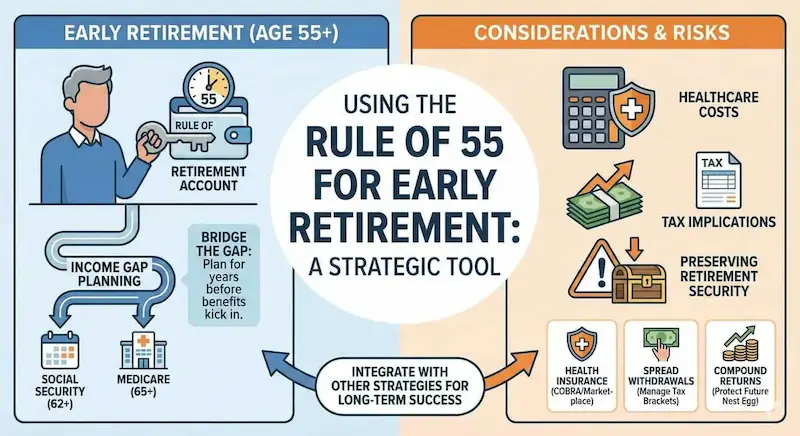
If you’re planning to retire early, the rule of 55 can be a valuable component of your strategy, but it shouldn’t be your only income source. Here’s what to consider:
Income Gap Planning Early retirees face a significant income gap. Social Security benefits don’t start until age 62 at the earliest, and Medicare doesn’t kick in until 65. Your rule of 55 withdrawals need to bridge this gap alongside other income sources.
Healthcare Costs Without employer-sponsored health insurance, healthcare becomes a major expense. Factor COBRA continuation coverage costs or marketplace insurance premiums into your early retirement budget.
Tax Implications of Large Withdrawals Taking substantial rule of 55 withdrawals in a single year could push you into higher tax brackets. Consider spreading withdrawals across multiple tax years or coordinating with other tax planning strategies.
Preserving Retirement Security Every dollar you withdraw early is one less dollar earning compound returns for your later years. Run projections to ensure you’ll still have adequate retirement income after age 65.
Tax Implications of Rule of 55 Withdrawals
Understanding the tax consequences is essential for effective planning:
Federal Income Tax Rule of 55 withdrawals are taxed as ordinary income at your marginal tax rate. If you’re in the 22% tax bracket and withdraw $50,000, you’ll owe about $11,000 in federal taxes (before any deductions or other considerations).
State Income Tax State tax treatment varies significantly. Some states don’t tax retirement income at all, while others tax it fully as ordinary income. Research your state’s specific rules or consult a tax professional.
Withholding Requirements Plan administrators generally withhold 20% for federal income tax unless you request otherwise or elect substantially equal periodic payments. This withholding might not cover your full tax obligation, potentially leaving you with a bill at tax time.
Tax Planning Strategies Consider coordinating rule of 55 withdrawals with deductible expenses like medical costs, charitable contributions, or business deductions to minimize your overall tax burden.
Alternatives to Rule of 55 Withdrawals
Before tapping your 401k early, explore these alternatives:
401k Loans If your plan allows loans and you’re still employed, borrowing from your 401k might be better than taking a withdrawal. You pay yourself back with interest and avoid taxes and penalties entirely.
Hardship Withdrawals Even if you don’t qualify for the rule of 55, you might qualify for other penalty exceptions like medical expenses exceeding 7.5% of your adjusted gross income, permanent disability, or certain educational expenses.
Bridge Employment Taking a part-time job or consulting work can provide income while preserving your retirement savings. This strategy often works better than depleting your 401k early.
Taxable Investment Accounts If you have investments in taxable accounts, consider using those first. While you’ll pay capital gains tax, the rates are often more favorable than ordinary income tax rates.
FAQs
Can I use the rule of 55 if I was fired?
Yes, the rule of 55 applies whether you leave your job voluntarily or involuntarily. As long as you separate from service during or after the year you turn 55, you qualify for penalty-free withdrawals.
What if I get another job after using the rule of 55?
You can continue taking withdrawals from your former employer’s plan even if you start a new job. However, the money must stay in that original plan—you can’t roll it to your new employer’s plan or an IRA without losing the rule of 55 benefit.
Does the rule of 55 apply to 403b plans?
Yes, the rule of 55 applies to 403b plans offered by nonprofit employers, just like 401k plans. The same age and separation requirements apply.
Can I roll old 401k accounts into my current plan to use the rule of 55?
Yes, if your current employer’s plan accepts rollovers, you can consolidate old 401k accounts before leaving your job, then use the rule of 55 to access all those funds penalty-free.
How much can I withdraw under the rule of 55?
There’s no specific limit on how much you can withdraw, but your plan’s rules determine whether you can take partial withdrawals or must withdraw the entire balance. Consider the tax implications of large withdrawals.
Conclusion
The rule of 55 can be a powerful tool for accessing your retirement savings during life transitions, but it’s not a decision to take lightly. While avoiding the 10% early withdrawal penalty is significant, you’re still paying ordinary income tax and permanently reducing your retirement nest egg.
At Layoff Lifeline, we help you navigate these complex decisions with personalized guidance tailored to your unique situation. Don’t let uncertainty derail your financial future— work together to create a plan that protects both your immediate needs and long-term goals. Schedule a consultation today and take control of your financial transition.
Keep Reading
More practical guidance for the financial, career and emotional side of a layoff.


