
Financial Guidance
How to Salvage Unvested RSU After Your FAANG Layoff 2026

When your FAANG layoff notice arrives, there’s a ticking clock on hundreds of thousands of dollars in unvested equity. I’ve seen tech workers walk away from life-changing compensation simply because they didn’t know these unvested rsus could be negotiated. The standard severance package your employer hands you assumes you’ll forfeit everything that hasn’t vested yet—but that’s just their opening position. What happens to your rsus when termination hits doesn’t have to be a complete loss if you act quickly and strategically.
Key Takeaways
- Unvested RSUs are typically forfeited upon termination unless you negotiate accelerated vesting or prorated equity into your severance package before your last day
- Most tech companies allow 90-day post-termination exercise periods for vested stock options, but this window can be extended through strategic negotiation
- Timing matters: Understanding your vesting schedule, cliff dates, and company-specific plan documents gives you leverage to salvage hundreds of thousands in equity compensation
Understanding What Happens to RSUs During Tech Layoffs

When tech layoffs strike, your restricted stock units follow specific rules that most companies don’t advertise. The typical FAANG vesting schedule grants 25% of your total equity after your first year cliff, then 6.25% quarterly for the remaining three years. If you’re terminated before completing that first year, some FAANG companies will still provide the full first year’s worth of stock allocation—but this isn’t guaranteed across all tech companies.
The harsh reality is that unvested equity usually gets forfeited the moment your employment ends. Your vested RSUs remain yours, but anything that hasn’t crossed the vesting date threshold typically goes back to the company. This is where understanding your grant agreement and plan documents becomes critical, because these contracts contain the exact termination clauses that determine what happens to the RSU when you’re laid off.
Tech employees at Meta, Amazon, and other FAANG companies saw this firsthand during the massive layoffs throughout 2025, when approximately 55,000 positions were eliminated specifically due to AI-related restructuring. Many of these tech workers lost significant unvested stock because they didn’t realize the vesting terms could be negotiated during severance discussions.
The RSU Cliff Problem: Why Timing Is Everything
The one-year cliff represents the most vulnerable period for tech workers facing layoffs. During cliff-based vesting, there’s typically a full year waiting period before any RSUs begin to vest, and once that cliff period expires, a significant portion vests simultaneously. If your layoff happens 11 months into your tenure, you could forfeit your entire first-year equity grant unless you negotiate otherwise.
This becomes particularly painful when you calculate the actual dollar amounts at stake. At the current company’s stock valuations, losing unvested RSUs before your vesting schedule completes can mean forfeiting $500K or more in total compensation. The 2022 tech correction already demonstrated how RSU values impact overall income—when stock prices dropped 50%, tech employees effectively lost half their equity compensation for work already performed.
Your termination date matters more than most people realize. Companies might use vague language in severance agreements like “continued employment through X date” without clarifying whether vesting continues during transition periods. If you’re staying on payroll for paid administrative leave or a transition period, you need explicit language confirming that vesting continues during that time.
Negotiation Scripts That Actually Work
The key to salvaging unvested equity lies in how you frame your severance negotiation. When your employer presents the initial severance package, your response should be strategic and specific. Start with language that acknowledges the offer while opening the door to adjustments: “I appreciate the severance package offered, and I’d like to discuss a few adjustments to better reflect my contributions and tenure.”
Here’s a more targeted script for addressing unvested RSUs directly: “Given that I’m [X months] from my next vesting date and my performance record, I’d like to explore accelerated vesting for the prorated portion of my unvested equity. This represents work already completed and value I’ve already delivered to the company.” The goal is to position unvested stock as compensation you’ve earned but haven’t yet received, rather than future benefits you’re not entitled to.
When companies push back with “this is our standard package,” counter with specifics: “I understand the standard terms, but given my [specific contributions, upcoming cliff date, years of service], I believe there’s room to include prorated vesting or a cash equivalent for my unvested equity in exchange for [transition assistance, non-disparagement agreement, extended notice period].” This frames your request as a win-win rather than a demand.
What to Ask For Specifically
Focus your negotiation on these concrete items:
- Accelerated vesting: Request that some or all unvested RSUs become vested immediately upon involuntary termination without cause
- Prorated vesting: Ask for a portion of unvested units to vest based on time worked during the vesting period
- Cash equivalent: If accelerated vesting isn’t possible, negotiate a cash payout equal to the current fair market value of soon-to-vest equity
- Extended termination date: Request that your official termination date be pushed to your next vesting milestone, keeping you on payroll (even on administrative leave) until shares vest
Stock Options vs RSUs: Different Rules Apply
While rsus and stock options both fall under equity compensation, they operate differently during layoffs. Stock options give you the right to purchase company stock at a predetermined strike price, while restricted stock units are actual shares granted outright once vested. This distinction matters significantly when termination happens.
For vested stock options, you typically face a 90-day post-termination exercise period where you must decide whether to purchase your vested shares. This window is known as the PTEP, and it starts the day your service ends—not when you receive your final paycheck. The company won’t remind you about this deadline, so you need to be proactive about checking your grant agreement for your strike price and calculating whether exercising makes financial sense.
Incentive stock options (ISOs) and non-qualified stock options (NSOs) have different tax implications tied to this 90-day requirement. If you don’t exercise within the PTEP, you forfeit those options entirely. However, this deadline is negotiable—many tech workers successfully extend their post-termination exercise period during exit discussions, especially when they’re close to additional vesting dates or the strike price makes immediate exercise financially difficult.
For Employee Stock Purchase Plans (ESPP), different rules typically apply. Most espp programs require continued employment through the purchase date, meaning any contributions made during the offering period before your termination may be refunded rather than used to purchase discounted stock.
Accelerated Vesting Clauses You Might Already Have
Many equity grant agreements already contain accelerated vesting provisions that activate under specific circumstances—you just need to know where to look. Single-trigger acceleration means unvested equity vests immediately upon involuntary termination without cause, while double-trigger acceleration requires both a change in control (like a company acquisition) and your subsequent termination.
Review your original grant agreement and stock plan documents carefully for these clauses. Some agreements specify that all unvested rsus immediately vest upon events like disability, death, or retirement. Others include language about “Vesting Termination” scenarios where restricted periods end if you’re terminated without cause or resign for “Good Reason.”
The challenge is that these acceleration clauses often require you to sign and not revoke a release of claims within 60 days after your termination date. If you’re terminated for cause or resign without good reason—or if you don’t execute the required release within the specified timeframe—you forfeit any right to accelerated vesting.
For acquisitions and changes in control, your RSU agreement may contain provisions for accelerated vesting that your employer isn’t actively advertising. When Twitter went private in 2022, many RSU agreements were canceled outright, and offsetting compensation was entirely at the acquirer’s discretion. This demonstrates why negotiating up-front severance agreements with accelerated vesting provisions is critical before these situations arise.
Timing Your Severance Negotiation
The moment you receive layoff notice is when your negotiation window opens—and it closes faster than most tech workers realize. Companies typically want severance agreements signed quickly, often within a few days, but you should resist this pressure. Respond with: “I appreciate the offer, and I’d like to take the necessary time to review it properly.”
Your leverage is strongest before you sign anything. Once you accept the initial severance package and sign the release, your ability to negotiate additional terms essentially disappears. This is why you need to review not just the severance agreement but also your equity plan documents, grant notices, and any related agreements side by side before responding.
If you’re approaching a cliff date or vesting milestone, timing becomes even more critical. Companies may define your “termination date” as either your last working day or the end of your severance period—and this seemingly minor distinction can mean the difference between keeping or forfeiting significant unvested equity. Push for clarity and, ideally, for your official termination date to extend past your next vesting event.
Document everything in writing. Verbal assurances from HR about vesting schedules, exercise windows, or equity treatment won’t protect you if they contradict what’s in your written agreements. Get confirmation in your severance agreement itself about the number of vested shares as of your termination date, deadlines to exercise them, and whether the company considers vesting to continue during any transition period.
What Actually Happens to Different Equity Types
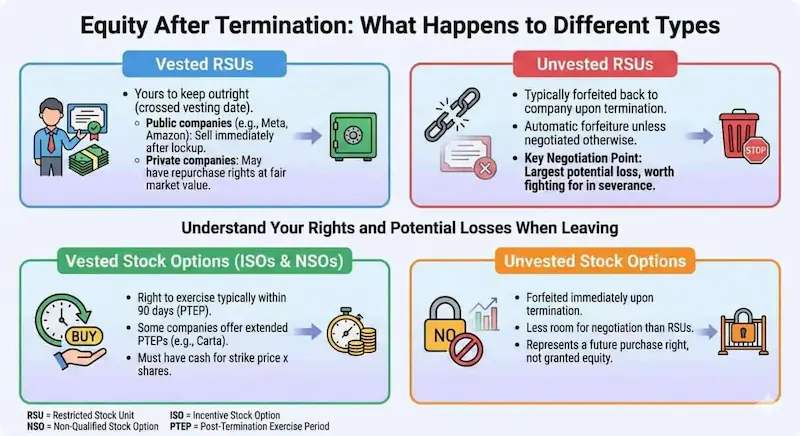
Vested RSUs
These shares are yours to keep once they’ve crossed their vesting date. You own the stock outright, though some privately held companies may have repurchase rights that let them buy back vested shares at fair market value. For public company stock like Meta or Amazon, vested shares can be sold immediately once any lockup periods expire.
Unvested RSUs
Unless negotiated otherwise, unvested restricted stock units are forfeited back to the company upon your termination. The forfeiture happens automatically on your termination date unless your specific plan documents or severance agreement says otherwise. This is the equity that’s most worth fighting for during severance negotiations because it represents the largest potential loss.
Vested Stock Options (ISOs and NSOs)
You maintain the right to exercise these within your post-termination exercise period, typically 90 days. Some tech companies now offer more generous PTEPs—Carta, for example, gives departing employees as long as they worked at the company to exercise their vested options. You’ll need cash on hand to cover the strike price multiplied by the number of shares you want to purchase.
Unvested Stock Options
These are forfeited immediately upon termination. Unlike rsus where you might negotiate prorated or accelerated vesting, unvested options typically offer less room for negotiation because they represent a future purchase right rather than granted equity.
The Cash Equivalent Strategy
When accelerated vesting proves impossible to negotiate, pivot to requesting cash equivalents for your unvested equity. Calculate the current fair market value of the unvested rsus you’re forfeiting and present this as a specific dollar figure in your counteroffer. For example: “The 1,000 unvested rsus I’m forfeiting are currently valued at $250,000. I’d like to include a cash payment of $100,000 in the severance package to partially offset this loss, particularly given my contributions to [specific projects or outcomes].”
This approach works because it converts an accounting complexity (equity treatment) into a straightforward severance enhancement. Companies often have more flexibility to increase cash severance than to make exceptions to equity vesting policies, especially during mass layoffs where precedent-setting becomes a concern.
Frame the request around fairness and your specific circumstances. If you’re three months from a major vesting cliff, emphasize the timing: “I’ve completed 9 of the 12 months required for my first cliff vesting. Rather than forfeiting 100% of that first-year grant, I’m requesting a cash payment representing the prorated value of the work period I’ve completed.”
Red Flags in Severance Agreements
Watch for vague language around equity treatment. If your severance agreement doesn’t explicitly address what happens to unvested RSUs, vested but unexercised options, or your ESPP contributions, ask for clarification before signing. Silence on these issues typically means standard forfeiture applies.
Be wary of clawback provisions that might require you to return the value of previously vested equity if you violate the terms of your severance agreement. These clauses are becoming more common in executive severance packages and can create unexpected liability.
Review any repurchase rights carefully, especially if you work for a privately held company or a startup pre-ipo. These provisions can require you to sell vested shares back to the company at a price that may not reflect true market value, particularly if the company has experienced down rounds or valuation decreases since your RSU grant.
Check the definition of “cause” in your termination paperwork. If your layoff is characterized as termination for cause rather than a reduction in force, you may lose rights to accelerated vesting clauses or severance enhancements that only apply to involuntary terminations without cause. Push for clear language stating your separation was involuntary and not for cause.
Post-Layoff Financial Priorities

Once you’ve negotiated the best possible severance package, your immediate priorities shift to execution and protection. For vested stock options, calculate whether exercising makes sense given your strike price, the current company stock value, and your available cash. Don’t let the 90-day PTEP deadline pass without making an active decision.
For vested rsus in public companies like the FAANG companies, consider your concentration risk. Many financial advisors recommend keeping employer stock capped at 10-30% of your total portfolio. This is particularly important if you’ve just been laid off, as your financial stability shouldn’t be overly dependent on your former employer’s stock performance.
Address the tax implications immediately. Rsus are taxed as ordinary income at vesting, and if shares vested during your employment but you haven’t sold them yet, you may still owe taxes on their vesting-date value even if the current market value is lower. Consult a tax professional about estimated tax payments or withholding adjustments to avoid surprises during tax season.
If you negotiated accelerated vesting or received a cash equivalent payment, plan for the taxable event this creates. These amounts will be taxed at your ordinary income rate, potentially pushing you into a higher tax bracket for the year. Consider whether estimated tax payments make sense to avoid underpayment penalties.
FAQ
What happens to my unvested RSUs if I get laid off from a FAANG company?
Unvested rsus are typically forfeited upon termination unless your equity grant agreement contains accelerated vesting clauses or you successfully negotiate partial vesting into your severance package. The standard treatment is complete forfeiture on your termination date, which is why negotiating before you sign your severance agreement is critical.
Can I negotiate to keep my unvested equity during a layoff?
Yes, unvested equity is negotiable as part of your severance package. You can request accelerated vesting (having unvested shares vest immediately), prorated vesting (vesting a portion based on time worked), or a cash equivalent payment representing the value of forfeited equity. Your success depends on your negotiating leverage, which includes factors like your tenure, proximity to vesting dates, and the circumstances of your termination.
How long do I have to exercise vested stock options after being laid off?
Most companies provide a 90-day post-termination exercise period for vested stock options, though some tech companies now offer more generous windows. This deadline is negotiable during severance discussions, especially if you need more time due to financial constraints or uncertainty about the company’s prospects. The PTEP begins on your termination date, not your last paycheck date, so clarify this timing in your severance agreement.
Do tech layoffs in 2025-2026 change how RSUs are treated?
The fundamental treatment of unvested rsus during layoffs hasn’t changed, but the scale of tech layoffs in 2025—with Amazon cutting 14,000 roles and Meta reducing 600 AI positions—has made equity negotiation more common. Mass layoffs sometimes create opportunities for better severance terms because companies want to avoid legal challenges and maintain their reputation as the tech industry faces continued restructuring in 2026.
What’s the difference between forfeiting RSUs and losing stock options in a layoff?
Rsus are actual shares granted to you that become yours once vested, while stock options give you the right to purchase shares at a specific strike price. When laid off, unvested rsus are forfeited back to the company, and you lose that equity entirely. Vested stock options remain exercisable during your post-termination exercise period, but you must have cash available to purchase the shares at the strike price. Unvested options are also forfeited, but the loss represents a future purchase opportunity rather than granted equity compensation.
Conclusion
Walking away from a FAANG layoff doesn’t have to mean accepting total forfeiture of your unvested equity. The severance package they hand you is a starting point, not a final offer. Every month you’ve worked represents real value delivered, and that equity compensation was part of your total compensation package from day one. By understanding your vesting schedule, knowing what leverage you have, and using strategic negotiation scripts, you can salvage significant portions of unvested rsus or negotiate equivalent value.
The tech industry’s ongoing transformation means these skills will remain relevant as companies continue restructuring through 2026 and beyond. Don’t sign anything until you fully understand what you’re giving up and what you might still negotiate.
If you’re facing a layoff and need help navigating your equity compensation and severance negotiation, book your free 15-minute strategy session with Layoff Lifeline to discuss your specific situation. We’ll help you understand exactly what’s at stake and create a plan to maximize your financial recovery during this transition.
Keep Reading
More practical guidance for the financial, career and emotional side of a layoff.


