
Job Assistance
Networking Email Templates for Job Seekers After Inactivity

Your resume sits there collecting digital dust while your former colleagues, classmates, and coworkers have moved into positions where they could actually help you. I’ve seen it happen countless times: professionals spend weeks perfecting their resume only to realize that reconnecting with their network would have landed them interviews faster. If you’ve been out of touch for years or just experienced a layoff, your network isn’t dead—it’s just sleeping. Let me show you how to wake it up.
Key Takeaways
- Your dormant network holds more value than your resume when returning to the job market after a long break or layoff
- Personalized networking emails with clear calls to action generate higher response rates than generic cold outreach
- Strategic follow-up templates and LinkedIn messages can transform old contacts into meaningful connections and job opportunities
Why Your Resume Takes a Back Seat to Real Relationships

The truth stings a bit: hiring managers receive hundreds of resumes for every open position. Your carefully crafted document becomes one in a massive stack of qualifications that all start to look the same. Meanwhile, someone you used to work with ten years ago could forward your name to a hiring manager and get you an interview by next week.
I’m not saying your resume is worthless. But when you’re currently looking for a new position after being away from active networking, your relationships carry more weight than any bullet point ever could. People hire people they know or people recommended by someone they trust. That’s where networking email templates become your secret weapon.
The Psychology Behind Reactivating Old Connections
Here’s what most job seekers get wrong: they think reconnecting after years of silence is awkward. They worry their old contacts will see through their intentions. But here’s the reality—most professionals actually enjoy hearing from former colleagues. We’re hardwired to help people we once knew, especially if they’re pursuing a career change or facing a setback like a layoff.
The key is authenticity. When you wanted to reach out but held back because you thought it would seem transactional, you were overthinking it. A well-crafted networking email acknowledges the time gap, offers genuine interest in their current work, and makes a specific request. That’s not manipulation—that’s professional communication.
Building Your Email Template Foundation
Before you start sending messages, you need a framework that works across different scenarios. Every networking email should include these elements:
A personalized subject line that mentions a shared connection or specific topic. Generic subjects like “Catching Up” get ignored. Try “Following up on our conversation about [specific project]” or “Loved your recent article on [industry topic].”
An opening that acknowledges the relationship and time gap without apologizing excessively. You don’t need to grovel. A simple “It’s been a while since we worked together at [company name], and I’ve been following your career with interest” works perfectly.
A clear reason you’re reaching out that focuses on them first. This is where most templates fail. Don’t immediately ask for a job. Instead, express genuine interest: “I’d love to learn more about your work in [their current field]” or “I really enjoyed your LinkedIn post about [specific topic] and wanted to discuss your career path.”
A specific call to action that makes responding easy. Vague requests get vague responses or silence. Try “Would you be open to a brief phone call next week?” or “Please let me know if you’re available for a 20-minute conversation.”
Sample Networking Emails That Actually Work
Template 1: The Former Colleague Reconnection
Subject: Quick question about [their current company/industry]
Hi [Name],
I came across your profile on LinkedIn and saw you’re now at [company name]. It’s been about [number] years since we used to work together at [previous company], and I’ve been impressed watching your progression into [their current role].
I’m currently exploring opportunities in [industry/field] after [brief mention of your situation—layoff, career transition, etc.], and I’d really value your perspective. I know you have specific skills in [area relevant to them], and I’d love to get together to learn more about your experience.
Would it be possible to set up a call sometime in the next two weeks? I’m happy to schedule around your availability. Thanks in advance for considering it.
Look forward to hearing from you, [Your name]
Template 2: The Informational Interview Request
Subject: Interested in learning about [specific aspect of their work]
Hi [Name],
I hope this finds you well. We connected briefly at [event/through mutual connection] a few years back, and I’ve been following your career trajectory with interest, particularly your work on [specific project or achievement].
I’m pursuing a career in [field] and would greatly value an informational interview to discuss your career path and the industry landscape. I’m not currently looking for a job through your company specifically, but rather hoping to gain insights from someone with your expertise.
Let me know if you’re available for a 15-20 minute call in the coming weeks. I’m flexible with timing and happy to work around your schedule.
Thank you so much for considering, [Your name]
Template 3: The Cold Email to a New Contact
Subject: [Mutual connection] suggested I reach out
Hi [Name],
[Mutual connection name] mentioned you might be a great person to speak with about [industry/topic]. I recently [brief career situation], and I’m particularly interested in [specific area they work in].
I came across your profile and was impressed by [specific achievement or aspect of their background]. Would you be open to a brief conversation about [specific topic]? I’m not asking for anything beyond career advice and your perspective on [industry].
Please let me know if there’s anything I can help you with in return. I have experience in [your area of expertise] if that’s ever useful.
Thanks again,
[Your name]
The Follow-Up Email Strategy
Most job seekers send one email and give up. That’s leaving opportunities on the table. People get busy, emails get buried in their inbox, and good intentions fade. A follow-up email isn’t pushy—it’s professional.
Wait about one week after your initial outreach, then send a brief follow-up:
Subject: Following up on my previous email
Hi [Name],
I wanted to follow up regarding my previous email about connecting for a brief conversation. I know inboxes get overwhelming, so I thought I’d circle back.
If now isn’t a good time, no problem at all. I’d still love to chat whenever your schedule opens up, even if that’s a month or two from now.
Best, [Your name]
After two follow-ups with no response, move on. They might not be in a position to help, or the timing might not work. That’s okay. Your job search shouldn’t depend on any single contact.
LinkedIn Networking: Your Parallel Strategy
While email remains powerful, LinkedIn has become essential for job seekers. The platform lets you reconnect with old contacts and establish new connections simultaneously. Your LinkedIn outreach should complement, not replace, your email strategy.
When sending LinkedIn connection requests, always include a personalized note. The default “I’d like to add you to my professional network” gets ignored. Instead, write something specific: “Hi [Name], we both worked at [company] back in [year]. I’d love to reconnect and hear what you’re working on now.”
Once connected, don’t immediately ask for favors. Engage with their content first. Comment thoughtfully on their posts. Share their articles. Build goodwill before making a request. When you do reach out, use a similar template structure to your emails but keep it slightly shorter since LinkedIn messages feel more casual.
Turning Conversations Into Opportunities
Let’s say your networking emails work and people start responding. Great! But this is where many job seekers stumble. They get the conversation but don’t know how to guide it toward actual opportunities.
During your informational interview or catch-up call, focus on them first. Ask about their current work, what challenges they’re facing, and what excites them about their company. Take genuine interest. People can tell when you’re just checking boxes.
After you’ve learned about their situation, share yours briefly. Don’t unload your entire career history or complain about your previous employer. Keep it factual: “I was part of a layoff at [company] and I’m exploring opportunities in [field]” or “I’m transitioning from [industry] to [new industry] because [brief reason].”
Then, and only then, make your specific ask. It might be: “Do you know if your company has any openings that might be a good fit for someone with my background?” or “Would you be willing to introduce me to [person in their network]?”
Always end with gratitude and a commitment to stay in touch. Send a thank you email within 24 hours. A simple message works: “Thank you so much for taking the time to speak with me today. Your insights about [specific topic] were incredibly helpful. If there’s anything I can help you with, please don’t hesitate to reach out.”
Common Mistakes That Kill Your Response Rate
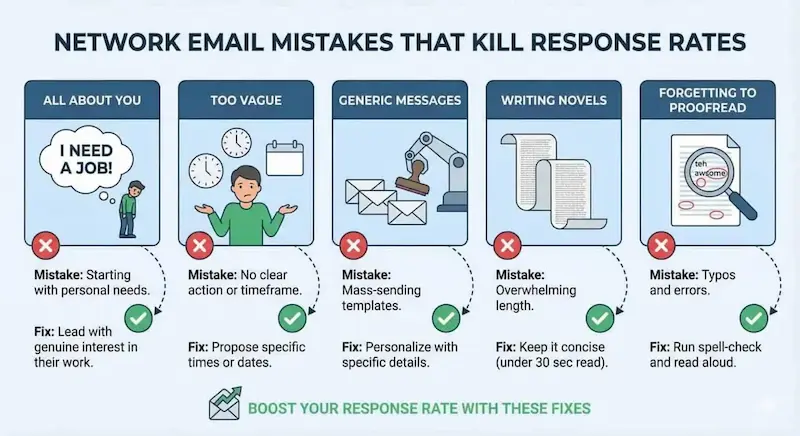
I’ve reviewed thousands of networking emails from job seekers, and certain patterns guarantee failure. Avoid these:
Making it all about you. Starting with “I need help finding a job” puts the burden on them immediately. Lead with genuine interest in their work instead.
Being too vague. “Let’s catch up sometime” has no urgency and no clear action. Propose specific times or at least a specific timeframe.
Sending generic messages. If you copy-paste the same template to 50 people without any personalization, your response rate will be abysmal. Reference something specific about each person.
Writing novels. Your initial email should be readable in under 30 seconds. Save the detailed career story for the actual conversation.
Forgetting to proofread. Typos and grammatical errors suggest carelessness. Run spell-check and read your email out loud before sending.
The Follow-Up System That Keeps Your Network Warm
Once you’ve reconnected with someone, don’t let the relationship go dormant again. Create a simple system to maintain meaningful connections without being annoying.
Set reminders to check in every three to six months. Share relevant articles with a quick note: “Saw this piece on [topic] and thought of our conversation.” Congratulate them on promotions or company milestones. Offer help when you see opportunities to assist them.
This isn’t manipulation—it’s relationship maintenance. The strongest networks aren’t activated only during job searches. They’re nurtured consistently over time. Even while you’re currently looking for work, think long-term about these relationships.
Leveraging Recruiters Through Strategic Outreach
Recruiters occupy a special place in your networking strategy. They have access to multiple companies and hiring managers, making them valuable contacts. However, recruiters also receive countless emails from job seekers, so your approach needs to stand out.
When you follow up with a recruiter, be direct about your situation and what you’re looking for. They appreciate clarity. Skip the lengthy preamble and get to the point:
Subject: [Job title] professional seeking new opportunities in [industry]
Hi [Recruiter name],
I’m reaching out because I saw you specialize in placing [job title/industry] professionals. I recently [brief career situation] and I’m actively searching for positions in [specific field or role].
My background includes [2-3 key accomplishments or skills that match their placement area]. I’d appreciate the opportunity to discuss any current or upcoming openings that might be a good fit for my experience.
I’ve attached my resume for your review. Please let me know if you’d like to schedule a call to discuss further.
Best regards, [Your name]
The Internship Angle for Career Changers
If you’re pursuing a career in a completely new field after years away, consider framing your outreach around internship opportunities or project-based work. This approach lowers the barrier for contacts who might want to help but aren’t sure how to place someone with your unique background.
Mentioning your willingness to start with smaller commitments shows flexibility and genuine interest. Some of the best full-time positions emerge from these trial arrangements once you’ve proven your value.
Measuring Your Networking Success
Track your outreach efforts to understand what’s working. Create a simple spreadsheet with columns for contact name, date sent, template used, response received, and outcome. After sending 20-30 emails, patterns will emerge.
Are certain subject lines getting better open rates? Do follow-up emails on specific days get more responses? Is one template significantly outperforming others? Use this data to refine your approach.
Your response rate should be somewhere between 20-40% for warm contacts and 5-15% for cold outreach. If you’re below these ranges, revisit your templates and add more personalization. If you’re above them but not getting actual conversations, work on your call to action clarity.
When to Pivot Your Strategy

If you’ve sent 50 personalized emails with minimal response, something’s off. Maybe your network is colder than you thought. Maybe your industry has specific cultural norms around outreach. Maybe your timing is off.
Don’t keep doing the same thing expecting different results. Try different subject lines. Shorten your emails. Change your call to action from phone calls to coffee meetings. Experiment with LinkedIn InMail versus regular email.
The job search requires persistence, but it also demands adaptability. Pay attention to what generates responses and conversations, then double down on those approaches.
FAQs
How long should I wait before following up on a networking email?
Wait five to seven business days before sending your first follow-up. People need time to see your message and respond, but waiting too long means they’ll forget entirely. After your first follow-up, wait another week before trying once more. Two follow-ups is the maximum—after that, move on to other contacts.
Is it okay to ask for a job directly in my first networking email?
Generally, no. Unless someone has explicitly told you to reach out about a specific job opening, your first email should focus on reconnecting and building rapport. Position yourself as interested in learning about their work and industry insights. The job conversation can happen naturally during your actual discussion.
Should I mention I was laid off in my networking emails?
You can mention it briefly without dwelling on it. A simple “I’m exploring new opportunities after a recent layoff” is honest and straightforward. Don’t go into detail about the circumstances or speak negatively about your former employer. Keep the focus on moving forward, not explaining the past.
What if I don’t have any recent accomplishments to mention in my emails?
Focus on transferable skills and what you’re actively learning or pursuing now. You might say “I’m currently developing skills in [area]” or “I’ve been following developments in [industry] closely.” Your genuine interest and willingness to learn matter more than a gap in recent achievements.
How many networking emails should I send per week?
Quality matters more than quantity, but aim for 10-15 personalized outreach emails per week. This pace is sustainable and allows you to customize each message properly. Spending 15-20 minutes crafting each email will yield better results than blasting 50 generic messages that get ignored.
Conclusion
Your network represents years of relationships and shared experiences that no resume can capture. The contacts you made 5, 10, or 15 years ago are now in positions to open doors, make introductions, and offer insights that dramatically accelerate your job search. The networking email templates I’ve shared aren’t magic formulas—they’re frameworks for genuine, professional communication that respects both your time and theirs.
If you’re feeling overwhelmed by the networking process or unsure how to position yourself after a layoff, you don’t have to figure it out alone. Layoff Lifeline provides personalized guidance to help you navigate this transition strategically. We’ll help you identify the strongest contacts in your network, craft messages that resonate, and turn conversations into opportunities. Schedule a consultation today and let’s create your roadmap forward together.
Keep Reading
More practical guidance for the financial, career and emotional side of a layoff.


