
Uncategorized
NQDC Layoff and Deferred Comp Disasters You Must Know Now

I’ve watched too many senior executives walk into a conference room expecting a standard severance package, only to discover they’ve triggered a deferred compensation disaster that will haunt them for years. The tax consequences of getting your NQDC plan wrong during a layoff aren’t just painful—they’re financially devastating.
When big tech companies restructure and L7+ executives get caught in the crossfire, the real damage isn’t always the job loss. It’s the tax bomb hiding in your nonqualified deferred compensation plan that most people never see coming until the IRS comes calling.
Key Takeaways
- A Section 409A violation triggers immediate taxation of your entire vested NQDC balance, plus a 20% penalty and premium interest charges—potentially creating a multi-million dollar tax bill
- Garden leave, separation from service timing, and change in control provisions can accelerate deferred compensation distributions when you least expect it, forcing income recognition in high-tax years
- Non-compete buyouts and deferred compensation acceleration clauses often contain hidden tax traps that most L7+ executives overlook until it’s too late
Understanding NQDC Plans and Why They Explode During Layoffs

What Makes Nonqualified Deferred Compensation Different
A nonqualified deferred compensation plan lets you defer salary, bonuses, or other compensation to a future date—typically retirement. Unlike qualified plans such as 401(k)s that have strict contribution limits and ERISA protections, NQDC plans can favor highly compensated employees and don’t cap how much you can defer. Your employer may offer matching contributions, and the deferred amount grows tax-deferred until distribution.
But here’s the critical difference: these plans are unsecured promises to pay. If your employer faces financial trouble, creditors can claim those funds. And when you separate from service—whether voluntary or not—the taxation clock starts ticking in ways most executives don’t understand.
The Section 409A Minefield
Section 409A governs how nonqualified deferred compensation plans must operate, and the penalties for noncompliance are brutal. If your NQDC plan violates 409A rules—even accidentally—the entire vested balance becomes immediately taxable. You’ll also face a 20% penalty tax on top of ordinary income tax, plus premium interest charges dating back to when the compensation vested.
The tax applies to all deferred compensation under the noncompliant plan, not just the portion that caused the violation. For an L7+ executive with $2 million in deferred comp, a single 409A error can trigger over $1 million in immediate federal and state taxes, plus the 20% penalty—that’s $400,000 in additional tax before you even count interest.
The Distribution Timing Trap That Catches Executives
Separation From Service Rules You Can’t Ignore
Under 409A regulations, separation from service is one of the limited permissible payment events for NQDC distributions. When you separate from service, your NQDC plan terms dictate exactly when and how you receive deferred amounts. Most executives don’t realize that the timing of this separation—and what happens in the months surrounding it—can dramatically impact their tax liability.
If you’re a specified employee at a publicly traded company, distributions can’t commence for at least six months following separation from service. This six-month delay exists to prevent you from timing your departure to access deferred comp quickly. Miss this rule, and you’ve violated 409A.
The Garden Leave Acceleration Nobody Warns You About
Garden leave arrangements—where your employer keeps you on payroll but you don’t work—create unexpected tax complications with deferred compensation. Payments made during garden leave are treated as taxable earnings subject to payroll tax at the time of payment. But here’s what trips up executives: if your NQDC plan contains vesting conditions tied to employment status, garden leave can trigger vesting earlier than you planned.
When compensation is no longer subject to a substantial risk of forfeiture, it vests for tax purposes. The timing of vesting determines when FICA taxes apply to NQDC—and payroll tax hits at the time of vesting, not distribution. For deferred compensation, that means you could owe Social Security and Medicare taxes years before you receive a dollar, and if you’re on garden leave when vesting occurs, your employer may withhold those taxes from your salary or require you to write a check.
Change in Control and Acceleration Clauses
How M&A Activity Triggers Deferred Comp Payouts
Change in control events—mergers, acquisitions, or significant ownership changes—are specifically recognized under Section 409A as permissible payment events. Many NQDC plans include provisions allowing distribution upon a change in control, sometimes immediately. If your company gets acquired while you’re holding substantial deferred amounts, those funds may be paid out within 24 months of the transaction.
The problem? That forced acceleration can push you into the highest marginal tax rates precisely when you don’t want it. If you’re receiving severance, equity acceleration, and NQDC distributions all in the same tax year, you’re looking at massive taxable income potentially taxed at 37% federal plus state taxes. The tax consequences of poor timing can easily exceed six figures for senior executives.
Acceleration Clause Exceptions and Plan Terminations
Section 409A strictly prohibits accelerating the time or schedule of benefit payments except under very limited circumstances. One exception involves permitted plan terminations following a change in control of the employer. The employer can terminate and liquidate all similar deferred compensation arrangements, but the rules are rigid: no payments can be made for 12 months following plan termination unless already scheduled, all payments must be completed within 24 months, and the employer can’t adopt a new aggregated plan for three years.
These plan termination provisions give employers a way to clear NQDC obligations during major transitions, but they can create tax disasters for participants who suddenly receive lump sum distributions during high-income years. If your NQDC plan allows termination, you need to understand whether your employer is likely to exercise that option and plan accordingly.
The Non-Compete Buyout Tax Treatment Nobody Explains
When Severance Payments Become Ordinary Income
Non-compete buyouts in connection with asset purchases or layoffs are generally treated as ordinary income for the recipient. This is distinct from capital gains treatment you might get on goodwill or equity sales. When you sign a covenant not to compete as part of your exit, any payment specifically allocated to that non-compete is taxed at ordinary income rates—potentially 37% federal plus your state’s top rate.
For buyers, non-compete agreements are typically Section 197 intangibles amortizable over 15 years on a straight-line basis, which incentivizes them to allocate meaningful value to the covenant. But that tax advantage for the buyer translates to ordinary income tax for you. The allocation must reflect economic reality, and courts scrutinize agreements that appear designed solely to engineer tax outcomes.
Employment Taxes and Self-Employment Considerations
Whether non-compete buyout payments are subject to employment taxes or self-employment tax depends on the specific facts. If the payment is contingent on continued employment, performance metrics, or services rendered, it may be recharacterized as wages triggering payroll tax withholding. A standalone unconditional non-compete paid at closing is more likely treated as non-wage ordinary income potentially reported on Form 1099.
The distinction matters enormously because employment taxes add 7.65% (or more for Medicare on high earners), and employers must match that amount. If your severance package includes both a non-compete buyout and traditional severance, the tax treatment of each component must be carefully documented to avoid IRS recharacterization and unexpected tax bills.
The Substantial Risk of Forfeiture Confusion
What Actually Constitutes a Forfeiture Condition
Under Section 409A, deferred compensation is subject to a substantial risk of forfeiture when payment is conditional on the future performance of substantial services. This is similar to the definition under Section 83 for property transfers. The key word is “substantial”—the risk must be real, not merely theoretical.
If you’re a direct or indirect owner of your employer, there’s a presumption that no substantial risk of forfeiture exists. Many elective NQDC plans never include forfeiture conditions, meaning benefits are fully vested at all times. When that’s the case, taxation and penalty calculations become simpler but also more immediate if something goes wrong.
The 2½ Month Short-Term Deferral Exception
There’s a critical exception to Section 409A: amounts required to be paid no later than 2½ months after the taxable year in which they’re no longer subject to substantial risk of forfeiture are generally exempt from 409A. This “short-term deferral” rule means if your bonus vests in December and must be paid by March 15 of the following year, it’s not treated as deferred compensation under 409A.
This timing matters intensely during layoffs. If your severance or bonus qualifies as short-term deferral, you avoid 409A’s complex distribution and election rules. But if payment extends beyond that 2½ month window, you’re fully subject to 409A—and all the landmines that come with it.
Tax Planning Strategies L7+ Executives Miss
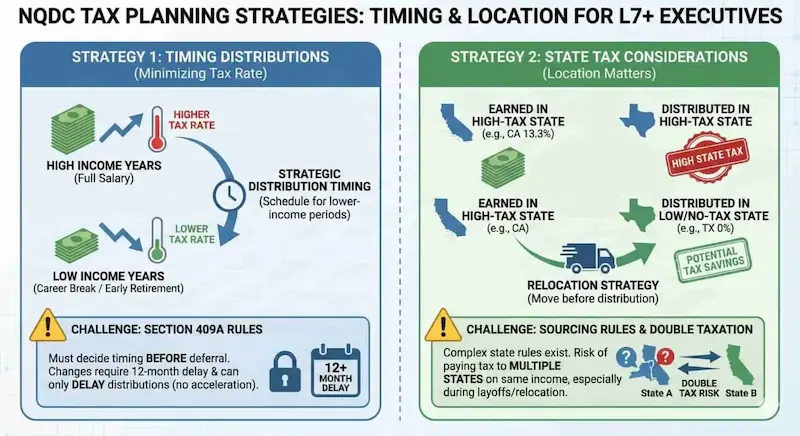
Timing Distributions to Minimize Tax Rate Impact
One of the few planning opportunities with NQDC distributions involves timing them to align with lower-income years. If you’re taking a career break, planning extended time off, or moving to a lower-paying role, scheduling distributions during those years can significantly reduce your effective tax rate. Some executives strategically take distributions in early retirement before Social Security and Required Minimum Distributions begin, when taxable income is at its lowest.
The challenge is that distribution elections must generally be made before you defer the compensation, and changes to distribution timing are severely restricted under Section 409A. You can’t simply decide in December that you want your NQDC paid next year instead of this year. The plan must comply with specific election timing rules, and subsequent changes require at least a 12-month delay and can only push distributions further out, not accelerate them.
State Tax Considerations for NQDC
State tax treatment of NQDC varies significantly. Some states tax deferred compensation when it’s earned, others when it’s distributed. If you defer compensation while working in California but move to Texas before distribution, you might avoid California’s 13.3% top rate on that income—or you might not, depending on how the state applies its sourcing rules.
This becomes especially complex during layoffs involving relocation. If your severance includes both immediate payments and deferred comp distributions, and you’re moving states as part of your transition, the tax consequences must be modeled carefully. Some states have specific rules for nonresident taxation of deferred amounts, and getting this wrong can result in paying tax to multiple states on the same income.
The Employer Insolvency Risk
NQDC Plans Are Unsecured Creditor Claims
Unlike 401(k) plans protected by ERISA, nonqualified deferred compensation plans are unsecured promises to pay. If your employer faces financial difficulties or bankruptcy, your deferred comp sits alongside other unsecured creditor claims. You might recover pennies on the dollar, or nothing at all.
This risk intensifies during layoffs because companies don’t lay off senior executives when business is thriving. If you’re being separated and you have substantial NQDC, you need to assess your employer’s financial health immediately. Some executives negotiate for immediate payout of deferred amounts as part of severance specifically to eliminate this insolvency risk, even if it means accepting a discounted amount or facing a larger current-year tax bill.
Rabbi Trusts and Limited Protection
Some employers establish rabbi trusts to hold NQDC assets, which provides some level of psychological security but limited legal protection. A rabbi trust protects deferred comp from the employer’s unwillingness to pay but not from insolvency. Creditors can still reach assets in a rabbi trust during bankruptcy.
The advantage of a rabbi trust is that it signals the employer’s commitment and creates a segregated funding source that’s harder for the company to divert to other purposes. But don’t confuse a rabbi trust with the same protection you’d have in a qualified plan. During a layoff, if your NQDC is held in a rabbi trust, you’re still exposed to employer bankruptcy risk.
Common 409A Violations During Separation
Accelerated Payments That Break the Rules
The most common 409A violation during layoffs involves improperly accelerated payments. An employer who wants to “clean up” NQDC obligations might offer to pay out your deferred comp immediately as part of your severance package. Unless the payment fits within a narrow exception—like a permitted plan termination following change in control—this acceleration violates 409A.
The result? That accelerated payment becomes immediately taxable, you owe the 20% penalty tax, and you’re liable for premium interest. Even if you and your employer both wanted the early payout, if it doesn’t comply with 409A’s anti-acceleration rules, the IRS will penalize you harshly.
Substitution Arrangements That Trigger Penalties
Section 409A regulations scrutinize “substitution” arrangements where an employer pays current compensation in exchange for forfeited NQDC. If you forfeit your deferred comp rights but then receive an unusual cash bonus approximating the discounted value of what you gave up, the IRS will deem that bonus a payment from the underlying NQDC plan—an improper acceleration.
This comes up during layoff negotiations when executives try to get creative about accessing deferred comp early. You can forfeit NQDC benefits—that’s specifically allowed—but if there’s any payment that looks like it’s replacing what you forfeited, you’ve violated 409A. The penalties apply to the entire NQDC account balance, not just the substituted amount.
What to Do When You Get the Layoff Call
Immediate Questions to Ask About Your NQDC
When you learn you’re being laid off, you need answers about your deferred compensation immediately, not weeks later when you’re reviewing paperwork. Ask HR or your benefits department:
- What is my current NQDC account balance and vested percentage?
- When are distributions scheduled to begin under my current elections?
- Does my separation trigger any acceleration clauses or change in control provisions?
- Will the company terminate the NQDC plan or offer any early distribution options?
- How will garden leave or severance pay periods affect the separation from service date for NQDC purposes?
These answers determine whether you face immediate tax consequences or have time to plan. Don’t sign any severance agreement until you understand exactly how it interacts with your NQDC plan.

Document Everything Related to Plan Terms
In the chaos of a layoff, executives often lose track of critical NQDC plan documents. Get copies of your plan document, summary plan description, all election forms you’ve submitted, and any amendments or updates to the plan. If the company is being acquired or undergoing financial stress, these documents may become harder to obtain later.
You’ll need these records for tax planning, to verify distributions are made correctly, and potentially to enforce your rights if the employer fails to pay. Your NQDC plan is a legally binding contract—treat it like one and maintain complete documentation.
FAQs
What happens to my NQDC if I get laid off?
Your NQDC remains subject to the plan’s distribution rules, which typically trigger payment upon separation from service. The timing and form of distribution depend on elections you made when you deferred the compensation. If you’re a specified employee at a public company, distributions can’t begin for six months after separation. Violating these rules triggers immediate taxation, a 20% penalty, and interest charges under Section 409A.
Can my employer accelerate my deferred compensation when they lay me off?
Generally, no. Section 409A strictly prohibits acceleration except in limited circumstances like permitted plan terminations following a change in control, or distributions for unforeseeable emergencies. If your employer offers to pay your NQDC early as part of a severance package and it doesn’t fit an exception, accepting that payment will trigger 409A penalties on your entire vested balance.
How are taxes calculated on NQDC distributions?
NQDC distributions are taxed as ordinary income in the year you receive them, subject to federal income tax at your marginal rate plus state taxes. Additionally, FICA taxes (Social Security and Medicare) apply at the time of vesting, not distribution—meaning you may have already paid payroll tax years earlier when the amounts deferred were no longer subject to substantial risk of forfeiture.
What is the Section 409A 20% penalty and when does it apply?
The 20% penalty tax applies when your NQDC plan fails to comply with Section 409A rules regarding deferral elections, distribution timing, or acceleration restrictions. This penalty is in addition to ordinary income tax and applies to the entire amount of deferred compensation that became taxable due to the violation. You’ll also owe premium interest calculated from the year of vesting.
Should I try to get my deferred comp paid out immediately during a layoff?
Probably not, unless your employer is facing insolvency risk and offers a compliant early distribution option. Accelerated payments typically violate Section 409A and trigger massive penalties. Even if you could get the money early without penalties, receiving large NQDC distributions in the same year as severance pay usually creates a worse tax outcome than spreading distributions over multiple years in lower tax brackets.
Conclusion
The tax consequences of mishandling nonqualified deferred compensation during a layoff can exceed seven figures for senior executives. Section 409A violations, poor distribution timing, and overlooked acceleration clauses create disasters that take years to resolve and permanently reduce your wealth.
You don’t have to navigate this alone. Whether you’re facing an imminent layoff, negotiating severance, or trying to optimize existing NQDC elections, expert guidance makes the difference between a tax disaster and a strategic financial transition.
Book your free 15-minute strategy session with Layoff Lifeline to discuss your specific situation. We’ll help you identify the hidden tax traps in your deferred compensation plan and create a roadmap to protect your wealth during this transition. Your financial recovery plan starts with understanding exactly what you’re facing—and what leverage points you actually control.
Keep Reading
More practical guidance for the financial, career and emotional side of a layoff.


