
Job Assistance
The One-Third Approach To Job Search!

Facing a career disruption can feel like standing at the base of a mountain without a map. The job market landscape constantly shifts, and traditional approaches often leave job seekers feeling scattered and overwhelmed. At Layoff Lifeline, we’ve witnessed firsthand how a structured strategy can transform this journey.
The one-third approach to job search isn’t just another technique—it’s a balanced framework that acknowledges the full spectrum of what creates career success. Let’s explore how dividing your efforts equally can multiply your results exponentially.
Key Takeaways
- The one-third approach divides finding a job into equal focus on online applications, networking, and personal development.
- Balancing these three elements prevents burnout while maximizing opportunities across multiple channels.
- This strategic method transforms career transitions from overwhelming challenges into structured paths for professional growth.
What Is the One-Third Approach to Job Searching?
The one-third approach is exactly what it sounds like—dividing your job search efforts into three equal parts to land a successful job:
- One-third on traditional job applications: Including online job openings, company websites, and application tracking systems
- One-third on networking and relationship building: Connecting with industry professionals, former colleagues, hiring managers, and expanding your professional circle
- One-third on personal development: Upgrading skills, refining your personal brand, and maintaining mental wellness
This balanced methodology prevents the common pitfall of over-relying on a single strategy—typically submitting endless online applications—which often leads to diminishing returns and increased frustration.
Why the Traditional Job Hunt Approach Falls Short
The conventional wisdom of job searching often emphasizes application volume—submit as many resumes as possible and hope for the best. This “resume bombing” strategy has increasingly diminished in effectiveness as applicant tracking systems filter out qualified candidates and hiring becomes more relationship-driven.
Consider these statistics from recent employment research:
- Up to 80% of positions are filled through networking connections rather than public postings
- The average corporate job posting receives 250+ applications
- Most online applications have less than a 2% response rate
These numbers highlight why a more balanced approach is critical for today’s job seeker. By allocating only one-third of your efforts to online applications, you’re recognizing their place in the process while not over-investing in a low-yield activity.
Breaking Down the One-Third Approach
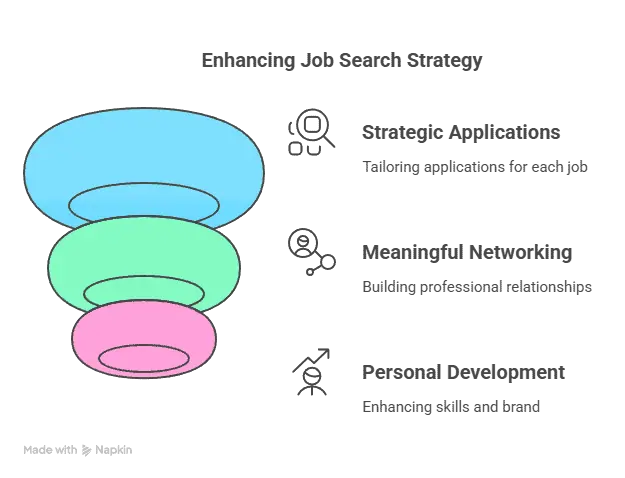
One-Third: Strategic Applications
The keyword here is “strategic” when approaching job listings in today’s competitive market. Your application process should be deliberate and targeted, focusing on tailoring resumes for each position, researching companies thoroughly, and meticulously following application instructions.
Track your submissions systematically and set realistic daily application goals that emphasize quality over quantity. Remember that five well-researched, customized applications and cover letters typically yield better results than 25 generic submissions that fail to address the specific needs of each prospective employer.
One-Third: Meaningful Networking
Effective networking isn’t just about collecting connections—it’s about cultivating meaningful relationships that can open doors throughout your career. Dedicate time to conducting informational interviews with industry professionals, attending relevant events and conferences, and engaging actively on professional platforms like LinkedIn.
Reconnect with former colleagues and classmates while joining professional associations where you can contribute valuable insights to ongoing discussions. The most successful networking is reciprocal—look for opportunities to provide value to your connections rather than simply extracting help, which builds genuine relationships that lead to introductions, referrals, and insider information about unadvertised opportunities.
One-Third: Personal Development
Personal growth during a career transition period is perhaps the most overlooked aspect of an effective job search strategy. Invest time in enhancing your skills through targeted courses, certifications, or workshops while refining your brand, including optimization of your online presence across platforms.
Maintain emotional and physical health through deliberate wellness practices, and consider volunteer work or freelance projects to fill employment gaps while demonstrating your capabilities to potential employers. This focused approach to personal development ensures you’re not just searching for a job but emerging from the transition as a stronger, more marketable professional with expanded capabilities and renewed confidence.
Implementing the One-Third Approach in Your Daily Routine
Practical application is where many job search strategies falter. Here’s how to make the one-third approach work in your daily life:
- Create a weekly schedule: Allocate specific time blocks for each of the three components
- Set measurable goals for each third (e.g., five quality applications, three networking conversations, one skill-building session per week)
- Track your efforts and outcomes to identify what’s working
- Maintain balance even when one area seems more immediately productive
- Adjust proportions based on industry norms and personal circumstances
For example, a tech professional might find that coding boot camps (personal development) and GitHub contributions (networking) yield better results than traditional applications. The beauty of the one-third approach is its flexibility while maintaining overall balance.
Common Challenges and How to Overcome Them
Even with a structured approach, job seekers face obstacles when trying to land a job:
Challenge: Networking feels inauthentic or uncomfortable.
Solution: Start with existing connections and focus on genuine curiosity about others’ experiences rather than immediate job leads.
Challenge: Finding time for personal development during financial stress.
Solution: Utilize free or low-cost resources like library services, MOOCs, or community workshops.
Challenge: Maintaining motivation when applications go unanswered.
Solution: Build a support system of fellow job seekers, career coaches, or mentors who understand the process.
Challenge: Balancing urgency with strategy.
Solution: Create short-term financial plans that allow for strategic job searching rather than panic-driven applications.
Customizing the One-Third Approach for Your Situation

While the equal division is a starting point, you may need to adjust based on:
- Career stage: Early career professionals might benefit from more networking, while senior executives may need more targeted applications
- Industry norms: Creative fields often rely heavily on portfolio development (personal third) and connections (networking third)
- Job market conditions: In high-demand fields, applications might yield faster results
Maintain awareness of all three dimensions rather than falling into the common trap of over-relying on just one approach.
FAQs
How long should I expect results using the one-third approach?
I’m in urgent need of income. Should I still divide my time equally?
How do I measure success in the networking and personal development fields?
Can the one-third approach work in highly specialized fields?
How should I optimize my LinkedIn profile as part of the one-third approach?
Conclusion
The one-third approach to job searching isn’t just about finding your next position—it’s about transforming a challenging transition into an opportunity for holistic growth. By balancing applications, networking, and personal development, you’re setting yourself up not just for employment but for career advancement.
At Layoff Lifeline, we’re here to guide you through each third of this journey. Ready to transform your job search? Reach out today for a free consultation on implementing this balanced strategy tailored to your unique career path.
Keep Reading
More practical guidance for the financial, career and emotional side of a layoff.


