
Financial Guidance
How To Plan Around Kids’ Private School Tuition After Layoff

A layoff reshapes your financial life overnight, and if your kids are in private school, the pressure hits even harder. You’re not just managing a gap in income — you’re staring down a tuition bill that doesn’t pause while you job hunt. This guide walks you through how to honestly evaluate your private school tuition obligations, make the most of financial aid options, and weigh your alternatives without making a decision you’ll regret.
Key Takeaways
- A single private school enrollment can cost anywhere from $12,000 to over $30,000 per year, meaning a layoff doesn’t just cut your income — it puts a massive fixed expense directly in your path.
- You can appeal for financial aid after a layoff — most schools treat documented job loss as a qualifying hardship, but you need to act fast and come prepared with paperwork.
- Public school is not a failure fallback — for many families navigating severance, it’s a strategic, temporary reset that buys time and breathing room without derailing your child’s future.
The $60K Problem: When Private School Commitments Meet a Shorter Runway

Let’s be direct: private school tuition after a layoff is one of the most emotionally charged financial decisions a family can face. You enrolled your child because you believed in that learning environment — the smaller class sizes, the individualized attention, maybe even the specialized support for IEPs. Walking that back feels like you’re taking something away from your kid.
But here’s the reality check. The average private day school in the United States costs around $30,692 per student per year. If you have two children enrolled, you’re looking at roughly $60,000 annually — and that’s before activity fees, uniforms, or assessments. On severance pay, that number hits very differently than it did on a full salary.
The real danger isn’t the tuition itself — it’s the assumption that you can keep paying it because you always have. Severance runs out. Unemployment benefits are capped. And unlike a mortgage where missing a payment triggers a grace period, many independent schools require tuition commitments upfront or in structured monthly payments with penalties for early withdrawal. The school year doesn’t care about your job search timeline.
This is the “$60K annual decision you can’t undo” — because once you’ve committed to a school year and signed those enrollment agreements, you’re often on the hook financially whether your child attends or not.
Read Your Enrollment Agreement Before You Do Anything Else
Before you make any calls or decisions, pull out your enrollment contract and actually read it. Most families sign these during a season of optimism and never revisit them. But buried in that document are the answers to questions you suddenly need right now:
- What is the withdrawal policy? Some schools require 30, 60, or even 90 days’ written notice to avoid paying full tuition for the remainder of the school year.
- Is there a refund policy? Partial refunds may be available if you withdraw early enough in the term, but many schools have cutoff dates after which no refund is issued.
- Did you purchase tuition insurance? More than 1,000 private schools across North America offer tuition refund plans that can cover a portion of remaining tuition if a student withdraws due to financial hardship or job loss. Some plans pay out 60–100% of unused tuition depending on the reason for withdrawal.
Tuition insurance is one of those products most families overlook until they need it. If your school offered it and you opted in, this is the moment to file a claim. If your child has not yet been enrolled for the upcoming year, check whether coverage can still be added before the school year begins.
How to Appeal for Financial Aid After a Layoff
Here’s something not enough families know: a layoff is one of the strongest grounds for a financial aid appeal at a private school. Schools expect household income to be relatively stable when they make initial aid decisions — a sudden, documented job loss is exactly the kind of “unexpected financial hardship” that triggers a reconsideration.
Most school administrations have a formal appeal process, and the head of school or financial aid director is usually the right person to contact. Here’s how to approach it:
1. Act immediately. Don’t wait until you’ve burned through your severance to have this conversation. The sooner you reach out, the more options the school can offer — including retroactive aid adjustments, temporary payment deferrals, or tuition assistance grants.
2. Document everything. Schools will want to see your termination letter, most recent pay stubs, your severance agreement, and any unemployment benefit statements. Treat this like a financial aid application, because that’s exactly what it is.
3. Write a clear, honest appeal letter. Thank the school for the current year’s support, clearly explain the change in your household income, and specifically request reconsideration of your tuition obligation. Include documentation. Express your child’s commitment to the school and your intention to re-enroll under better financial circumstances if tuition assistance makes it feasible.
4. Ask specifically what the school can provide. Some schools have emergency hardship funds. Others will restructure payment plans to reduce monthly payments. A few may offer a partial scholarship bridge for mid-year financial changes. You won’t know unless you ask — and most families are surprised by how much a school is willing to work with families who communicate proactively.
One thing to keep in mind: the school’s ability to help depends heavily on their own endowment and available financial aid program budget. Smaller independent schools may have limited flexibility, while larger institutions may have more resources to allocate. Eligibility for aid is almost always tied to demonstrated financial need, so be transparent about your full financial picture — including severance pay, savings, a 529 plan balance, your spouse’s income, and any investment assets.
Evaluating Whether You Can Still Afford Private School on Severance
Even if the school is willing to help, you need to do your own math honestly. Here’s a straightforward way to frame it:
Monthly severance or unemployment income minus your essential fixed expenses — mortgage, utilities, groceries, insurance — gives you your real discretionary runway. If tuition payments would consume more than you have left after essentials, you cannot comfortably afford private school right now, regardless of how much you want to.
A few questions worth sitting with:
- How long is your job search likely to take? Most professionals find new positions within three to six months, but that varies significantly by industry and role level.
- What does your savings buffer look like? Paying full tuition out of savings is a viable short-term strategy only if it doesn’t eliminate your emergency fund entirely.
- Can a 529 plan help? If you’ve been contributing to a qualified tuition savings account, K-12 private school tuition is a qualified expense under federal tax law — meaning you can withdraw up to $10,000 per student per year tax-free to help cover school costs. This won’t solve a $30,000 annual bill, but it can offset a meaningful portion of it.
- Is your spouse or partner still employed? If your household income has dropped but not disappeared, a restructured budget — perhaps cutting discretionary spending while maintaining monthly payments — may be sustainable for a defined period.
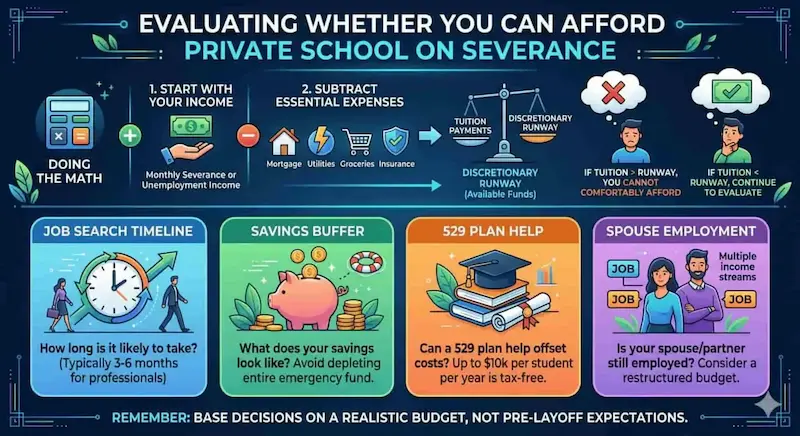
The goal here isn’t to guilt you into keeping your child in private school or pressuring you to pull them out. It’s to get you working from a budget rooted in your actual numbers, not your pre-layoff expectations.
Public School as a Strategic Reset, Not a Step Down
Let’s reframe something: considering public school during a period of financial transition is not a failure. For many families, it’s one of the smartest moves they make.
Public schools vary widely in quality, and depending on your school district, your child may have access to strong academic programs, extracurriculars, and even specialized services for learning differences or IEPs that a private school cannot match. If you’re in a better school district, the decision to temporarily attend school locally may cost your family virtually nothing and preserve thousands of dollars of savings per year.
There are real adjustments, of course. The class sizes are typically larger, and the learning environment is different. Transitions mid-year can be socially challenging for children, particularly at the private high school level. But children are more resilient than we give them credit for, and a stable household with a financially secure parent is a far better foundation than a stretched household clinging to a school cost that threatens everything else.
If you do decide to withdraw, follow your enrollment contract’s timeline carefully to maximize any potential refund or minimize remaining tuition liability. Ask the school administration about the proper withdrawal process and whether they have any documentation requirements for mid-year departures.
Other Ways to Pay When the Usual Options Run Out

If financial aid, tuition insurance, and savings don’t fully close the gap, there are a few other levers worth exploring:
- Merit-based and need-based scholarships: Various national and local organizations offer K-12 scholarship support based on academic performance and financial need. Your state department of education may also list scholarship programs tied to your school district.
- Sibling discounts and flexible payment plans: Ask the school directly — many will quietly offer monthly payment restructuring or sibling discounts that aren’t formally advertised.
- Employer tuition assistance in your next role: Some employers, particularly in finance, law, and technology, offer dependent education benefits or tuition assistance. It’s worth factoring this into your next job search criteria.
- State voucher programs and education savings accounts: Depending on your state, there may be publicly funded programs that help families pay for private school education for K-12 students, particularly those with disabilities or specific learning needs.
FAQs
Can I appeal for financial aid at my child’s private school after losing my job?
Yes. Most private schools treat documented job loss as a qualifying financial hardship and will consider a mid-year financial aid appeal. Contact the school’s financial aid office or head of school as soon as possible, provide your termination letter, severance details, and any unemployment documentation, and submit a formal written appeal requesting reconsideration of your tuition obligation.
Does tuition insurance cover layoffs or job loss?
It depends on your policy. Some tuition insurance plans do cover withdrawal due to job loss, particularly if the tuition payer was terminated through no fault of their own. Check your plan’s declaration of coverage for specific language around employment termination and review your school’s own refund policy alongside it.
Can I use a 529 plan to pay for private K-12 tuition?
Yes. Under current federal tax law, 529 plan funds can be used to pay for qualified tuition expenses at K-12 private schools, up to $10,000 per student per year, tax-free. This can meaningfully offset the cost of tuition during a transitional period without triggering penalties on the withdrawal.
What happens if I withdraw my child mid-year — do I still owe tuition?
It depends entirely on your enrollment contract and the timing of your withdrawal. Most schools have defined cutoff dates after which remaining tuition for the school year is still owed. Review your agreement carefully, give written notice as early as possible, and ask school administration about any partial refund eligibility based on your withdrawal date.
Should I pull my child from private school during a layoff or try to keep them enrolled?
There’s no universal answer, but the honest framework is this: if staying enrolled requires draining your emergency fund, missing essential household expenses, or taking on debt — it’s time to have the hard conversation. Public school in a decent school district is a viable, often excellent option. If the school can provide meaningful financial aid or if your severance covers a well-defined runway, staying enrolled may make sense for stability. Your child’s long-term wellbeing depends far more on a financially secure household than on which school they attend this year.
Conclusion
Managing private school tuition after a layoff is genuinely hard — not because the decision itself is complicated, but because it sits right at the intersection of your finances and your instincts as a parent. The best thing you can do right now is get clear on your real numbers, communicate with the school early, and resist the pressure to figure it all out alone.
At Layoff Lifeline, we help families navigate exactly this kind of inflection point — where the financial and the emotional are completely tangled up. If you’re not sure where to start, let’s talk it through. Book your free 15-minute strategy session to discuss your specific situation.
Keep Reading
More practical guidance for the financial, career and emotional side of a layoff.


