
Uncategorized
Salary Negotiation Scripts: Turn Low Offers into Great Deals

Negotiating your salary can be a daunting task, often filled with anxiety and uncertainty. But it’s a crucial step in securing the compensation you deserve and maximizing your earning potential. This article provides you with proven salary negotiation scripts and effective strategies to confidently navigate this critical process and achieve a successful outcome.
Key Takeaways
- Prepare thoroughly with market research, a walk-away point, and practiced delivery.
- Use tailored scripts that emphasize enthusiasm, value, and data-backed requests.
- Negotiate beyond salary—consider benefits and be confident enough to decline inadequate offers.
Why Salary Negotiation Matters
Many people hesitate to negotiate their salary, fearing they might appear greedy or jeopardize the job offer. However, employers often expect negotiation and build some wiggle room into their initial offer. By not negotiating, you’re essentially leaving money on the table.
Negotiating your salary is not just about increasing your immediate income. It also impacts your future earnings, as raises and promotions are often calculated as a percentage of your current salary. A successful negotiation early on can set you up for greater financial success throughout your career.
Before You Begin: Essential Preparation
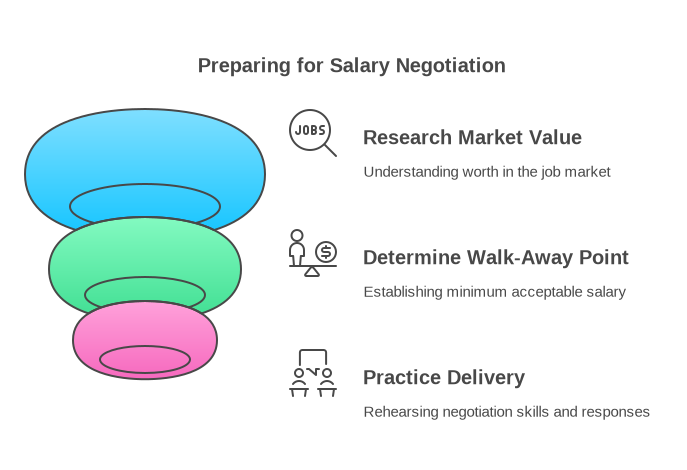
Effective salary negotiation requires thorough preparation. Here are key steps to take before entering any negotiation:
Research Your Market Value
Understanding your worth in the current job market is crucial. Begin by researching salary data for comparable positions in your industry, location, and experience level. Utilize resources like Glassdoor, Salary.com, LinkedIn Salary, and Payscale to gather comprehensive data. Pay attention to salary ranges rather than just averages, and consider factors like company size, geographical location, and required skills that might affect compensation. Reach out to industry contacts or professional associations for additional insight into current market trends. Document this research to reference during your negotiation.
Know Your “Walk-Away Point”
Determine the minimum salary you’re willing to accept before entering any negotiation. Calculate your essential living expenses, financial goals, and the value of your skills to establish this baseline. Consider both financial and non-financial factors such as growth opportunities, work-life balance, and benefits package. Having a clear bottom line prevents you from accepting an offer in the heat of the moment that doesn’t align with your needs and worth. Remember that this figure should remain private—it’s your internal guideline, not a negotiation point.
Practice Your Delivery
Rehearse your negotiation script until you can deliver it confidently and naturally. Practice with a trusted friend, mentor, or career coach who can provide objective feedback. Record yourself to assess your tone, body language, and verbal pacing. Prepare for various scenarios, including pushback, and develop responses to potential objections. Practice maintaining a positive, collaborative tone even when discussing challenging points. Focus on clear articulation of your value proposition and how your skills translate to organizational benefits. Regular practice reduces anxiety and builds the muscle memory needed for confident negotiation.
Analyze the Complete Compensation Package
Look beyond base salary to evaluate the entire compensation package. Consider bonuses, stock options, retirement benefits, health insurance, paid time off, flexible work arrangements, professional development opportunities, and other perks. Understand which components are negotiable and which aren’t. Calculate the financial value of non-salary benefits to make accurate comparisons between offers. Prioritize which elements matter most to you personally, as this varies based on individual circumstances and life stage.
Research the Company’s Financial Position
Understanding a company’s financial health provides context for your negotiation. Research recent funding rounds, quarterly earnings, new client acquisitions, or expansion plans for private companies. For public companies, review annual reports and recent news. This information helps you gauge what’s reasonable to request and tailor your approach accordingly. Companies in growth phases or with recent successes may have more flexibility than those facing financial challenges.

Salary Negotiation Scripts for Different Scenarios
Here are some sample scripts for common salary negotiation scenarios:
1. Responding to an Initial Offer
Script:
“Thank you so much for this offer! I’m very excited about the opportunity to join your team and contribute to it. I’ve reviewed the offer, and while I’m thrilled about the role, I was hoping we could discuss the salary. Based on my research and experience, I believe a salary in the range of would be more aligned with my qualifications and the market value for this position.”
Key Takeaways:
- Express enthusiasm for the role and the company.
- Clearly state your desired salary range.
- Support your request with data and your qualifications.
2. Negotiating After Receiving a Higher Offer from Another Company
Script:
“Thank you for this offer! I’m very impressed with the team. However, I’ve also received another offer with a higher salary. While is my preferred choice, I would need to consider the compensation difference. Would you be able to match or come closer to this figure?”
Key Takeaways:
- Be honest about the competing offer.
- Reiterate your preference for the current company.
- Be prepared to discuss why you prefer this company despite the salary difference.
3. Negotiating a Raise in Your Current Role
Script:
“Thank you for taking the time to meet with me. I’ve been with the company for and have consistently exceeded expectations in my role. I’ve taken on additional responsibilities and contributed significantly to them. Based on my performance and industry benchmarks, I believe a salary increase is warranted.”
Key Takeaways:
- Highlight your achievements and contributions.
- Provide data to support your request.
- Express your commitment to the company.
Tips and Tricks for Successful Negotiation
- Focus on Value: Emphasize the value you bring to the company, highlighting your skills, experience, and accomplishments.
- Be Confident: Believe in your worth and articulate your points clearly and assertively.
- Be Prepared to Walk Away: Knowing your “walk-away point” gives you leverage and the confidence to decline an offer that doesn’t meet your needs.
- Consider Non-Monetary Benefits: Negotiate for benefits like vacation time, flexible work arrangements, or professional development opportunities.
- Be Gracious and Professional: Maintain a positive and respectful tone throughout the negotiation.
Real-Life Examples of Successful Salary Negotiations
- Jackie, an attorney: Successfully negotiated an 18K increase from the initial offer by confidently asking for 20K more and backing it up with her qualifications.
- Mitch, a product team member: Secured a 12% raise by presenting data and a list of accomplishments to justify his request.
- Patty, a retail professional: Negotiated an 8% salary increase and two extra weeks of paid vacation by highlighting her value and being persistent.
How to Pivot When Base Salary is “Locked”
When a recruiter says the base salary is fixed, this is rarely the end of the negotiation. Acknowledge their constraint professionally, then immediately pivot to other compensation components like signing bonuses, performance bonuses, stock options, additional vacation days, professional development budgets, or remote work flexibility. Use this script: “I understand the base salary is set at [$X]. Would there be flexibility to discuss a signing bonus or additional benefits to help bridge the gap?” This demonstrates you’re a collaborative problem-solver while still advocating for your worth.
Common Salary Negotiation Mistakes to Avoid
Many professionals sabotage their negotiations by revealing their salary expectations too early in the hiring process, accepting the first “no” as final, or framing their request as a personal need rather than a business case. Other costly mistakes include failing to research market rates, negotiating over email when a phone call would be more effective, and forgetting to negotiate beyond base salary when the employer claims the number is “locked in”. Avoid making ultimatums or comparing yourself to colleagues, as these tactics damage rapport and rarely produce positive results.
FAQs
What should I do if the written offer is lower than my salary expectations?
How can I effectively negotiate my salary during a job offer?
What are some salary negotiation tips for asking for a raise?
How do I handle a situation where the hiring manager says the offer is too low?
Conclusion
Layoff Lifeline stands as more than just a career resource—we’re a comprehensive support system designed to transform the layoff experience from crisis to opportunity. Our research-backed approach addresses the documented mental health impacts of job loss while providing practical tools for financial stability and career advancement.
By combining immediate crisis support with long-term development resources, we create a continuous pathway to professional resilience. Our freemium model ensures accessibility for all while sustaining our mission of comprehensive support. Through our website, community forums, and personalized coaching, we’re building a safety net that catches people at their most vulnerable moments and empowers them to emerge stronger.
As we continue to expand our services into proactive career development, partnerships with universities, and industry-specific guidance, Layoff Lifeline remains committed to our founding vision: no one should navigate job loss alone. Join us in revolutionizing how professionals experience career transitions—where every ending becomes a meaningful new beginning. Contact us today!
Keep Reading
More practical guidance for the financial, career and emotional side of a layoff.


