
Job Assistance
Beat Age Bias in Your Senior Tech Professional Job Search

If you’ve been told you’re “overqualified” or felt invisible in your senior tech professional job search, you’re not alone. The data confirms what many of us experience: the share of tech workers over 40 dropped from 56% to 52% between 2014 and 2022. But here’s what I’ve learned through this challenging landscape—your experience isn’t the problem. It’s how you’re positioning it. Let me show you how to turn age bias into your competitive advantage.
Key Takeaways
- Reframe your extensive experience as a strategic advantage by emphasizing hands-on technical skills over leadership titles, targeting roles where execution matters more than hierarchy
- Combat age bias proactively by demonstrating technological fluency, modernizing your resume with current frameworks, and directly addressing the “overqualified” concern before it becomes an objection
- Target companies and decision-makers strategically by connecting with engineering managers and CTOs directly, researching organizations with proven track records of hiring experienced professionals
Understanding the Reality of Ageism in Tech at 45

For those of us over 45, this creates a unique challenge. Recruiters and hiring managers often view experienced candidates through a lens of concern rather than opportunity. They worry about salary expectations, cultural fit, or whether we’ll stay engaged. The irony? These same companies desperately need the problem-solving abilities, stakeholder management skills, and technical depth that only years of experience can provide.
The tech industry’s youth obsession has real consequences. Between 2014 and 2022, the number of tech employees under 25 grew approximately 9% annually, while those over 65 grew only 4%. But recent shifts suggest the landscape is evolving—the average workforce age at large public tech firms rose from 34.3 to 39.4 years between 2023 and 2025.
| Age Group | Tech Workforce % | All Industries % | Annual Growth Rate |
|---|---|---|---|
| Under 25 | Growing sector | Lower representation | ~9% (2014-2022) |
| 25-39 | 41% | 33% | Steady growth |
| Over 40 | 52% (down from 56%) | Higher representation | Declining |
| Over 65 | Smallest segment | Similar | ~4% (2014-2022) |
The age distribution gap in tech compared to other industries reveals systematic bias against experienced professionals.
Why “Overqualified” Is a Positioning Problem, Not a Reality
When a hiring manager labels you “overqualified,” they’re really expressing three fears: you’ll demand too much salary, you’ll leave when something better comes along, or you’ll be bored and disengaged. None of these concerns reflect your actual capabilities or intentions—they reflect how you’ve presented yourself.
I’ve seen countless senior technical professionals make the same mistake: leading with their most impressive titles and broadest scope of responsibility. A resume highlighting “VP of Engineering overseeing 50+ developers across 5 product lines” immediately triggers the overqualified alarm for a senior software engineer position. But that same candidate likely spent years writing code, architecting systems, and solving complex technical problems—the exact skills the role requires.
The solution isn’t to hide your experience or dumb down your resume. Research shows candidates who proactively address potential objections increase their hiring chances by up to 30%. Instead, you need to reposition your narrative. Add a Career Intent statement to your resume that directly addresses motivation: “Seeking a hands-on developer role where I can directly contribute to product development and collaborate with a growing engineering team.”
This simple addition removes doubt and reframes the conversation. You’re not someone settling for less—you’re someone deliberately choosing technical depth over management overhead.
Resume Tactics That Work for Senior Technical Professionals
Your resume needs two versions: a leadership resume and a technical resume. For most individual contributor roles, the technical version is your strongest play. If the job title doesn’t explicitly say “Director,” “VP,” or “Chief,” send the technical resume. It’s easier to discuss leadership accomplishments in an interview than to prove technical skills on the fly.
Emphasize Execution Over Strategy
Restructure your experience to highlight hands-on impact. Instead of “Led cross-functional teams to deliver enterprise software solutions,” try “Developed microservices architecture using Python and Kubernetes, reducing deployment time by 40% and improving scalability for 2M+ users.” This approach demonstrates technical skills, shows measurable results, and uses programming languages that ATS systems scan for.
Every bullet point should follow the X-Y-Z formula: Accomplished X by doing Y, resulting in Z. Focus on the technologies you used, the problems you solved, and the quantifiable outcomes. For a senior technical program manager position, emphasize project management methodology, stakeholder coordination, and budget oversight tied to specific deliverables.
Optimize for ATS Without Keyword Stuffing
Create a dedicated technical skills section near the top of your resume listing programming languages, frameworks, automation tools, and relevant certifications. Be specific about your proficiency. For a devops engineer role, include CI/CD pipelines, infrastructure management tools, cloud platforms, and scripting languages. For information security positions, list risk assessment methodologies, compliance frameworks, and security automation tools.
Match the language of the job details section in the posting. If they’re seeking someone with experience in “continuous improvement initiatives,” use that exact phrase when describing your process optimization work. If the role emphasizes “collaborative work with cross-functional teams,” provide an example demonstrating how you partnered with product managers, developers, and stakeholders to deliver results.
Tailor Your Experience to the Target Role
For each application, align your resume with the specific scope of the position. An automation engineer role focused on testing? Lead with your test framework development and quality assurance automation, even if you later moved into broader infrastructure management. A data analyst position emphasizing analytics and user experience? Highlight your work translating complex datasets into actionable insights that improved product decisions.
Remove or minimize experiences that make you appear overqualified for the specific role. If you’re targeting a senior director position, keep the leadership scope. If you’re pursuing an individual contributor software engineer position, scale back the management emphasis and amplify the coding, architecture, and technical problem-solving.
Interview Framework: Addressing Age Concerns Head-On
Don’t wait for the interviewer to bring up your experience level. Address it proactively in your opening or when discussing why you’re interested in the role. Prepare specific responses to common concerns:
“Why are you interested in this position given your background?” “I’ve spent the last few years in leadership roles, but I found what I really miss is the hands-on technical work—architecting solutions, writing code, and solving complex engineering challenges. This role offers exactly that opportunity, and I’m excited to contribute my deep technical skills to a team focused on innovation.”
“Won’t you be bored without direct reports?” “Actually, managing people took time away from what I love most about technology. I’ve deliberately chosen to return to individual contributor work where I can focus on technical excellence, mentorship through collaboration, and staying current with emerging technologies. That’s where I deliver the most value.”
“How do you stay current with new technologies?” Don’t wait to be asked—proactively mention recent certifications, courses, open-source contributions, or technologies you’re learning. Reference specific frameworks, programming languages, or platforms relevant to the role. For AI-related positions, discuss your experience with machine learning libraries or large language model applications. For information technology jobs, highlight your familiarity with modern cloud infrastructure or automation practices.
Keep your responses concise and focused. Resist the urge to tell your entire career story—the hiring process favors candidates who provide relevant information efficiently. Demonstrate adaptability by discussing how you’ve evolved your technical skills throughout your career, not just what you knew a decade ago.
Pre-Interview Preparation Checklist:
- Research the company’s tech stack and mention specific technologies in your responses
- Prepare 2-3 recent examples of technical work or learning (courses, certifications, projects)
- Draft a 30-second answer to “Why this role?” that emphasizes hands-on work over titles
- List 3-5 thoughtful questions about their development practices, not just benefits
- Review the job description and match your stories to their specific requirements
- Prepare examples showing adaptability and learning new technologies quickly
- Have a GitHub, portfolio, or project link ready to share if relevant
Strategic Job Search Tactics for Senior ICs
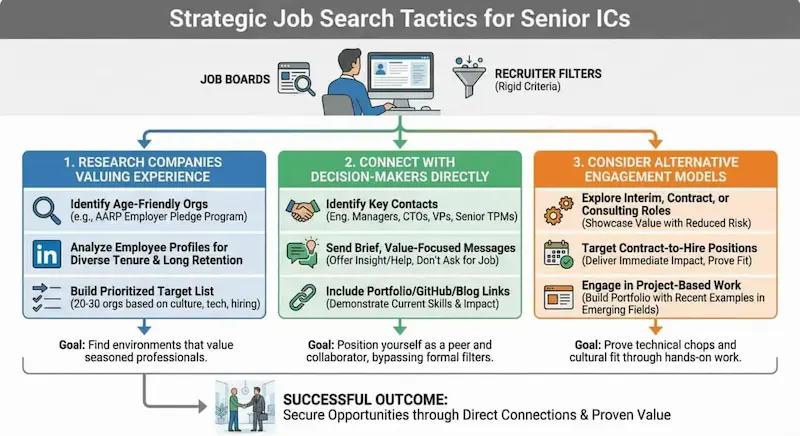
Job boards lead to recruiters who filter candidates based on rigid criteria. As a senior professional competing against candidates 15 years younger, you need a different approach. Target decision-makers directly—engineering managers, CTOs, VPs of technology, or senior technical program managers overseeing the team you want to join.
Research Companies That Value Experience
Not all tech companies maintain the same age bias. Use resources like AARP’s Employer Pledge Program to identify organizations committed to hiring experienced professionals. Research LinkedIn profiles of current employees at target companies. If the workforce consists primarily of recent graduates, they’re unlikely to value your experience. Look for diverse tenure ranges and employees with 10+ years at the organization—signs they retain and promote experienced tech talent.
Explore the “Pages people also viewed” feature on LinkedIn to find similar companies. Build a target list of 20-30 organizations, then prioritize based on culture fit, technology stack, and hiring patterns.
Connect With Decision-Makers Directly
Rather than applying through job portals, identify the hiring manager or team lead for roles you’re targeting. Send a brief, value-focused message—don’t ask for a job, offer insight or help. “I saw you’re expanding the automation team. I’ve spent the last eight years building testing frameworks that reduced release cycles by 50%+. I’d be happy to share some lessons learned if it would be helpful.”
Include a link to your portfolio, GitHub profile, or technical blog demonstrating your current skills. This approach positions you as a peer and collaborator rather than a supplicant. Many senior roles get filled through these relationships rather than formal recruitment.
Consider Alternative Engagement Models
If full-time positions aren’t materializing, consider interim roles, contract work, or consulting engagements that showcase your value. These arrangements reduce employer risk (they can try before committing) while giving you opportunities to prove your technical chops and cultural fit. Many contract-to-hire positions favor experienced professionals who can deliver immediate impact without extensive onboarding.
Project-based work also builds your portfolio with recent, relevant examples. For emerging fields like AI, cybersecurity, or data analytics, demonstrating current hands-on experience matters more than your title history.
Negotiating From a Position of Strength
When you reach the offer stage, prepare for creative negotiation approaches that address employer concerns while meeting your needs. Consider performance-based salary increases after proving yourself, flexible scheduling or remote work options, professional development budgets for certification programs, or opportunities to provide mentorship to junior team members.
Focus on mutual gains rather than positional bargaining. Frame your experience as reducing their risk: “Given my background in software development and application development, I’ll have a shorter ramp-up time and can contribute to best practices from day one. That’s why I’m confident in proposing a 60-day performance review tied to specific technical deliverables, with a salary adjustment if we both agree I’m exceeding expectations.”
For senior technical positions involving people leader responsibilities, emphasize how your experience enables you to grow your career while helping the technology team scale effectively. You’re not just filling a role—you’re solving their business continuity and disaster recovery challenges with someone who’s seen those problems before.
Long-Term Positioning: Building Your Brand as a Strategic Hire

Your job search doesn’t end when you land a role—it’s an ongoing process of positioning yourself as someone who delivers disproportionate value. Update your LinkedIn profile with a clear headline reflecting your technical identity, not just your last title. Share insights about emerging technologies, best practices in your domain, or lessons learned from complex projects. This establishes you as a thought leader rather than just an experienced hire.
Contribute to open-source projects relevant to your target roles. This demonstrates commitment to the tech community, proves your technical skills are current, and provides concrete examples you can discuss with recruiters. For fields like automation, AI, or software development, a well-maintained GitHub profile showcases your capabilities better than any resume.
Invest in continuous learning through platforms like Coursera, LinkedIn Learning, or edX. Pursue certifications in high-demand areas—cloud platforms, cybersecurity frameworks, data analytics tools, or AI/ML applications. These credentials signal you’re committed to staying current and competitive.
Most importantly, recognize that the tech recruiter evaluating your application or the hiring manager conducting your interview may be younger than you. That’s not a disadvantage—it’s an opportunity to demonstrate how your experience complements their energy and fresh perspective. You bring pattern recognition, troubleshooting expertise, and the wisdom to avoid costly mistakes. That’s not “overqualified”—that’s exactly what a strategic hire looks like.
FAQs
How should I address employment gaps on my resume as a senior tech professional?
Be honest and frame gaps positively. If you took time for skill development, freelance work, or personal projects, include a brief line describing the activity. For recent layoffs, acknowledge the gap directly in your cover note: “Following a company restructure, I’ve been focusing on expanding my expertise in cloud automation and modern DevOps practices.” Employers understand the tech industry’s volatility—confidence matters more than seamless timelines.
Should I remove older experience from my resume to appear younger?
No—don’t remove strong experience, reposition it. Keep your most relevant 10-15 years in detail, then summarize earlier roles in a “Prior Experience” section with company names, titles, and brief descriptions. This maintains credibility while focusing attention on recent, relevant accomplishments. Remove graduation dates from education sections to eliminate obvious age markers.
How do I demonstrate technical skills if I’ve been in management for several years?
Highlight technical decisions you made, architecture you designed, or code reviews you conducted even in leadership roles. If there’s a genuine skills gap, take action now: complete a relevant certification, contribute to an open-source project, or build a portfolio piece demonstrating current capabilities. Then lead with that recent work in your technical resume.
What’s the best way to connect with younger hiring managers without seeming out of touch?
Focus on shared technical interests rather than highlighting generational differences. Use current terminology, avoid phrases like “back in my day,” and demonstrate familiarity with modern tools and methodologies. Ask thoughtful questions about their technology stack, development practices, and team culture. Show genuine curiosity about their perspective rather than positioning yourself as someone who “knows better.”
Should I accept a lower title or salary to get back into the workforce?
It depends on your financial situation and career goals. If accepting a title step-down gives you access to emerging technologies, better work-life balance, or a company with strong growth potential, it may be a strategic move. Negotiate creatively—performance-based increases, equity, flexible arrangements, or expanded scope after proving yourself. Make sure you’re genuinely interested in the work itself, not just accepting any offer to end the search.
Conclusion
Your senior tech professional job search isn’t about competing with younger candidates on their terms—it’s about reframing the conversation around the unique value only experience provides. The data on ageism in tech is real, but so are the opportunities for professionals who position themselves strategically. Focus on hands-on technical skills, modernize your approach to match current hiring practices, and target organizations that recognize experience as an asset.
If you’re navigating a job transition after unexpected layoff, you don’t have to figure this out alone. Book your free 15-minute strategy session to discuss your specific situation with Layoff Lifeline. We’ll help you create a personalized roadmap that turns this career challenge into your next opportunity—because your experience isn’t a liability, it’s exactly what the right employer needs.
Keep Reading
More practical guidance for the financial, career and emotional side of a layoff.


