
Financial Guidance
Solo Financial Planning After Layoff at 55 for Singles

Getting laid off at 55 when you’re single hits differently. There’s no second income to fall back on, no partner to share the health insurance burden, and every financial decision carries more weight. Let me walk you through what actually matters right now and how to build a solid financial plan that accounts for your solo reality.
Key Takeaways
- Singles at 55 face unique financial challenges after layoff without a partner’s income safety net, requiring strategic emergency fund management and healthcare navigation during the Medicare gap years
- The Rule of 55 allows penalty-free 401k withdrawals from your current employer, but understanding tax consequences and long-term impacts is critical before accessing retirement accounts
- Social Security timing, housing decisions, and estate planning take on heightened importance for solo households building financial resilience through this career transition
Table of Contents
- Building Financial Resilience After Layoff Without a Partner’s Income Safety Net
- Social Security Maximization Strategies for Single Filers
- Healthcare Navigation for Single Individuals in the Medicare Gap
- Housing Decisions for Singles: Roommates, Downsizing, and Co-Housing at 55+
- Emergency Fund Targets and Withdrawal Strategies for Solo Households
- Estate Planning Essentials for Singles Without Immediate Heirs
- Community and Co-Living Arrangements for Financial Efficiency
- FAQs
- Conclusion
Building Financial Resilience After Layoff Without a Partner’s Income Safety Net

Losing a job at 55 without a spouse’s income means every dollar in your emergency fund needs to work harder. The traditional advice about three to six months of expenses doesn’t cut it when you’re facing a potentially longer job search in your mid-fifties and dealing with age discrimination in the job market.
For solo households, financial advisors typically recommend eight to twelve months of living expenses in readily accessible accounts. Before panic sets in about that number, understand that your severance package counts toward this cushion. If you received three months of severance, you need five to nine additional months saved.
Emergency Fund Architecture for Singles
Structure your emergency reserves in tiers rather than keeping everything in a single savings account. Keep one month of expenses in checking for immediate needs. Park three to four months in a high-yield savings account you can access within 24 hours. The remaining balance can sit in short-term Treasury bills or a money market fund offering slightly better returns while maintaining liquidity.
This layered approach prevents you from touching retirement accounts prematurely while maximizing the modest returns available on cash. The psychological benefit matters too. Watching one massive emergency fund shrink feels demoralizing. Knowing you have multiple buckets provides mental breathing room during your job search.
Income Replacement Strategies
Unemployment benefits become your first line of defense immediately after being laid off. File within the first week even if severance payments might delay your first check. Understanding your state’s rules about severance and unemployment prevents costly mistakes.
Part-time work or consulting in your field can bridge income gaps without decimating savings. The challenge for singles is balancing any earned income against unemployment benefit limits. Each state sets different thresholds for how much you can earn before losing partial or full unemployment payments.
Clients facing layoff at 55 often overlook their stock option plan or company’s stock price performance as potential income sources. If you have vested stock options or restricted stock units, evaluate whether exercising them now makes sense given current tax brackets. An attorney or tax professional should review any decisions involving substantial stock option exercises to minimize tax consequences.
Social Security Maximization Strategies for Single Filers
Social Security timing matters exponentially more when you’re single. Married couples have spousal benefit strategies and survivor benefits that create flexibility. Singles get one shot at this decision, and the financial impact ripples through retirement.
The earliest you can claim Social Security is 62, but taking benefits before your full retirement age (67 for most people reading this) permanently reduces your monthly payment by roughly 30%. For someone whose full retirement age benefit would be $2,000 monthly, claiming at 62 drops that to approximately $1,400. That $600 monthly difference compounds over decades.
Understanding Delayed Filing Benefits
Waiting until 70 increases your benefit by 8% annually beyond full retirement age. That same $2,000 monthly benefit grows to roughly $2,480 if you delay until 70. For singles without spousal or survivor benefits to consider, this decision purely depends on life expectancy assumptions, current financial needs, and other income sources.
Financial advisers can help model break-even scenarios. Generally, if you expect to live past your early 80s and can fund living expenses through other means until 70, delaying maximizes lifetime benefits. The challenge after a layoff at 55 is bridging that 15-year gap to age 70 without depleting retirement accounts.
Bridge Strategies to Delay Social Security
Tapping taxable investment accounts first preserves tax-advantaged retirement accounts and allows Social Security to grow. If you have a brokerage account outside your 401k or IRA, strategic withdrawals from this bucket can fund living expenses while unemployment benefits run out and before finding full-time work.
The Rule of 55 creates another option. If your layoff occurs at age 55 or older, you can take penalty-free distributions from your current employer’s 401k plan. This doesn’t apply to IRAs or 401k plans from previous employers unless you roll them into your current 401k before separation. Understanding this timing is critical and working with a financial advisor before making any moves prevents costly mistakes.
Part-time work that covers basic expenses without triggering the Social Security earnings test becomes the sweet spot. In 2025, if you claim Social Security before full retirement age, you can earn up to a certain threshold without benefit reductions. Exceeding that amount reduces your benefit by $1 for every $2 earned above the limit.
Healthcare Navigation for Single Individuals in the Medicare Gap
The years between 55 and 65 represent the Medicare gap, and for singles after job loss, healthcare costs become the most immediate financial threat. COBRA extends your employer’s health insurance for 18 months, but you pay the full premium plus a 2% administrative fee. What felt like reasonable insurance suddenly costs $600 to $800 monthly for individual coverage.
COBRA vs. Marketplace Insurance
Run the numbers on COBRA versus Affordable Care Act marketplace plans immediately after being laid. COBRA makes sense if you have significant medical needs and your employer plan had excellent coverage with providers you can’t lose. You also get credit for any deductibles already met during the year of your layoff.
Marketplace plans might offer lower premiums, especially if your income drops significantly after job loss. Premium subsidies kick in based on income, and when unemployment represents your only income source, these subsidies can reduce monthly costs substantially. The trade-off often involves narrower provider networks and higher out-of-pocket maximums.
Health Savings Account Strategies
If you had a high-deductible health plan with a Health Savings Account (HSA), those funds remain yours regardless of employment status. HSAs offer triple tax advantages: contributions are tax-deductible, growth is tax-free, and withdrawals for qualified medical expenses are tax-free. For singles, this becomes a critical healthcare funding source during the Medicare gap.
Resist the urge to drain your HSA immediately. If you can cover current medical expenses through emergency funds or COBRA, let the HSA continue growing. After age 65, HSA withdrawals for non-medical expenses get taxed as ordinary income without penalties, essentially functioning as an additional IRA. This flexibility matters when building financial resilience without a partner’s income.
Medicare Planning Before 65
Understanding Medicare enrollment windows prevents costly lifetime penalties. Initial enrollment begins three months before your 65th birthday and extends three months after. Missing this window without creditable coverage triggers permanent premium increases on Medicare Part B and Part D.
If you find new employment with health insurance before 65, that coverage typically qualifies as creditable and allows delayed Medicare enrollment without penalties. Document everything. Medicare requires proof of continuous creditable coverage if you enroll late, and employer HR departments should provide this documentation when you leave.
Housing Decisions for Singles: Roommates, Downsizing, and Co-Housing at 55+
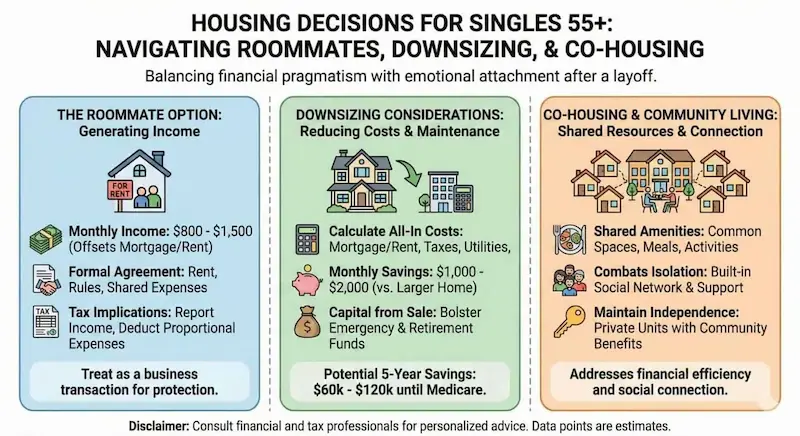
Housing typically represents the largest expense in solo households, and a layoff at 55 forces a realistic assessment of whether your current living situation remains sustainable. The emotional attachment to your home battles against financial pragmatism, and singles face this decision alone without a partner’s input or income contribution.
The Roommate Option
Taking on a roommate feels like moving backward, but it’s potentially the fastest way to reduce housing costs without relocating. Renting out a bedroom or basement can generate $800 to $1,500 monthly depending on location, directly offsetting mortgage or rent payments.
Screen potential roommates carefully through background checks and references. Draft a formal rental agreement covering rent amount, payment due dates, shared expense responsibilities, house rules, and notice periods. Treating this as a business transaction rather than simply letting someone crash at your place protects both parties.
Tax implications matter when renting rooms. Rental income must be reported, but you can deduct proportional expenses like utilities, insurance, and repairs. If you rent 20% of your home’s square footage, you can deduct 20% of these expenses against rental income. A tax professional should review your specific situation.
Downsizing Considerations
Moving to a smaller home or apartment reduces not just housing costs but also maintenance, utilities, insurance, and property taxes. Calculate your true all-in housing costs: mortgage or rent, property taxes, insurance, utilities, maintenance, and homeowners association fees. Compare this to realistic costs of alternative housing.
For many singles, the difference between a three-bedroom house and a two-bedroom apartment runs $1,000 to $2,000 monthly. Over five years until Medicare eligibility at 65, that’s $60,000 to $120,000 in savings. If you own your home, selling provides capital to bolster emergency funds and retirement accounts.
Co-Housing and Community Living
Co-housing represents a middle ground between traditional single-family living and institutional arrangements. These intentional communities feature private homes or units with shared common spaces, meal preparation, and activities. Residents maintain independence while sharing costs and reducing isolation.
For singles at 55+, co-housing addresses both financial efficiency and social connection. Monthly costs often run lower than market-rate housing due to shared resources, and the built-in community combats the isolation that can accompany both job loss and aging alone. Not every city offers co-housing options, but interest is growing.
Emergency Fund Targets and Withdrawal Strategies for Solo Households
Withdrawal strategy matters as much as total amount saved. Depleting reserves too quickly creates panic and bad decisions. Withdrawing too conservatively might mean missing mortgage payments. Singles need clear rules for tapping emergency funds because there’s no partner providing reality checks.
The Staged Withdrawal Approach
Month one through three post-layoff should rely primarily on severance and unemployment benefits. Minimize emergency fund withdrawals during this window while aggressively pursuing new employment opportunities. This preserves capital while you adapt to the new reality and assess how long your job search might take.
Months four through six, if employment hasn’t materialized, start strategic emergency fund withdrawals to supplement unemployment. Calculate your monthly shortfall between unemployment benefits and essential expenses. Essential means housing, utilities, food, insurance, and minimum debt payments. Withdraw only the shortfall amount monthly rather than large lump sums.
Beyond six months, reevaluate everything. Are you pursuing realistic opportunities or holding out for compensation matching your previous role? Should you consider contract work or part-time positions to extend runway? Financial planners help clients facing extended job searches make these difficult assessments objectively.
When to Tap Retirement Accounts
Retirement account withdrawals should be your last resort, but the Rule of 55 creates a penalty-free option for accessing 401k funds from your current employer if you’re 55 or older when you leave your job. This doesn’t eliminate income taxes on withdrawals, only the 10% early withdrawal penalty that normally applies before age 59½.
The catch is this only works for your current employer’s plan. If you roll your 401k into an IRA after layoff, you lose Rule of 55 eligibility and face penalties on any withdrawals before 59½. Before touching any retirement account, model the long-term impact. Withdrawing $30,000 from your 401k might solve immediate problems but reduces future retirement security significantly.
Investment Account Withdrawal Sequencing
If you have multiple account types—taxable investment accounts, traditional IRAs, Roth IRAs, and 401k plans—withdrawal order impacts your long-term financial health. The general hierarchy prioritizes taxable accounts first since you’ve already paid taxes on contributions and long-term capital gains rates often run lower than ordinary income tax rates.
Traditional IRAs and 401k withdrawals get taxed as ordinary income. If you’re in a low tax bracket after job loss, this might be an optimal time for strategic Roth conversions, paying taxes now to create tax-free income later. However, large conversions can spike your income and affect marketplace health insurance premium subsidies.
Roth IRA contributions can be withdrawn anytime without taxes or penalties since you already paid taxes on that money going in. For singles, Roth IRAs represent your most flexible retirement savings because of this contribution withdrawal feature, but depleting them early sacrifices decades of tax-free growth.
Estate Planning Essentials for Singles Without Immediate Heirs
Singles without children or close family face unique estate planning challenges that become urgent after job loss at 55. Without automatic heirs, your assets might end up distributed according to state intestacy laws rather than your wishes. A layoff creates time to address these issues you’ve likely been postponing.
Core Documents Every Single Person Needs
A will directs asset distribution and names an executor to manage your estate. Without a will, state law determines who inherits, typically prioritizing parents, then siblings, then more distant relatives. If you want assets going to friends, charities, or specific causes, a will makes this legally binding.
Durable power of attorney designates someone to manage financial decisions if you become incapacitated. Singles often overlook this because they assume they’ll handle their own affairs, but stroke, accident, or illness can strike anyone. Without this document, courts might appoint a conservator who doesn’t know your values or preferences.
Healthcare power of attorney and living will address medical decisions. Who decides about life support, organ donation, or long-term care if you can’t communicate? Singles need these documents more than married people because there’s no automatic next of kin making decisions.
Beneficiary Designations and Digital Assets
Retirement accounts, life insurance, and many financial accounts pass directly to named beneficiaries regardless of what your will states. Review every beneficiary designation after job loss. That 401k might still list an ex-partner or deceased parent. Life insurance through your former employer ends unless you convert it to an individual policy.
Your digital life needs estate planning too. Password managers, social media accounts, cryptocurrency wallets, digital photos, and online financial accounts all require access planning. Create a secure document listing accounts and access information, stored where your executor can find it. Some password managers offer emergency access features letting designated people request access after a set time period.
Community and Co-Living Arrangements for Financial Efficiency

Beyond formal co-housing, various community arrangements help singles at 55+ reduce costs while building social networks that protect against isolation. The job loss at 55 often coincides with empty nest years when friends are pairing off or relocating for retirement, amplifying loneliness and financial strain simultaneously.
Informal Shared Housing Networks
Groups of friends or acquaintances sometimes form shared housing arrangements—buying a multi-unit property together or renting a large house with private bedrooms and shared common spaces. These work best with clear agreements about finances, house responsibilities, guest policies, and exit strategies.
Financial advisors help clients structure these arrangements to protect everyone involved. If purchasing property together, legal agreements should specify ownership percentages, buyout procedures if someone wants to leave, and decision-making processes for major repairs or improvements.
Service Exchange and Geographic Options
Timebanking and skill-sharing networks let you exchange services without money changing hands. You might offer financial planning advice, home repairs, or transportation in exchange for receiving home-cooked meals, pet care, or yard maintenance from other members. These networks stretch limited budgets while building community connections.
Relocating to lower cost-of-living areas represents a dramatic option but one that can extend runway dramatically. Selling an expensive urban home and moving to a smaller city or even another country where living costs run half your current expenses effectively doubles your financial resources. Geographic moves work best when you’re already untethered from a specific location due to job loss.
FAQs
Can I access my 401k at 55 without penalty after being laid off?
Yes, if you’re 55 or older in the year you leave your job, the Rule of 55 allows penalty-free withdrawals from that employer’s 401k plan. This doesn’t apply to IRAs or 401k plans from previous employers. You still pay ordinary income tax on withdrawals, only the 10% early withdrawal penalty is waived. This rule only works if you leave the 401k with your former employer rather than rolling it into an IRA.
How long should my emergency fund last as a single person after job loss at 55?
Singles should target eight to twelve months of essential living expenses in emergency reserves. This accounts for potentially longer job searches at 55+ due to age discrimination and the lack of a partner’s income safety net. Severance payments count toward this cushion. Structure reserves in tiers with immediate access to one month’s expenses and remaining funds in higher-yielding accounts.
Should I take Social Security at 62 after losing my job at 55?
Delaying Social Security typically maximizes lifetime benefits if you can fund expenses through other sources until 70. Claiming at 62 reduces your benefit roughly 30% permanently. For singles without spousal benefits to consider, running break-even calculations with a financial advisor helps make this decision based on your health, other income sources, and life expectancy assumptions.
What’s the best health insurance option during the Medicare gap from 55 to 65?
Compare COBRA continuation coverage against Affordable Care Act marketplace plans immediately after layoff. COBRA costs more but provides continuity with your current doctors and counts any deductibles already met. Marketplace plans often offer lower premiums, especially with income-based subsidies when unemployment reduces your earnings.
Do I need different estate planning as a single person without children?
Singles without immediate heirs need comprehensive estate planning more urgently than married people with children. Essential documents include a will directing asset distribution, durable power of attorney for financial decisions, and healthcare power of attorney plus living will for medical situations. Review all beneficiary designations on retirement accounts and insurance policies.
Conclusion
Facing layoff at 55 as a single person tests your financial resilience in ways that married couples with dual incomes simply don’t experience. Every decision carries more weight when there’s no safety net, no second opinion at the dinner table, and no shared income to smooth over rough patches.
The strategies we’ve covered work, but they require action rather than paralysis. You don’t need to implement everything simultaneously. Start with the emergency fund assessment and healthcare coverage, then work through retirement account decisions and career transition planning methodically.
Layoff Lifeline specializes in navigating exactly this situation. We understand the unique pressures you’re facing and can build a personalized financial roadmap that accounts for your solo reality. Schedule a consultation to discuss your specific situation and start building the financial security you deserve.
Keep Reading
More practical guidance for the financial, career and emotional side of a layoff.


