
Job Assistance
Taking a Pay Cut vs Waiting for the Right Job: How To Choose

If you’re sitting on a job offer that’s $250K less than what you were making — or staring at a dwindling savings account while still looking for a job at your previous level — this one’s for you. The question of taking a pay cut vs waiting isn’t just emotional. It’s a math problem, and most people skip the math entirely.
Let’s fix that.
Key Takeaways
- Run the numbers first. Before deciding between a pay cut or a longer job search, calculate your financial runway — how many months you can sustain your current lifestyle without your previous income.
- A lower salary isn’t always a step backward. Total compensation — including equity, bonuses, work-life balance, and career growth — often matters more than the base number on your offer letter.
- The 6-month mark is your decision trigger. If your runway dips below six months, the calculus shifts dramatically. Accepting a lower salary now may protect you more than holding out for the perfect role.
The Real Question Behind the Pay Cut Debate

When the job market slows down and offers start coming in below your market rate, the gut reaction is to keep looking. That’s understandable. But “keep looking” has a cost, and that cost compounds every month you’re not working.
The decision to take a pay cut or wait isn’t about pride — it’s about understanding your financial runway and your equity cliff. A 6-month runway means you have enough saved to cover your essential expenses for six months without any income. That’s the baseline. And once you map that out, the decision gets a lot clearer.
Most career advice glosses over this part. It focuses on job satisfaction and career goals, which absolutely matter — but not before you’ve covered rent.
How to Calculate Your 6-Month Runway
This is where things get concrete. Your personal runway works the same way a startup’s does:
Runway (months) = Total liquid savings ÷ Monthly burn rate
So if you have $90,000 in savings and your monthly expenses (rent, food, insurance, loan payments, and other financial obligations) total $15,000 per month, your runway is six months.
Here’s what to include in your burn rate:
- Fixed expenses: Rent or mortgage, car payments, loan minimums, insurance premiums
- Variable essentials: Groceries, utilities, transportation
- Benefits gap: Health insurance you’re now paying out of pocket (this one surprises people)
- Childcare, education, or tuition reimbursement you were previously receiving through your employer
Now ask yourself: At this burn rate, how long can I realistically keep looking for a job at my previous salary?
If the answer is four months or less, you’re not in a position to wait. You’re in a position to evaluate what’s actually on the table.
The $250K Pay Cut Scenario: Is It Really That Steep?
Let’s take a close look at what a $250K pay cut actually means in practice — because on paper, it sounds catastrophic. But the full picture is more nuanced.
Say your previous total compensation was $600K (base + bonus + equity). A new role offers $350K base with a strong equity package, better work-life balance, a remote-friendly policy, and solid opportunities for advancement. The headline pay cut is $250K. But is it really?
Consider what you’re comparing:
- Unvested equity at your previous company — if you were laid off before a cliff, that’s already gone
- Bonus that was “expected” but never guaranteed — take a close look at how often it actually paid out
- Quality-of-life factors — a job that doesn’t require 60-hour weeks has real monetary value when you calculate the time with family and the reduction in burnout-related costs
- Career development trajectory — does the new role offer new skills, a path to a higher-paying role in 18–24 months, or exposure to a different industry that expands your long-term career ceiling?
Sometimes, taking what looks like a salary cut is actually accepting a lower cash number while gaining meaningful total compensation elsewhere.
When Waiting Makes Sense
Quick gut-check — waiting may be worth it if you can answer YES to all three:
- My runway is 9 months or more ✅
- I am actively getting interviews at my target level ✅
- I have data showing the market rate for my role is stable or rising ✅
If you can’t check all three, keep reading.
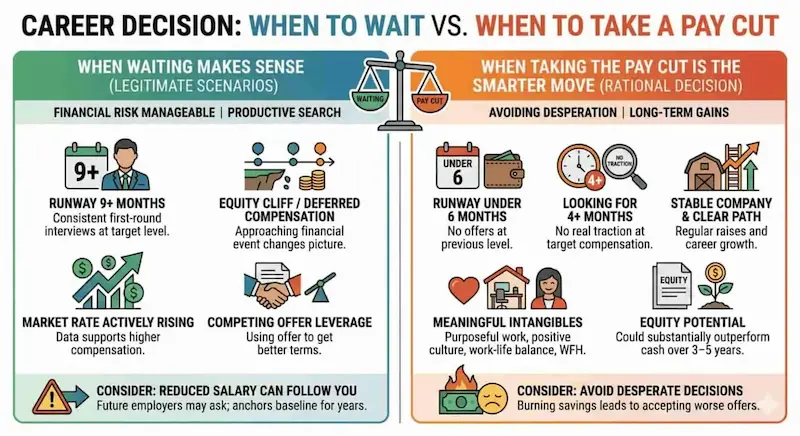
There are legitimate scenarios where holding out is the right career move. Consider waiting if:
- Your runway is 9+ months and you’re getting consistent first-round interviews at your target level
- You have a specific equity cliff approaching at a new role or a deferred compensation event that changes your financial picture significantly
- The market rate for your role is actively rising and you have data to support that
- You have a competing offer you’re using as leverage to get better terms elsewhere
In these situations, the financial risk of waiting is manageable. The job search is productive. And the cost of accepting a lower salary now — especially if it anchors your future compensation — is genuinely higher than the short-term sacrifice of staying patient.
One thing worth considering: a reduced salary can follow you. When future employers ask about your pay history (in regions where that’s still permitted), or when you negotiate at a new company, your baseline matters. A slight pay cut might be worth it. A dramatic one that anchors you low for years deserves more scrutiny.
When Taking the Pay Cut Is the Smarter Move
On the other hand, there are clear signs that accepting a lower salary now is the more rational financial decision:
- Your runway is under 6 months and you have no offers at your previous level
- You’ve been looking for a job for 4+ months with no real traction at your target compensation
- The job offer comes from a stable company with a clear path to regular raises and career growth
- The role offers meaningful intangibles — purposeful work, a positive work culture, better work-life balance, or the ability to work from home a few days a week — that reduce your overall expenses or stress load
- The new role offers equity that could substantially outperform cash compensation over a 3–5 year window
I’d also add this: consider taking a pay cut if the alternative is burning through savings at a rate that forces you into a desperate decision in month seven. Desperation is expensive. It leads to accepting even worse offers under worse conditions.
The Equity Cliff Factor
This one deserves its own section because it trips people up constantly.
An equity cliff is the vesting trigger point where a significant chunk of your compensation unlocks. If you’re six months from a major vest and you’re considering a new role now, the math changes. Leaving early could mean forfeiting hundreds of thousands of dollars in unvested stock — especially if you’re coming out of a startup or a publicly traded company with a strong equity plan.
On the flip side, if you were laid off before your cliff, that unvested equity is already gone. It shouldn’t factor into your decision about what comes next. A common mistake is mentally counting money you’ll never see as part of your “previous comp” and using it to reject valid offers.
Strip out the equity you no longer have access to. Recalculate your true market rate. Then evaluate the new role offers in front of you with those clean numbers.
A Framework for Making the Call

Here’s a simplified decision framework you can use right now:
Step 1 — Calculate your runway. Total savings ÷ monthly burn rate = months of runway.
Step 2 — Map your search trajectory. How many qualified applications per week? How many interviews? What’s your hit rate? If you’re getting interviews and progressing to final rounds at your target level, waiting may be justified. If you’re not getting traction, that’s data.
Step 3 — Evaluate total compensation, not just salary. List every financial and non-financial element of the new role: base, bonus, equity, vacation time, paid time off, health coverage, work from home flexibility, career path clarity, and growth potential. Compare that to the real (not imagined) comp at your previous role.
Step 4 — Apply the 6-month rule. If your runway drops below 6 months before you land a role at your target level, take the pay cut. If you’re above 6 months and your search has real momentum, keep looking — but set a hard deadline.
Step 5 — Talk to a financial advisor or career strategist. Especially if equity, deferred comp, or a career change to a different industry is involved, get a second set of eyes on your numbers. The risks and rewards in these decisions are highly individual.
FAQs
How much of a pay cut is too much?
There’s no universal threshold, but a pay cut larger than 20% of your base salary can meaningfully impact your ability to save for retirement, handle emergencies, and maintain your standard of living. That said, “too much” depends entirely on your savings cushion, your burn rate, and what you’re gaining in return. A 20% pay cut to join a high-growth startup with strong equity might be worth it. A 20% pay cut for marginal career development probably isn’t.
Will taking a lower salary hurt my future earnings?
It can, especially if your next employer uses your current salary as an anchor point for negotiations. However, many jurisdictions now restrict salary history questions, and strong performance in a new role can reset your market rate quickly — especially if you’re building new skills or moving into a higher-trajectory career path.
Should I tell interviewers I’m open to a lower salary?
Not upfront. Let the offer come first, evaluate it in full, and negotiate from there. Signaling flexibility too early can reduce your negotiating floor before you’ve even seen the number.
What if I’m considering a pay cut for better work-life balance?
This is one of the most legitimate reasons to consider taking a pay cut, and it’s more common than people admit. If your current job or job search is costing you your health, relationships, or sanity, that has a real financial value — it just doesn’t show up on a spreadsheet.
How long should I realistically wait before accepting a lower offer?
A good rule of thumb: if you’ve been looking for a job for more than four months at your previous level with minimal traction, it’s time to broaden your criteria. The job market for senior roles is slower by nature — searches can take 6–12 months at the executive level — but if you’re not getting interviews, something needs to change, whether that’s your target role, your compensation expectations, or your job search strategy.
Conclusion
At some point, the question of taking a pay cut vs waiting stops being a career question and becomes a financial one. Run your runway. Look at your burn rate. Evaluate the total picture — not just the salary line. The job market at senior levels is slow by design, and patience is a legitimate strategy — but only when your numbers support it. If your six-month window is closing, don’t let the perfect role be the enemy of a very good one that’s right in front of you. The smartest career decisions aren’t always the ones that feel best in the moment; they’re the ones that hold up three years from now.
That’s exactly the kind of thinking Layoff Lifeline is built to help you with. Whether you’re weighing a specific offer, trying to figure out how long you can realistically keep looking, or just need a second opinion on your financial runway, you don’t have to figure it out alone. Book your free 15-minute strategy session — let’s look at your numbers together and map out the move that actually fits your life, not just your resume.
Keep Reading
More practical guidance for the financial, career and emotional side of a layoff.


