
Job Assistance
Laid-Off Tech Executive? How to Land Advisory Roles Now

I know the shock of a layoff hits hard, especially when you’ve built years of expertise at a technology company. But here’s what most laid-off executives miss: your experience as a technology leader is exactly what hundreds of startups desperately need right now. While you’re updating your resume, founders are searching for advisors who’ve navigated the exact challenges they’re facing. Advisory roles offer flexible engagement, equity upside, and compensation that can exceed $50K annually—sometimes significantly more.
Key Takeaways
- Advisory board positions typically offer 0.15% to 1% equity compensation plus $50K-$250K annual cash, with board observer roles averaging $148K median salary
- Your FAANG or high-tech leadership experience provides immediate credibility as a technology advisor for startups seeking digital transformation guidance
- Most advisory seats come through warm introductions rather than job postings—strategic networking through investors, former colleagues, and industry events drives 80%+ of placements
Understanding Tech Executive Advisory Roles

What Advisory Positions Actually Look Like
Tech executive advisory roles come in several distinct formats, each with different levels of commitment and compensation structures.
Advisory board member positions typically require 5-10 hours monthly and focus on strategic guidance across technology transformation, business development, and organizational scaling. As an advisor, you’ll consult with founders and c-suite leaders on specific challenges where your years of experience provide immediate value.
Board observer seats offer a pathway to full directorship while providing companies access to your insight without voting rights. These roles suit executives who want to understand governance dynamics before committing to fiduciary responsibilities.
Paid directorship positions involve formal board membership with legal obligations, quarterly meetings, and compensation packages averaging $148K to $316K depending on company stage and complexity.
Compensation Realities for Technology Advisors
Let me be direct about what you can expect financially, because unrealistic expectations derail many executive transitions.
Early-stage startups typically offer 0.25% to 1% equity with minimal cash compensation, using a two-year vesting schedule with a three-month cliff. For pre-Series A companies, expect equity-heavy packages as they prioritize cash preservation.
Growth-stage companies (Series A and beyond) balance equity and cash, offering 0.15% to 0.5% equity plus $25K-$75K annually for strategic advisory work. Your role shifts from broad guidance to specialized domain expertise in areas like ai adoption, platform architecture, or technology leadership development.
Established tech companies seeking advisory support typically pay $50K-$250K per year in cash with minimal equity, valuing your ability to navigate complex challenges around digital transformation, vendor relationships, and performance management.
The FAANG Advantage in Advisory Markets
Your experience at a technology leader like Google, Amazon, Meta, Facebook, or Microsoft carries substantial weight with founders seeking to establish credibility with investors and optimize their technology transformation journey.
Startups actively seek advisors who understand how high-tech companies establish engineering excellence, implement innovation at scale, and navigate the hiring process for specialized technology talent. Your familiarity with methodologies used by market leaders provides a blueprint younger companies can adapt to their business goals.
CTOs and CIOs from established technology companies bring particularly valuable insight around digital transformation, cybersecurity protocols, cloud adoption, and building internal and external stakeholder alignment. These strategic priorities represent the exact challenges venture-backed startups face as they scale beyond initial product-market fit.
Step-by-Step Path to Landing Advisory Roles
Reframe Your Executive Experience
I need you to shift how you present your background, because traditional job search approaches fail spectacularly when pursuing advisory opportunities.
Transform your LinkedIn profile headline to explicitly state your advisory availability. Instead of “Former CTO at [Company],” use “Technology Executive | Advisor to High-Growth Startups | AI & Platform Architecture.” This signals your intent to potential companies scanning for domain expertise.
Create a dedicated advisory-focused resume highlighting strategic contributions, not job responsibilities. Emphasize outcomes like “Led digital transformation generating $50M revenue growth” or “Established platform adoption across 200+ enterprise clients.” Quantified impact matters more than years of experience.
Position yourself as serving as a trusted advisor through thought leadership content addressing specific challenges technology leaders face. Write LinkedIn posts about navigating organizational change, scaling engineering teams, or optimizing technology investment—content that demonstrates your ability to provide insight founders actually need.
Build Your Strategic Network
Most advisory positions never reach job boards. Warm introductions through your existing network drive the majority of successful placements, so systematic relationship-building becomes your primary job search activity.
Leverage investor connections by mapping venture capital and private equity contacts, especially those with Operating Partner or Platform roles. These individuals actively matchmake advisors with portfolio companies and can facilitate multiple introductions simultaneously.
Reconnect with former colleagues who’ve transitioned to founder or early executive roles. If you’ve helped them navigate challenges previously, they’ll vouch for your ability to add value to their current ventures. Email them specifically offering guidance on one challenge you know they’re facing.
Monitor funding announcements and board additions on LinkedIn and company PR channels. Reach out within 1-2 weeks of these announcements, as companies often establish full advisory structures during these transition periods.
Attend targeted conferences where you can engage founders and investors around specific domains. Research 2-3 attendees beforehand and approach with genuine insight about their business challenges, not generic networking small talk.
Position Your Advisory Value Proposition
Startups need to understand exactly what problems you solve and how your engagement delivers measurable value.
Identify your primary advisory focus areas—whether that’s technology transformation, scaling engineering organizations, ai implementation, or establishing technology leadership culture. Founders value specificity over generalist claims.
Develop case studies from your technology executive experience that demonstrate how you’ve helped organizations navigate similar challenges. Even if examples come from your employment history, frame them as advisory-style interventions: “Consulted with leadership team to establish cloud adoption strategy reducing infrastructure costs 40%.”
Establish your engagement model before initial conversations. Will you consult monthly? Participate in quarterly strategic planning? Provide on-demand guidance for specific initiatives? Clear expectations prevent misalignment and establish professional boundaries.
Execute Your Outreach Strategy
Generic networking fails, but strategic relationship-building with specific value propositions works consistently.
Craft personalized outreach messages that reference specific challenges the company faces and how your background provides relevant insight. Instead of “I’d love to join your advisory board,” try: “I noticed your Series A announcement and focus on enterprise adoption. I led similar expansion at [Company], growing enterprise revenue from $10M to $80M in 18 months. Happy to share insights on navigating this transition.”
Use multiple channels including email, LinkedIn, and warm introductions through mutual connections. Vary your approach based on relationship warmth—cold outreach requires more specific value demonstration than reconnecting with former colleagues.
Follow up systematically without being aggressive. If someone doesn’t respond within two weeks, send one brief follow-up referencing a recent company announcement or industry development. If still no response, move on and revisit in 2-3 months.
Navigate the Advisory Selection Process
When companies express interest, you’ll need to demonstrate both strategic capability and cultural alignment.
Initial conversations focus on understanding company challenges, strategic priorities, and how your background maps to their immediate needs. Listen more than you talk—founders want advisors who ask insightful questions, not deliver monologues about past accomplishments.
Proposal stage requires specificity about your engagement model, compensation expectations, and deliverables. Address equity percentage, vesting timeline, cash compensation if applicable, expected time commitment, and specific areas where you’ll provide guidance.
Reference checks work both directions. Ask to speak with other advisors or board members to understand company culture, decision-making processes, and how seriously leadership actually values external insight.
Structuring Your Advisory Agreements
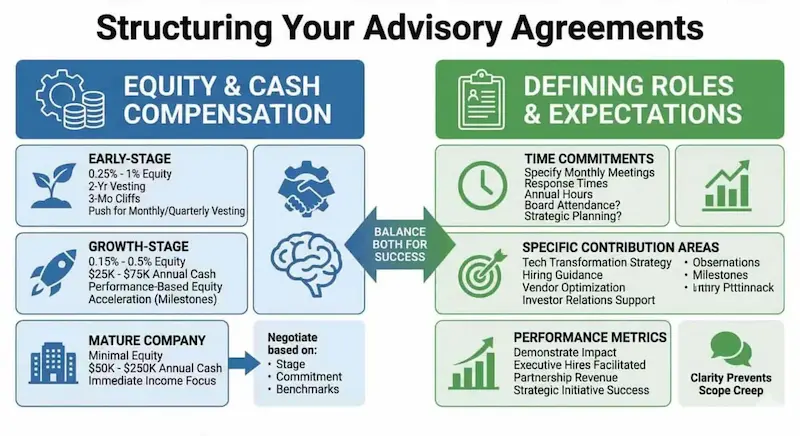
Equity and Cash Compensation
Negotiate compensation based on company stage, your time commitment, and market benchmarks.
For early-stage advisory roles, expect 0.25% to 1% equity with two-year vesting and three-month cliffs. Push for monthly or quarterly vesting rather than annual cliffs to ensure you’re compensated for ongoing contributions.
Growth-stage positions typically offer 0.15% to 0.5% equity plus $25K-$75K annual cash. Negotiate for performance-based equity acceleration if you achieve specific milestones around fundraising, key hires, or strategic partnerships.
Mature company advisory roles emphasize cash compensation ($50K-$250K annually) with minimal equity. These arrangements suit executives seeking immediate income during job transitions.
Defining Roles and Expectations
Vague advisory relationships create frustration for both parties.
Establish clear time commitments specifying monthly meeting frequency, response time expectations for urgent questions, and annual hour estimates. Document whether you’ll attend board meetings, participate in strategic planning sessions, or provide on-demand consult.
Define specific contribution areas such as technology transformation strategy, hiring process guidance for technical roles, vendor relationship optimization, or investor relations support. Clarity prevents scope creep and ensures your insight gets applied to highest-priority challenges.
Set performance metrics that demonstrate advisory impact. These might include successful executive hires you facilitate, partnership introductions that convert to revenue, or strategic initiative success rates.
Common Challenges Technology Executives Face
Overcoming the “Too Senior” Objection
Some founders worry that former CIOs or CTOs from large technology companies won’t understand startup constraints.
Address this proactively by emphasizing your ability to adapt methodologies from high-tech environments to resource-constrained settings. Share specific examples of how you’ve helped earlier-stage companies navigate similar adaptation challenges.
Position your experience as providing a roadmap to avoid common pitfalls, not a rigid prescription. Founders respond well to advisors who acknowledge the difference between established company resources and startup realities while offering practical scaling frameworks.
Managing Multiple Advisory Relationships
As you establish credibility, you’ll likely receive multiple advisory opportunities.
Limit active advisory roles to 3-5 companies maximum to maintain quality engagement. More than this dilutes your ability to provide meaningful insight and damages your reputation as companies realize you’re spread too thin.
Avoid conflicts of interest by declining advisory positions with direct competitors or companies in markets where existing advisees operate. Transparency about other commitments builds trust and prevents awkward situations later.
Establish systems for tracking commitments, meeting schedules, and follow-up items across multiple companies. Simple project management tools prevent you from missing critical deliverables or double-booking advisory calls.
Converting Advisory Roles to Full-Time Opportunities
Some executives pursue advisory work as a bridge to their next executive position.
View advisory roles as extended interviews where both parties evaluate long-term fit. Companies frequently hire advisors into operating roles once they’ve proven their strategic value and cultural alignment.
Don’t commit to advisory relationships expecting automatic conversion to employment. Approach each engagement authentically focused on delivering value, allowing full-time opportunities to emerge naturally if alignment exists.
Maximizing Your Advisory Impact
Delivering Strategic Value
Your effectiveness as an advisor directly impacts both your reputation and future opportunities.
Focus on high-leverage activities where your experience creates disproportionate value. Facilitating key executive hires, opening doors to strategic partners, or providing frameworks for technology transformation decisions delivers more impact than attending every team meeting.
Provide thought leadership that shapes strategic priorities rather than tactical execution guidance. Founders need advisors who challenge their thinking and identify blind spots, not consultants who implement specific projects.
Establish accountability mechanisms ensuring your recommendations get implemented. Follow up on previous advice, track outcomes, and adjust guidance based on results. This demonstrates commitment beyond collecting advisory shares.
Building Your Advisory Brand
Success in one advisory role leads to multiple opportunities through reputation effects.
Document success stories (with company permission) highlighting specific challenges you helped address and measurable outcomes achieved. These case studies become your primary marketing material for future advisory opportunities.
Develop content addressing common challenges technology leaders face in areas like digital transformation, ai adoption, platform scaling, or building technology leadership teams. Regular LinkedIn posts or blog articles establish your expertise and attract inbound advisory inquiries.
Request introductions from satisfied founders and investors to their networks. The strongest advisory pipeline comes from referrals by people who’ve experienced your impact directly.
The Technology Advisory Landscape in 2026

Current market dynamics favor experienced technology executives seeking advisory positions.
AI adoption challenges create massive demand for advisors who can guide companies through technology transformation while managing organizational change. CTOs and CIOs with hands-on ai implementation experience command premium advisory compensation.
Digital transformation initiatives across industries drive consistent demand for technology leaders who understand how to navigate complex ecosystem relationships, establish alignment between business goals and technology priorities, and optimize cloud adoption strategies.
Venture capital firms increasingly embed Operating Partners who actively matchmake portfolio companies with qualified advisors, creating more structured pathways into advisory roles than existed previously.
FAQs
How quickly can I realistically land my first advisory role after a layoff?
Timeline varies significantly based on your network strength and outreach consistency, but executives with strong technology leadership experience typically secure initial advisory conversations within 4-8 weeks and close first positions within 2-4 months. Systematic networking through investor connections and former colleagues accelerates this timeline considerably.
Should I work with recruiters to find advisory board positions?
Most advisory roles come through warm introductions rather than recruiters, but some specialized executive search firms and platforms do facilitate advisory placements. Be wary of anyone charging upfront fees—legitimate recruiters get paid by hiring companies, not candidates. Prioritize direct networking over recruiter relationships.
What’s the difference between advisory board roles and board observer positions?
Advisory board members provide strategic guidance without fiduciary duties or voting rights, typically engaging 5-10 hours monthly through scheduled consultations. Board observer positions involve attending formal board meetings without voting authority, offering pathway to full directorship while companies assess fit. Observers often have obvious loyalties to specific investors or stakeholders who arranged their participation.
Can I negotiate better advisory compensation than standard equity ranges?
Yes, particularly if you bring specialized expertise in high-demand areas like ai implementation, cybersecurity, or industry-specific domain knowledge. Advisors who commit to performance-based milestones—such as facilitating specific executive hires or partnership introductions—can negotiate equity acceleration or cash bonuses tied to achievement. Your leverage increases with the specificity and measurability of value you’ll deliver.
How do I balance advisory work with my active executive job search?
Advisory roles typically require 5-10 hours monthly, making them sustainable alongside job search activities. Many executives use advisory positions as income bridges while conducting deliberate executive searches, with the added benefit that advisory work often surfaces full-time opportunities. Limit yourself to 2-3 active advisory relationships during active job searches to maintain focus and energy.
Conclusion
Your technology executive experience represents exactly what hundreds of startups need to navigate their most critical challenges. Advisory roles offer flexible engagement, meaningful equity compensation, and the opportunity to leverage years of technology leadership expertise across multiple companies simultaneously.
The path forward starts with reframing your experience for advisory contexts, building strategic relationships with investors and founders, and systematically executing outreach that demonstrates specific value you’ll deliver. This transition won’t happen overnight, but executives who approach advisory positioning as seriously as they would a traditional job search consistently land meaningful roles.
Your financial recovery and career reinvention deserve expert guidance through this transition. Book your free 15-minute strategy session with Layoff Lifeline to discuss your specific situation and develop a personalized roadmap for turning your technology executive experience into advisory opportunities that provide both income and equity upside during your job search.
Keep Reading
More practical guidance for the financial, career and emotional side of a layoff.


