
Financial Guidance
The 529 Plan When Stock Options Go Underwater

So, you got laid off. Your stock options — the ones you’d been counting on — are now underwater. And sitting in your 529 plan is somewhere around $400,000 earmarked for your kid’s college tuition. That’s a lot of pressure converging at once. I’ve been there, and I know how fast the mental math starts spinning.
The good news? You have more options than you think. Let’s walk through how to protect that college savings account without making decisions you’ll regret when the market bounces back.
Key Takeaways
- When a layoff hits and stock options go underwater simultaneously, your 529 plan becomes the financial pressure point — knowing withdrawal rules, tax implications, and reallocation strategies can save you from costly mistakes.
- Age-based portfolios inside 529 accounts automatically shift toward bonds and cash as your child approaches college, offering a built-in buffer during market downturns — but that protection isn’t always enough when your income disappears overnight.
- Before touching your 529 funds in a crisis, explore alternatives like federal student loans, severance strategy, and temporary portfolio reallocation to give your investments time to recover.
Table of Contents
- Understanding the 529 Plan in a Financial Crisis
- Why Stock Options Going Underwater Changes Everything
- The 529 Triage Framework: Protecting $400K When Everything’s on Fire
- Managing 529 Accounts Alongside Concentrated Stock Risk
- What Financial Experts Say About Managing 529 Plans in a Downturn
- FAQs
- Conclusion
Understanding the 529 Plan in a Financial Crisis

A 529 plan is a tax-advantaged savings plan specifically designed to cover college expenses. Contributions grow tax-deferred, and qualified withdrawals — used for tuition, room and board, and other eligible college costs — are completely tax-free. In many states, you also receive a state income tax deduction on contributions.
But here’s where it gets complicated: if you withdraw money from a 529 plan for non-qualified expenses (say, to cover living costs after a layoff), you’ll owe ordinary income tax on the earnings plus a 10% penalty. That’s a double hit you want to avoid at all costs.
The 529 isn’t just a college fund — it’s a protected financial asset. Treating it that way, especially during turbulent times, is the first rule of 529 triage.
Why Stock Options Going Underwater Changes Everything
When your employer’s stock tanks and those options are no longer worth exercising, it doesn’t just hurt your net worth — it removes a major liquidity layer you may have been counting on to bridge gaps in your financial plan.
Concentrated stock positions are inherently risky. Many tech and finance professionals build their entire college funding strategy around vesting schedules, assuming those options will eventually fund the gap between their 529 plan balance and actual four-year tuition costs. When that plan collapses in a layoff scenario, the 529 often becomes the next line of defense — and that’s when panic-driven decisions happen.
Before you touch the money in the account, pause. The worst thing you can do is make permanent financial decisions based on temporary market conditions.
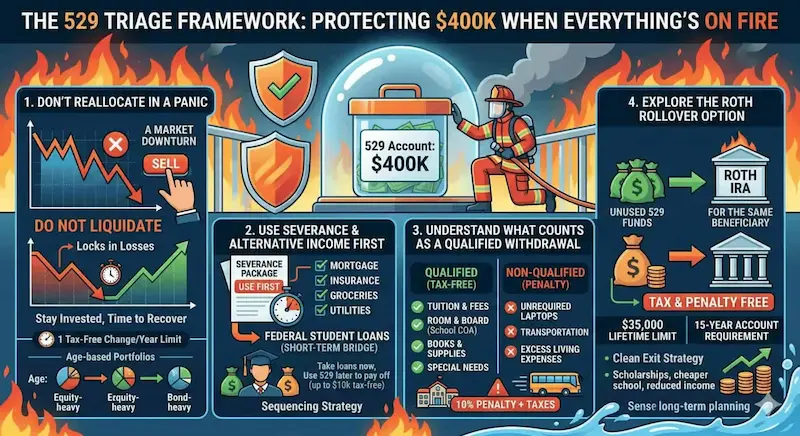
The 529 Triage Framework: Protecting $400K When Everything’s on Fire
Step 1: Don’t Reallocate in a Panic
The S&P 500’s 2025 volatility rattled a lot of 529 accounts. But according to college savings expert Mark Kantrowitz, the right move during a market downturn is usually not to liquidate. Selling into a downturn locks in losses and eliminates your portfolio’s time to recover.
Most 529 plans allow only one tax-free investment reallocation per calendar year per beneficiary. Use that move wisely. If your child is still several years from college, staying invested in a stock-heavy allocation may still make sense. If tuition payments are 12–18 months away, shifting a portion toward bonds and cash equivalents provides a more stable runway.
Age-based portfolios inside 529 accounts are designed to do this automatically — starting with heavier equity exposure and gradually shifting to less risky investments like bonds and cash as your child approaches college age. Check whether your plan uses a dynamic or static allocation and adjust accordingly.
Step 2: Use Severance and Alternative Income First
If you received a severance package, that’s your first line of defense — not your 529. Map out exactly how many months your severance covers essential expenses: mortgage, insurance, groceries, utilities. That buys your 529 plan funds time to stabilize.
If severance isn’t enough, consider federal student loans as a short-term bridge. Yes, loans. Here’s why it makes sense: you can take out federal student loans now to cover tuition payments, then use a qualified 529 withdrawal later (once the market has stabilized) to pay off up to $10,000 of that student loan debt per beneficiary without taxes or penalties. It’s a sequencing strategy, not a debt trap.
Step 3: Understand What Counts as a Qualified Withdrawal
Not all college expenses are created equal in the eyes of the IRS. Qualified education expenses for tax-free 529 withdrawal include:
- Tuition and mandatory fees
- Room and board (up to the school’s cost of attendance)
- Books, supplies, and required equipment
- Special needs services
- K–12 tuition (up to $10,000/year)
Non-qualified withdrawals — think laptops not required by the school, transportation, or living expenses beyond what’s listed in the school’s COA — trigger income tax on earnings plus that 10% penalty. A financial advisor can help you draw that line clearly before you pull any money.
Step 4: Explore the Roth Rollover Option
One underused strategy since 2024: unused 529 plan funds can be rolled over into a Roth IRA for the same beneficiary — tax- and penalty-free — up to $35,000 lifetime (with a 15-year account seasoning requirement and subject to annual Roth contribution limits). If your child ends up with scholarships, attends a less expensive school, or your financial situation changes dramatically, this is a clean exit for excess funds without a taxable event.
This is especially relevant when you’re managing a large 529 balance like $400K and facing the possibility that financial aid eligibility may shift based on your newly reduced income post-layoff.
Managing 529 Accounts Alongside Concentrated Stock Risk
One of the core mistakes in situations like this is treating your 529 plan and your stock options as separate financial universes. They’re not. Your overall asset allocation — including your brokerage account, retirement goals, and illiquid stock positions — should be viewed together.
When stock options go underwater, your effective net worth drops, your tax picture changes (no income event from exercising), and your liquidity profile shifts entirely. That changes what you need from your 529.
Here’s a simple way to think about it:
| Scenario | 529 Strategy |
|---|---|
| Child is 3+ years from college | Stay invested, consider increasing contributions |
| Child is 1–2 years from college | Shift portion to stable bonds and cash |
| Tuition bill is due within 6 months | Use severance/loans first, preserve 529 balance |
| Options vested but underwater | Do not exercise at a loss to fund 529 contributions |
| Layoff + market downturn simultaneously | Consult a financial advisor before any 529 withdrawal |
What Financial Experts Say About Managing 529 Plans in a Downturn
Experts consistently advise against reactive moves. Mark Kantrowitz recommends using alternative cash savings or other income sources to delay 529 distributions until market conditions improve. The logic is simple: a tax-deferred growth account that stays invested has a much better long-term outcome than one that gets liquidated at a trough.
A good financial advisor will also walk you through state-specific rules. In some states, you can receive a state income tax deduction on new contributions — meaning even during a tight cash year, a modest contribution could yield a meaningful tax benefit come filing time. Many states also allow you to contribute to a new 529 account for a different beneficiary, giving you flexibility to restructure as your family’s needs evolve.
One more thing financial experts often overlook in this conversation: the impact of a layoff on financial aid. With a significantly lower income year, you may now qualify for aid packages that weren’t previously on the table — including need-based aid at schools that seemed financially out of reach. Talk to an attorney or tax professional, or a financial advisor who specializes in college funding, before you make any major moves.

FAQs
Can I withdraw from a 529 plan after a layoff without penalty?
Only if the withdrawal is used for qualified education expenses. Non-qualified withdrawals are subject to ordinary income tax on earnings plus a 10% penalty. A layoff alone does not create an exception to the penalty rules.
What happens to my 529 if my stock options go worthless?
Your 529 plan is completely separate from your employer stock. Its performance is tied to the investment options you chose within the plan — not your company’s stock price. The crisis is a cash flow and liquidity issue, not a 529 account problem.
Should I change my 529 investment allocation during a market downturn?
You’re allowed one tax-free investment reallocation per calendar year. If your child is close to college age, shifting toward less risky investments like bonds and cash makes sense. If college is still years away, staying invested may be the better call.
Can I use my 529 to pay off student loans?
Yes — up to $10,000 per beneficiary, lifetime. This is a legitimate tax-free strategy and is especially useful when you take out federal student loans as a short-term bridge during a market downturn, then use the 529 to repay them once conditions improve.
Does a lower income after a layoff affect financial aid eligibility?
Absolutely. A significant income drop can change your Expected Family Contribution (EFC) and open doors to need-based aid. This is worth exploring with a financial advisor before assuming you need to fund everything out of pocket.
Conclusion
Protecting a $400K 529 plan when your stock options go underwater and your income suddenly stops is genuinely stressful — but it’s also manageable with the right framework. The worst outcomes happen when fear drives the decisions.
If you’re navigating this right now, talking through your specific situation with someone who gets both the financial planning side and the career transition piece makes a real difference. The team at Layoff Lifeline works with professionals exactly like you — people who built solid financial foundations and need help protecting them through an unexpected transition.
Book your free 15-minute strategy session to discuss your specific situation.
Keep Reading
More practical guidance for the financial, career and emotional side of a layoff.


