
Financial Guidance
The Rule of 55 Strategy That Cuts Your Tax Bill

If you’re looking to retire early or facing an unexpected job transition, the rule of 55 tax strategy might be your financial lifeline. This lesser-known IRS provision allows you to access your retirement funds without the typical early withdrawal penalty, potentially saving you thousands in taxes while providing crucial income during your transition years.
Key Takeaways
- Access your 401(k) funds penalty-free starting at age 55 if you leave your job in the calendar year you turn 55 or later
- Strategic withdrawal planning can significantly reduce your overall tax burden during early retirement years
- Proper implementation requires understanding IRS rules, tax implications, and coordination with other retirement accounts
What Is the Rule of 55?

The rule of 55 is an IRS provision that allows you to withdraw funds from your employer’s 401(k) or 403(b) retirement plan without paying the standard 10% early withdrawal penalty. The rule applies if you leave your job (whether through layoff, termination, or voluntary departure) during the calendar year you turn 55 or later.
This IRS rule of 55 creates a unique opportunity for those who find themselves in a position to retire early or need access to retirement funds before reaching the traditional age of 59½. Unlike other early access provisions, the rule of 55 doesn’t require you to prove financial hardship or take substantially equal periodic payments over multiple years.
How the Rule Works
When you use the rule of 55, you can take withdrawals from the specific employer plan where you were working when you left your job. The money from your retirement account becomes available without the federal tax penalty, though you’ll still owe ordinary income tax on traditional retirement plan distributions.
It’s important to note that the rule applies whether you have a traditional or Roth 401(k). However, the tax treatment differs between the two account types, with Roth 401(k) contributions having already been taxed.
Understanding Rule of 55 Withdrawals
Eligibility Requirements
To qualify for rule of 55 withdrawals, you must meet specific criteria:
- Leave your job during or after the calendar year you turn 55
- The withdrawal must come from the employer plan where you were working when you left
- You cannot roll the funds to an IRA and still maintain rule of 55 eligibility
- Some employer plans may have additional restrictions or may not offer this option
What Plans Qualify
The rule of 55 work with:
- 401(k) plans
- 403(b) plans (for non-profit and government employees)
- 457(b) plans (with some variations for public safety employees)
Traditional IRAs and Roth IRAs don’t qualify for the rule of 55. If you’ve already rolled your employer plan funds into an IRA, you’ve lost the ability to use this strategy for those particular funds.
Early Withdrawal Penalty Benefits
Avoiding the 10% Penalty
The primary benefit of the rule of 55 allows you to access retirement funds without the standard 10% early withdrawal penalty that typically applies to distributions before age 59½. For someone withdrawing $50,000 from their retirement plan, this saves $5,000 in federal tax penalties alone.
Tax Planning Opportunities
Without the additional tax penalty, you may find yourself in a lower overall tax bracket, especially if your early retirement income is less than your working years’ salary. This creates opportunities for strategic tax planning:
- Income smoothing: Spread withdrawals across multiple tax years to stay in lower tax brackets
- Conversion strategies: Consider converting traditional retirement funds to Roth accounts during low-income years
- State tax planning: Time your retirement to minimize state income tax obligations
Using the Rule of 55 to Retire Early
Creating Your Withdrawal Strategy
When you’re looking to retire early, developing a comprehensive withdrawal strategy is crucial. The rule of 55 can serve as a bridge between your working years and when you can access other retirement accounts penalty-free at age 59½.
Consider these approaches:
- Systematic withdrawals: Take regular distributions to cover living expenses
- Lump sum strategy: Withdraw larger amounts during particularly low-income tax years
- Coordinated approach: Balance rule of 55 withdrawals with other income sources
Timing Your Career Transition
The calendar year requirement creates strategic timing considerations. If you turn 55 in December, you have the entire year to make your job transition while maintaining rule of 55 eligibility. However, if you turn 55 in January, waiting until later in the year might provide more time to plan your financial transition.
Tax Implications and Retirement Income Planning
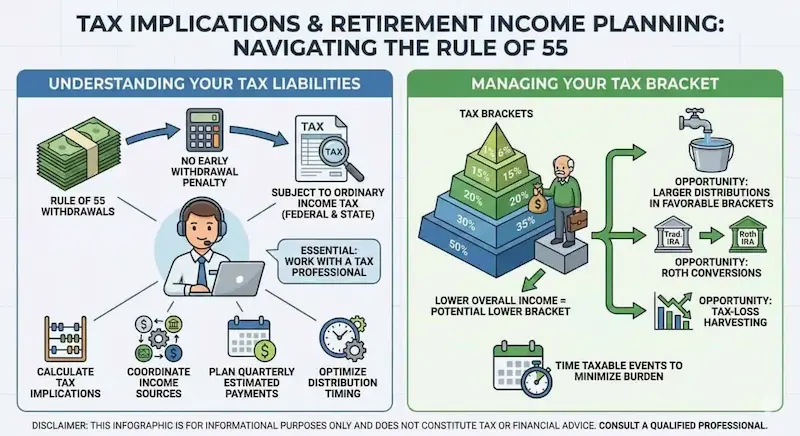
Understanding Your Tax Liabilities
While rule of 55 withdrawals avoid the early withdrawal penalty, they’re still subject to ordinary income tax. This means the distribution will be taxed at your regular federal tax rate, plus any applicable state income tax.
Working with a tax professional becomes essential when implementing this strategy. They can help you:
- Calculate the tax implications of various withdrawal amounts
- Coordinate with other retirement income sources
- Plan for quarterly estimated tax payments
- Optimize the timing of distributions
Managing Your Tax Bracket
Early retirement often means lower overall income, which can place you in a lower marginal tax bracket. This creates opportunities to:
- Take larger distributions while remaining in favorable tax brackets
- Convert traditional retirement funds to Roth accounts
- Implement tax-loss harvesting in investment accounts
- Time other taxable events to minimize overall tax burden
Coordinating With Other Retirement Accounts
IRA Considerations
Remember that IRAs don’t qualify for rule of 55 treatment. If you have both employer plan funds and IRA assets, you’ll need separate strategies for each account type. Traditional IRAs require waiting until age 59½ for penalty-free access, though certain exceptions apply for specific circumstances.
Social Security Planning
If you retire early using the rule of 55, you’ll likely need to bridge the gap until Social Security benefits become available. The earliest you can claim Social Security retirement benefits is age 62, though waiting until full retirement age (typically 66-67) provides higher monthly payments.
Healthcare Considerations
Early retirement means losing employer-sponsored health insurance. Factor healthcare costs into your withdrawal strategy, as medical expenses can significantly impact your retirement budget and tax planning.
Common Mistakes to Avoid
Rolling Funds to an IRA
One of the most critical mistakes is rolling your employer plan funds to an IRA before implementing the rule of 55 strategy. Once funds are in an IRA, they lose rule of 55 eligibility and become subject to the standard early withdrawal penalties.
Insufficient Tax Planning
Failing to plan for the income tax implications of rule of 55 withdrawals can create unexpected tax liabilities. Always consult with a tax adviser to understand the full impact of your withdrawal strategy.
Overlooking Employer Plan Rules
Not all employer plans offer rule of 55 withdrawals, and some may have additional restrictions. Review your plan documents carefully and confirm availability before making career decisions based on this strategy.
Ignoring State Tax Implications
While focusing on federal tax implications, don’t forget about state income tax consequences. Some states don’t tax retirement income, while others may have different rules that affect your overall tax burden.
Advanced Strategies for Rule of 55

Public Safety Employee Benefits
Public safety employees (police officers, firefighters, emergency medical technicians) may qualify for even earlier access to retirement funds. Some plans allow penalty-free withdrawals as early as age 50 for qualified public safety employees.
Coordinating Multiple Employer Plans
If you have retirement savings with multiple employers, you may be able to use the rule of 55 for your most recent employer’s plan while keeping other accounts intact for future access.
Income Replacement Planning
Create a comprehensive financial plan that maps out how rule of 55 withdrawals will provide income during your early retirement years. Consider how this income will coordinate with:
- Part-time work income
- Investment portfolio withdrawals
- Delayed Social Security claiming strategies
- Healthcare subsidy eligibility
FAQs
Can I use the rule of 55 if I’m fired from my job?
Yes, the rule applies regardless of whether you voluntarily leave, are terminated, or are laid off, as long as you meet the age requirements during the calendar year of separation.
What happens to my rule of 55 eligibility if I get rehired?
If you return to work for the same employer, you typically lose access to rule of 55 withdrawals from that plan. However, funds already withdrawn remain penalty-free.
Can I take partial withdrawals using the rule of 55?
Yes, you don’t need to withdraw your entire account balance. You can take partial distributions as needed, though each withdrawal will be subject to ordinary income tax.
Does the rule of 55 apply to inherited retirement accounts?
No, the rule of 55 only applies to your own employer-sponsored retirement accounts. Inherited accounts have different rules and exceptions.
Can I use the rule of 55 for a previous employer’s 401(k)?
No, the rule of 55 only applies to the employer plan where you were working when you separated from service at age 55 or later.
Conclusion
The rule of 55 tax strategy offers a valuable opportunity for early retirees and those facing career transitions to access retirement funds without penalty. However, successful implementation requires careful planning, tax consideration, and often professional guidance to maximize benefits while minimizing your overall tax burden.
If you’re considering early retirement or facing an unexpected career change, don’t navigate these complex financial waters alone. Layoff Lifeline specializes in helping people like you turn career challenges into opportunities. We’ll help you understand how the rule of 55 fits into your broader financial strategy and ensure you’re making the most of this valuable tax provision. To explore your options and create a personalized, schedule a consultation today.
Keep Reading
More practical guidance for the financial, career and emotional side of a layoff.


