
Job Assistance
WARN Act Layoff Rights: Know Your Legal Protections

Getting laid off is stressful enough without being caught completely off guard. I’ve seen too many workers face unexpected job loss without the advance notice they legally deserve. The Worker Adjustment and Retraining Notification Act exists to protect you, but many employees don’t realize when their rights have been violated or what they can do about it.
Key Takeaways
• The WARN Act requires employers with 100+ employees to provide 60 days advance notice before mass layoffs or plant closures affecting 50+ workers
• When employers violate WARN requirements, affected employees can receive up to 60 days of back pay and benefits as compensation
• You can file individual or class action lawsuits in federal court to enforce your WARN Act layoff rights, with potential attorney’s fees coverage
What is the WARN Act, and Who Does It Protect?

The federal WARN Act protects workers by requiring certain employers to provide advance notice before significant workforce reductions. This federal law applies to businesses with 100 or more full-time employees, not counting those who’ve worked less than six months in the past year or average fewer than 20 hours per week.
The act requires employers to give notice when they plan a mass layoff affecting 50 or more employees at a single site of employment, or when they’re closing a plant that will result in job loss for 50 or more workers during any 30-day period. For larger layoffs affecting 500 or more employees, or between 50-499 employees who constitute at least 33% of the workforce, the WARN requirements also apply.
When Employers Must Provide WARN Notice
The law mandates that covered employers must give at least 60 calendar days advance written notice before:
- Plant closings that will result in employment loss for 50 or more full-time employees
- Mass layoffs affecting 500+ workers, or 50-499 workers who make up at least 33% of the workforce
- Significant reductions in work hours for six months or more
Employers must notify affected employees, their representatives, the state’s Department of Labor, local workforce development boards, and the chief elected official of the local government where the site of employment is located.
Common WARN Act Violations and Red Flags
Unfortunately, many employers either don’t understand their WARN obligations or choose to ignore them. Common violations I’ve encountered include:
Insufficient Notice Period: Providing less than the required 60 days notice, or giving notice on the day of the layoff.
Incomplete Notifications: Failing to notify all required parties, including state agencies, local workforce development areas, or employee representatives.
Misclassifying Events: Calling a mass layoff a “restructuring” or “temporary furlough” to avoid WARN requirements.
Gradual Layoffs: Conducting layoffs in small groups over time to stay below the 50-employee threshold, when the cumulative effect should trigger WARN obligations.
Remote Work Complications: With more distributed workforces, some employers incorrectly assume WARN doesn’t apply to remote workers or satellite offices.
What You Can Do When Your WARN Act Rights Are Violated
If your employer failed to provide proper notice under the WARN Act, you have several options for seeking remedies:
File a Lawsuit for Back Pay and Benefits
Under federal law, employees can sue for up to 60 days of back pay and benefits for each day of the violation. This means if your employer gave you only 10 days notice instead of 60, you could recover 50 days of wages and benefits. The back pay calculation uses either your average regular rate during the previous three years or your final regular rate, whichever is higher.
Your compensation can include:
- Regular wages and overtime that would normally be available
- Health insurance premiums and other benefit costs
- Medical expenses that would have been covered under your employee benefit plan
Join a Class Action Lawsuit
Many WARN Act violations affect large groups of employees, making class action lawsuits an effective way to seek justice. Recent high-profile cases against major companies have resulted in significant settlements for affected workers. When you join with other employees, you can strengthen your position and share legal costs.
Report Violations to State Agencies
You can report WARN Act violations to your state’s workforce development agency or Department of Labor. While these agencies don’t enforce the federal WARN Act directly, many states have their own plant closure laws with additional protections. States like California WARN and New York’s worker adjustment laws often provide stronger protections than federal requirements.
Seek Trade Adjustment Assistance
If your job loss resulted from foreign competition or companies moving operations overseas, you might be eligible for Trade Adjustment Assistance. This federal program can provide extended unemployment benefits, job training, and relocation assistance.
Understanding WARN Act Exceptions
Employers aren’t required to provide 60-day notice in certain situations, though these exceptions are narrowly interpreted:
Natural Disasters: Floods, earthquakes, and similar unforeseeable events may excuse the notice requirement, though some notice must still be given after the fact.
Unforeseeable Business Circumstances: Sudden, dramatic business changes that weren’t reasonably predictable may reduce notice requirements.
Faltering Company: Businesses actively seeking capital or business to avoid closure may reduce notice periods if giving full notice would prevent obtaining the needed funding.
However, employers often misuse these exceptions. Economic downturns, general market conditions, or predictable seasonal fluctuations typically don’t qualify as unforeseeable circumstances.
State WARN Laws Provide Additional Protection
Many states have their own worker adjustment and retraining notification laws that offer stronger protections than the federal act requires. For example:
- California requires notice for smaller layoffs and has different calculation methods
- New York covers employers with 50+ employees and requires 90 days notice
- Illinois covers smaller employers and includes additional notification requirements
Even if your employer complies with federal WARN requirements, they might still violate state laws with more stringent notice provisions.
Rapid Response Services and Support
When employers submit a WARN notice properly, it triggers rapid response services from local workforce development boards. These services include:
- Job search assistance and career counseling
- Information about unemployment insurance benefits
- Retraining and skill development programs
- Connection to new employment opportunities
If your employer violated WARN requirements, you may have missed out on these valuable services during the critical transition period.
How to Protect Yourself and Document Violations
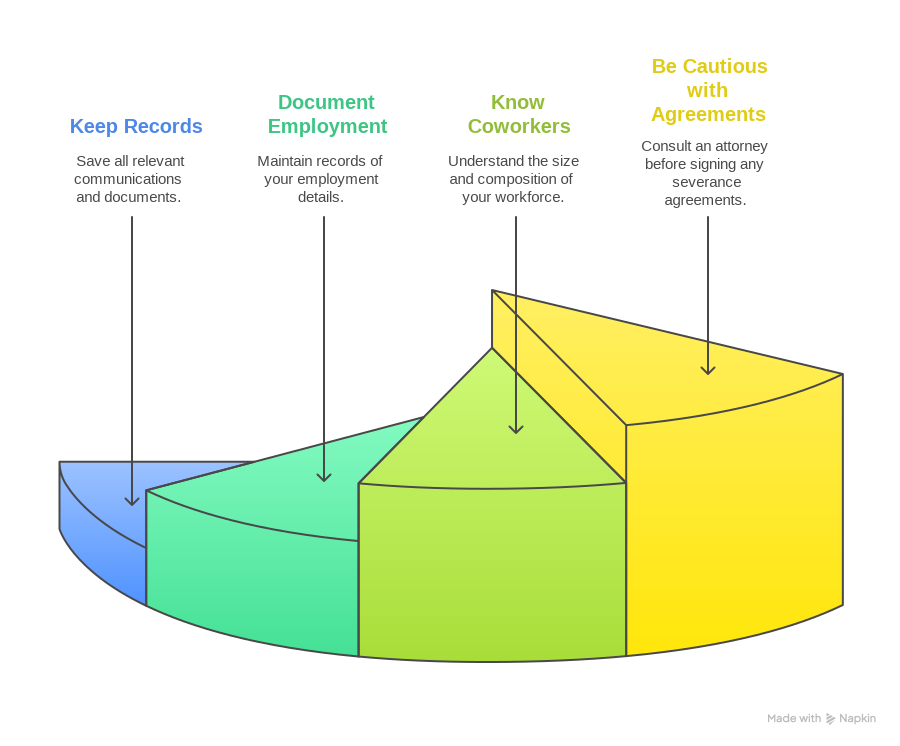
If you suspect your employer might be planning layoffs without proper notice:
Keep Records: Save emails, memos, and any communications about business conditions, rumors of layoffs, or company financial troubles.
Document Your Employment: Maintain records of your start date, hours worked, and job classification to establish your eligibility for WARN protections.
Know Your Coworkers: Understand how many people work at your site of employment and what constitutes your workforce for calculation purposes.
Be Cautious with Severance Agreements: Don’t sign any agreements waiving your WARN Act rights without consulting an employment attorney. Some employers try to offer minimal severance in exchange for releasing all claims.
The Importance of Legal Representation
WARN Act cases can be complex, involving calculations of damages, interpretation of exceptions, and coordination with multiple plaintiffs. An experienced employment attorney can help you:
- Determine if a violation actually occurred
- Calculate the full extent of your damages
- Navigate federal and state law differences
- Coordinate with other affected employees
- Handle negotiations with employers and their insurance companies
Many WARN Act attorneys work on contingency, meaning you don’t pay unless you win your case. The law also allows courts to award reasonable attorney’s fees to successful plaintiffs.
Recent Trends in WARN Act Enforcement
The employment landscape has changed significantly, and WARN Act violations continue to evolve. Recent trends include:
Technology Industry Layoffs: Major tech companies have faced multiple WARN Act lawsuits as they’ve conducted large-scale workforce reductions without proper notice.
Private Equity and Corporate Restructuring: Companies undergoing ownership changes or restructuring often mishandle WARN obligations during transitions.
Healthcare and Retail Closures: Hospital systems and retail chains frequently trigger WARN requirements when closing facilities or entire locations.
Remote Work Complications: The shift to distributed workforces has created new challenges in determining what constitutes a “single site of employment” and which state laws apply.
Taking Action: Your Next Steps
If you believe your employer violated the WARN Act, time is critical. While federal law doesn’t specify a statute of limitations, courts typically apply state law deadlines, which can range from several months to several years. Don’t wait to:
- Gather Documentation: Collect all relevant employment records, company communications, and evidence of the layoff circumstances.
- Connect with Coworkers: Identify other affected employees who might join a collective action.
- Understand Your Timeline: Research your state’s statute of limitations for employment claims.
- Consult Legal Counsel: Speak with an employment attorney who specializes in WARN Act cases.
- Don’t Accept Initial Offers: Be cautious about any severance packages that require you to waive legal rights.
Remember, employers who violate the WARN Act face liability for up to 60 days of back pay and benefits for each affected worker, plus potential civil penalties of up to $500 per day of violation. These damages can add up quickly, making it worthwhile for employers to settle legitimate claims.
The WARN Act exists to give you time to prepare for job transitions, seek new employment, and access retraining opportunities. When employers violate these rights, they’re not just breaking the law – they’re causing real financial harm to workers and their families during an already difficult time.
FAQs
How do I know if my employer is covered by the WARN Act?
The WARN Act applies to employers with 100 or more full-time employees, not counting those who’ve worked less than six months in the past year or average less than 20 hours per week. Both private companies and public entities operating in a commercial context are covered.
What if my employer claims the layoffs were due to “unforeseeable circumstances”?
Employers often misuse this exception. True unforeseeable circumstances are sudden, dramatic, and unexpected business changes that weren’t reasonably predictable. General economic downturns, market competition, or seasonal fluctuations typically don’t qualify. An employment attorney can help evaluate whether the exception legitimately applies.
Can I still file a WARN Act claim if I signed a severance agreement?
It depends on the specific language in your agreement. Some severance agreements include broad releases that waive WARN Act rights, while others may not. You should have an attorney review any agreement before signing, as you might be entitled to more compensation than the severance package offers.
How much compensation can I receive for a WARN Act violation?
You can recover up to 60 days of back pay and benefits for the period of violation. This includes your regular wages (calculated using either your average rate over three years or final rate, whichever is higher), plus the cost of benefits like health insurance premiums and medical expenses that would have been covered.
What’s the deadline for filing a WARN Act lawsuit?
Federal law doesn’t specify a statute of limitations, so courts apply state law deadlines. These vary significantly by state, from several months to several years. Because evidence can disappear and witnesses can become unavailable, it’s best to consult with an attorney and file your claim as soon as possible after discovering the violation.
Conclusion
Understanding your WARN Act layoff rights is crucial for protecting yourself and your family during unexpected job transitions. When employers violate these requirements, you have legal remedies available, but acting quickly is essential. Don’t let WARN Act violations go unchallenged – the compensation you recover can make a significant difference during your career transition.
If you’re facing unexpected job loss and believe your employer may have violated WARN Act requirements, you don’t have to navigate this complex situation alone. We at Layoff Lifeline understand both the legal and financial challenges you’re facing. Schedule a consultation today to explore your options and create a comprehensive plan for your financial recovery and career transition.
Keep Reading
More practical guidance for the financial, career and emotional side of a layoff.


