
Financial Guidance
You Face a FAANG Layoff — What Are Your Mortgage Options?

Getting laid off from a FAANG job hits differently when you’ve got a $1.2M mortgage sitting in the Bay Area or Seattle. One day you’re pulling in a FAANG salary with RSUs hitting quarterly, and the next you’re staring at a mortgage statement wondering how long severance can carry you. I’ve been there — and the honest truth is: the decision you make in the next 30 to 60 days matters more than anything else. Let’s walk through it clearly, without the panic.
Key Takeaways:
- A FAANG layoff doesn’t automatically mean losing your home — forbearance, loan modification, and strategic selling are all on the table, but timing matters.
- Your severance runway is your most important asset right now; mapping it against your monthly mortgage payment tells you exactly how much breathing room you have.
- Proactive communication with your loan servicer — before you miss a single payment — unlocks far more relief options than waiting until you’re already behind.
The $1.2M Mortgage Question: Sell, Refi, or Ride It Out?

This is the real fork in the road after a FAANG layoff. You have three broad paths: sell the home, refinance it, or hold on and use available relief options while you job hunt. None of them is automatically the “right” answer — the right one depends on how much severance you have, what the local market looks like, and how realistic your timeline is for landing a new tech job.
The Bay Area and Seattle real estate markets don’t move like the rest of the country. Even with rate pressure, high-demand neighborhoods have shown resilience, which means selling isn’t necessarily a panic move — it could actually be a strategic one if your equity is strong and your cost of living is bleeding you dry.
Before deciding anything, do one simple exercise: divide your total liquid assets (severance + savings + taxable investments) by your total monthly obligations (mortgage, car loan, student loans, credit card debt, utilities). That number is your runway in months. If it’s under 6 months, you need to move fast. If it’s 12+ months, you have room to be strategic.
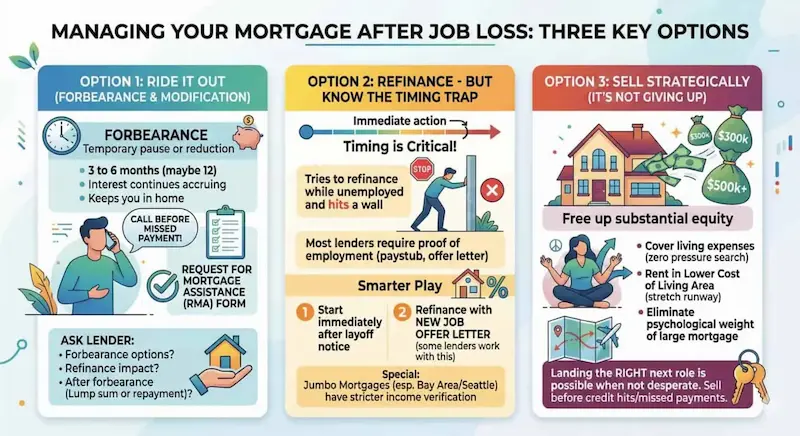
Option 1: Ride It Out With Forbearance or Loan Modification
If you believe you’ll land another job soon — within 3 to 6 months — riding it out through your lender’s relief programs is worth a serious look.
Forbearance allows you to temporarily pause or reduce your mortgage payments during a financial hardship. Most lenders offer forbearance periods of 3 to 6 months, sometimes extendable up to 12 months. It won’t erase what you owe — interest typically continues to accrue — but it can be the lifeline that keeps you in your home while you negotiate an offer letter.
Loan modification is a more permanent restructuring. Lenders may agree to extend your amortization, reduce your monthly payment, or adjust your repayment terms. If Fannie Mae or Freddie Mac owns your loan, you may qualify for the Flex Modification program, which can lower your monthly payment by around 20%. The catch: you generally need to show some household income to qualify — a working spouse or partner helps significantly here.
Here’s what most people don’t know: many lenders are far more willing to help homeowners who call before they miss a mortgage payment. Once you fall behind, your options narrow fast and the risk of foreclosure escalates. The moment you know you’ve been laid off, call your loan servicer, explain your situation honestly, and ask what assistance programs are available. You’ll likely need to submit a Request for Mortgage Assistance (RMA) form — it’s the document that gets the process moving.
What to ask your loan servicer:
- What forbearance options do you offer for job loss situations?
- Will forbearance affect my ability to refinance later?
- Is a loan modification available without current employment?
- How will this be reported to the credit bureaus?
- What happens when the forbearance period ends — lump sum or repayment plan?
Option 2: Refinance — But Know the Timing Trap
Refinancing sounds appealing on paper, especially if rates shift in your favor or you want to lower your monthly payment. But here’s the hard reality: most traditional mortgage lenders require proof of current employment — a paystub, offer letter, or verified new employment — before they’ll touch a refi application.
If you try to refinance while unemployed, you’re likely going to hit a wall with conventional lenders. Alternative or portfolio lenders may have more flexibility, particularly if you have significant equity and strong assets, but their rates and terms are rarely as favorable.
The smarter play: if a refi makes sense for your financial situation, start the process immediately after receiving your layoff notice — before your employment status officially changes in lender systems. If that window has passed, target refinancing once you have a new job offer letter in hand, even before your first paystub arrives. Some lenders will work with offer letters from verifiable employers.
One more consideration for Bay Area and Seattle homeowners specifically — your loan may be a jumbo mortgage, which carries stricter underwriting standards than conforming loans. Jumbo lenders are less flexible on income gaps, so the employment documentation requirement is even more critical.
Option 3: Sell Strategically (It’s Not Giving Up)
There’s a version of selling your home that isn’t a worst-case scenario — it’s actually a smart financial decision. If you’ve been in your Bay Area or Seattle home for several years, you likely have substantial equity. Selling could free up $300K, $500K, or more in cash that completely resets your financial stability.
That capital can:
- Cover living expenses and minimum monthly obligations while you job search with zero pressure
- Let you rent in a lower cost of living area and stretch your runway to 18–24+ months
- Eliminate the psychological weight of a massive mortgage hanging over every job negotiation
The real question is what happens to your job search when money isn’t the urgent constraint. Many people find that landing the right next role — rather than the first available one — becomes possible when they’re not desperate. Selling the home to buy time is a completely rational move, especially if you’re open to remote work, relocating to a lower-cost market, or even exploring an earlier-than-expected path to retire early.
Timing matters here too. You want to list before your credit takes any hits, while you can still qualify for bridge financing if needed, and before any missed payments show up in your history.
Severance Math: How Long Do You Actually Have?
FAANG severance packages can be generous — often 3 to 6 months of base salary, sometimes more at senior levels — but they feel a lot shorter when you’re staring at a $7,000–$10,000 monthly mortgage payment in the Bay Area or Seattle.
Do this math honestly:
| Monthly Obligation | Estimated Amount |
|---|---|
| Mortgage payment | $7,000–$10,000+ |
| Car loan/car payments | $500–$1,200 |
| Student loans | $300–$1,500 |
| Credit card debt minimums | $200–$800 |
| Other living costs | $3,000–$5,000 |
| Total burn rate | ~$11,000–$18,500/mo |
Now divide your total severance + liquid assets by that number. That’s your real runway — and it’s probably shorter than you thought.
If you’re looking at under 4 months of runway, forbearance or selling should move to the top of your list immediately. If you’re at 8–12 months, you can afford to be more deliberate: apply for forbearance as a buffer, keep your payments current for as long as comfortably possible, and give yourself a proper job search timeline without panic-applying for roles that don’t fit.
Managing Other Debt During a Layoff
Your mortgage isn’t the only obligation competing for your severance dollars. Federal student loan repayment has income-driven repayment options that can reduce payments to near zero during a period of unemployment — contact your federal student loan servicer and request an income-driven repayment plan adjustment immediately.
For credit card debt and car loans, the priority hierarchy is: mortgage first, then utilities, then car (if you need it for interviews or a future commute), then everything else. Credit card companies also have hardship programs — they’re not widely advertised, but they exist. A direct call explaining your situation often unlocks temporary reduced or deferred payment arrangements.
The worst thing you can do is try to pay everything at once, drain your savings in 60 days, and then have no buffer left for the mortgage. Prioritize ruthlessly.
Contingency Planning: What If the Job Search Takes Longer?

The tech job market has been humbling since 2023. FAANG-level roles with comparable compensation don’t appear on a predictable schedule, and even strong candidates are seeing 3–6 month searches. Build your contingency plan around a realistic worst-case scenario:
- Month 1–2: Apply for forbearance immediately, audit every expense, start networking and applying
- Month 3–4: Evaluate if a pay cut at a non-FAANG company is better than continued unemployment; many people discover that a lower-stress role with better work-life balance isn’t actually the downgrade it feels like on paper
- Month 5–6: If the mortgage is consuming more than 40% of your projected new income, run the numbers on selling seriously — not as defeat, but as a smart capital allocation decision
- Month 6+: If you haven’t landed something, selling the home and moving to a lower cost of living market may genuinely be the move that preserves your long-term financial stability
FAQs
Can I get forbearance on my mortgage after a FAANG layoff?
Yes. Most mortgage lenders — including those servicing jumbo loans — offer forbearance for documented financial hardship like job loss. Contact your loan servicer before you miss a payment to maximize your options. You’ll typically need to submit a hardship form explaining your situation.
Will forbearance hurt my credit score?
It depends on how your lender reports it to credit bureaus. Many forbearance agreements, particularly if entered proactively before you fall behind, have little to no negative impact. Ask your loan servicer specifically how they’ll report the arrangement before you agree.
Can I refinance my mortgage while unemployed after a layoff?
Traditional lenders generally require current employment documentation. However, if you act quickly after receiving your layoff notice — before your employment status changes — or once you have a new offer letter, refinancing may still be possible. Alternative lenders may have more flexibility if you have strong equity.
Should I sell my Bay Area or Seattle home after a tech layoff?
Not necessarily — but it’s a serious option worth modeling out. If you have significant equity and your severance runway is short, selling can provide financial stability and remove the pressure of an outsized monthly payment. It’s not giving up; it’s making an informed decision with the assets you have.
What’s the first thing I should do about my mortgage after a FAANG layoff?
Call your loan servicer within the first week — before you miss any payment. Explain your situation honestly and ask about available assistance programs. Being proactive unlocks options that simply aren’t available once you’ve already fallen behind.
Conclusion
A FAANG layoff with a seven-figure mortgage isn’t a financial death sentence — but it does require clear thinking and fast action. Whether you ride it out with forbearance, strategically sell to reset your runway, or pursue a refi once you’ve landed a new role, the decisions you make in the first 60 days will shape the next two years of your financial life. Don’t wait.
Facing this exact situation and not sure where to start? Layoff Lifeline specializes in helping people like you build a real financial roadmap after unexpected job loss — not generic advice, but a personalized plan for your numbers. Book your free 15-minute strategy session to discuss your specific situation and walk away knowing exactly what to do next.
Keep Reading
More practical guidance for the financial, career and emotional side of a layoff.


