
Financial Guidance
401k Rollover After Layoff at 55: Complete Planning Guide

Getting laid off at 55 feels like standing at a crossroads, you don’t choose. One minute you’re planning your path to retirement, and the next you’re navigating decisions about your 401k that could impact the next 30 years of your life. If you’re in this position right now, I want you to know something important: being 55 or older actually gives you financial options that younger workers simply don’t have. The Rule of 55 can be a game-changer, but only if you understand how to use it. Let me walk you through everything you need to know about your 401k rollover options after a layoff at this critical age.
Key Takeaways
- The Rule of 55 allows penalty-free withdrawals from your current employer’s 401k if you’re laid off at 55 or older, giving you unique financial flexibility that younger workers don’t have.
- You have four main options for your 401k after a layoff: keep it with your former employer, roll it into an IRA, transfer it to a new employer’s plan, or take a distribution, each with distinct advantages and tax implications.
- Acting strategically within 60 days of receiving your funds is critical to avoid mandatory tax withholding and potential penalties that could significantly reduce your retirement savings.
Understanding Your 401k Options After a Layoff at 55

When you lose your job at 55 or older, your 401k doesn’t just disappear, but what you do with it matters enormously. The decisions you make in the weeks following your layoff can either protect your retirement savings or cost you thousands in unnecessary taxes and penalties.
First, let me clear up a common misconception: your former employer can’t just confiscate your 401k money. That money is yours. What changes is where it lives and how you can access it. Your employer-sponsored retirement plan has been your financial home for years, but now you need to decide if it’s time to move or stay put.
The timing of your layoff matters tremendously. If you’re separated from service during or after the calendar year you turn 55, you’ve unlocked what financial planners call the “Rule of 55.” This exception to the standard early withdrawal penalty can provide crucial liquidity during your job transition without the typical 10% penalty that hits people who withdraw before age 59½.
Here’s what most people don’t realize: you don’t have to make this decision immediately. Unless your 401k balance is under $7,000, your former employer generally must allow you to keep your money in their plan. However, rushed decisions during stressful times often lead to costly mistakes. Take a breath, understand your options, and then move forward strategically.
The Rule of 55: Your Secret Advantage
The Rule of 55 is one of the most underutilized provisions in the tax code, and it’s specifically designed for people in your exact situation. If you’re laid off, terminated, or leave your job voluntarily during or after the year you turn 55, you can take distributions from that employer’s 401k without the standard 10% early withdrawal penalty.
Let me emphasize something critical here: the Rule of 55 only applies to the 401k from the employer you just left. If you have old 401k accounts sitting with previous employers, those don’t qualify. This is why the decision to roll over or not becomes so strategic.
Here’s a practical example: Let’s say you’re 56 and just got laid off. You have $400,000 in your current employer’s 401k and another $200,000 in an IRA from a previous rollover. Under the Rule of 55, you can access that $400,000 from your recent employer without penalty (though you’ll still owe income tax). The $200,000 in your IRA? That’s locked until 59½ without penalty, or you’d need to set up substantially equal periodic payments.
The strategic implication is clear: if there’s any chance you’ll need to access retirement funds during your 55-59 window, keeping money in your former employer’s 401k preserves that penalty-free option. Once you roll it into an IRA, you lose the Rule of 55 advantage for those specific funds.
Many people use the Rule of 55 as a bridge to their next job or to early retirement. It can cover living expenses while you’re between jobs, fund a career transition, or even serve as startup capital if you’re considering consulting or entrepreneurship. The flexibility is valuable, but it comes with a tradeoff: you’re drawing down retirement savings earlier than planned.
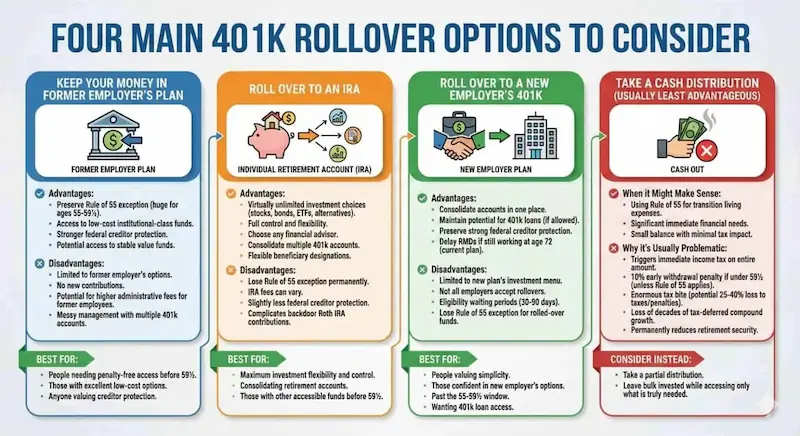
Four Main 401k Rollover Options to Consider
Keep Your Money in Your Former Employer’s Plan
This option often gets overlooked, but it can be the smartest move depending on your circumstances. If your balance exceeds $7,000, your former employer must allow you to keep your 401k in their plan. You’re no longer contributing, but your money continues to grow tax-deferred.
Advantages: You preserve the Rule of 55 exception, which is huge if you’re between 55 and 59½. Many employer plans also have access to institutional-class funds with lower expense ratios than retail investment options. If your plan includes stable value funds or other unique investment options, you might want to maintain access. Additionally, 401k assets generally have stronger creditor protection than IRAs under federal law.
Disadvantages: You’re limited to the investment options your former employer selected. You can’t make new contributions. Some plans charge higher administrative fees to former employees. And honestly, managing multiple 401k accounts across different employers gets messy as you move through your career.
Best for: People who might need penalty-free access to funds before age 59½, those with excellent low-cost investment options in their current plan, or anyone who values the additional creditor protection.
Roll Over to an IRA
The IRA rollover is probably the most popular option, and for good reason. It consolidates your retirement savings into one account you fully control, with investment options limited only by what the financial markets offer.
Advantages: You gain access to virtually unlimited investment choices, including individual stocks, bonds, mutual funds, ETFs, and even alternative investments depending on your IRA custodian. You can work with any financial advisor or robo-advisor you choose. You can consolidate multiple old 401k accounts into one IRA for simplified management. IRAs often have more flexible beneficiary designation options for estate planning.
Disadvantages: You lose the Rule of 55 exception permanently for those funds. IRA fees can sometimes be higher than good 401k plans, though this varies widely. You’ll have slightly less creditor protection under federal law, though many states provide strong IRA protections. If you return to work and want to do a backdoor Roth IRA contribution, having a traditional IRA can complicate the tax situation.
Best for: People who want maximum investment flexibility and control, those who already have other funds they can access if needed before 59½, or anyone consolidating multiple retirement accounts for simpler management.
Roll Over to a New Employer’s 401k
If you’ve already landed your next position or you’re confident you will soon, rolling your old 401k into your new employer’s plan is worth considering.
Advantages: You consolidate retirement accounts in one place while keeping funds in the 401k structure. You maintain the potential for 401k loans if your new plan allows them. You preserve strong federal creditor protection. If you’re still working at age 72, you can delay required minimum distributions on your current employer’s 401k.
Disadvantages: You’re again limited to your new plan’s investment menu. Not all employers accept rollover contributions from previous plans. You’ll need to wait until you’re eligible to participate in the new plan, which might be 30-90 days. And critically, you do not get the Rule of 55 exception for funds from your previous employer’s 401k once they’re rolled into a new employer’s plan.
Best for: People who value simplicity and are confident in their new employer’s 401k investment options, those who’ve already passed the 55-59½ window where the Rule of 55 matters, or anyone who wants to continue the possibility of taking 401k loans.
Take a Cash Distribution
I’m including this option for completeness, but I want to be crystal clear: taking a full cash distribution is usually the least advantageous choice. When you cash out your 401k, you trigger immediate income tax on the entire amount, and if you’re under 59½ (and not using the Rule of 55), you’ll also face a 10% early withdrawal penalty.
When it might make sense: You’re using the Rule of 55 and need the funds for living expenses during your transition. You have significant immediate financial needs and have exhausted other options. You have a small balance and the tax impact is minimal.
Why it’s usually problematic: The tax bite is enormous. A $100,000 distribution could easily result in $25,000-40,000 going to federal and state taxes, plus penalty if applicable. You lose decades of potential tax-deferred compound growth. You’re permanently reducing your retirement security. The money you thought would last decades gets cut down substantially before you even receive it.
If you need some money from your 401k, consider taking a partial distribution rather than cashing out everything. You can leave the bulk of your savings invested while accessing what you truly need.
Step-by-Step Guide to Rolling Over Your 401k
If you’ve decided a rollover is the right move, here’s how to execute it properly without triggering unnecessary taxes or penalties:
Step 1: Choose your destination first. Before doing anything with your current 401k, decide where it’s going. Open your IRA account or confirm your new employer’s 401k accepts rollovers. Having the receiving account ready prevents timing issues.
Step 2: Request a direct rollover. This is critical. Contact your former employer’s 401k administrator and specifically request a “direct rollover” or “trustee-to-trustee transfer.” In a direct rollover, the money moves from one retirement account to another without you ever touching it. This avoids mandatory 20% tax withholding and the 60-day deadline.
Step 3: Complete the paperwork carefully. You’ll need to provide your new account information and confirm how you want the funds transferred. Double-check account numbers and routing information. Errors here can cause frustrating delays.
Step 4: Understand the timeline. Direct rollovers typically take 2-4 weeks to complete, sometimes longer. Your former employer might process distributions on specific dates each month. Stay in communication with both the sending and receiving institutions to track progress.
Step 5: Confirm the rollover completed properly. Once the money arrives, verify that it was coded as a rollover contribution, not a regular contribution. Check that you received the full amount you expected. Save all documentation for your tax records.
Critical warning about indirect rollovers: If you receive a check made out to you (an indirect rollover), you have exactly 60 days to deposit it into another qualified retirement account. Your employer will withhold 20% for taxes, which means you’ll need to replace that 20% from other sources if you want to avoid it being treated as a taxable distribution. Miss the 60-day deadline, and the entire amount becomes taxable. Direct rollovers avoid this entire headache.
Tax Implications You Need to Know
Direct rollovers between pre-tax accounts generate no immediate tax consequences. Moving money from a traditional 401k to a traditional IRA or another traditional 401k is a non-taxable event. You’ll report it on your tax return, but no taxes are due. The money continues growing tax-deferred until you eventually take distributions in retirement.
Cash distributions are fully taxable as ordinary income in the year you receive them. If you take a $50,000 distribution, that’s $50,000 added to your taxable income for the year. Depending on your tax bracket, you could owe $10,000-20,000 in federal taxes alone, plus state income taxes. If you’re under 59½ and don’t qualify for the Rule of 55, add another $5,000 for the 10% early withdrawal penalty.
The Rule of 55 eliminates the penalty, not the income tax. This trips people up constantly. When you take a distribution under the Rule of 55, you still owe ordinary income tax on every dollar. You’re only avoiding the additional 10% early withdrawal penalty. The tax bill can still be substantial, so plan accordingly.
Roth conversions create immediate taxable income in exchange for future tax-free growth. Some people use a layoff year strategically for Roth conversions because their income is lower. If you’re normally in the 24% tax bracket but you’ll be in the 12% bracket this year due to the layoff, converting some traditional 401k money to Roth IRA could save you taxes long-term. You pay tax now at the lower rate to avoid higher taxes in retirement.
Required minimum distributions start at age 73 (for those born 1951-1959) or age 75 (for those born in 1960 or later). If you’re 55 now, you have years before this matters, but it’s worth understanding. Once RMDs begin, you must take taxable distributions from your traditional retirement accounts annually, whether you need the money or not.
State tax considerations matter too. Some states don’t tax retirement income, while others do. If you’re considering relocating during your career transition, the state tax treatment of retirement distributions could influence your timing and strategy.
Common Mistakes to Avoid
Mistake 1: Rolling over your 401k into an IRA and then needing the money before 59½. You just locked yourself out of the Rule of 55 exception. If you have any doubt about needing funds during the 55-59 window, keep at least some money in the 401k.
Mistake 2: Missing the 60-day rollover deadline. If you do an indirect rollover and miss the 60-day window, the entire distribution becomes taxable and potentially subject to penalties. The IRS rarely grants extensions except in cases of serious casualty, disaster, or other circumstances beyond your control.
Mistake 3: Forgetting about after-tax 401k contributions. Some plans allow after-tax contributions beyond the normal limits. These have special rollover rules. The after-tax contributions (but not the earnings) can potentially roll to a Roth IRA tax-free, while the earnings go to a traditional IRA. This requires careful coordination.
Mistake 4: Making emotional decisions during a stressful time. Getting laid off is traumatic. People often make quick financial decisions just to feel like they’re taking action. Resist the urge to rush. Take time to understand your full situation before moving retirement money around.
Mistake 5: Not considering your full financial picture. Your 401k rollover decision shouldn’t happen in isolation. Consider your emergency fund, your timeline to your next job, your other retirement accounts, your health insurance situation, and your spouse’s employment and benefits if applicable.
Mistake 6: Paying for advice you don’t need or skipping advice you do need. Some straightforward rollovers don’t require paying a financial advisor thousands of dollars. But if you have a complex situation, multiple accounts, tax considerations, or substantial assets, professional guidance could save you far more than it costs.
Mistake 7: Assuming all 401k plans are created equal. They’re not. Some plans have excellent low-cost investment options and strong participant protections. Others have limited choices and high fees. Before rolling money into a new employer’s 401k, evaluate the plan quality.
What to Do If You Have an Outstanding 401k Loan
Having an outstanding 401k loan when you get laid off creates a unique challenge that requires immediate attention. When your employment ends, most plans require you to repay the full loan balance quickly, often within 60-90 days rather than the original loan term.
Here’s what happens if you can’t repay the loan: the outstanding balance is treated as a taxable distribution. So if you borrowed $30,000 and can’t repay it, that $30,000 becomes taxable income to you. If you’re under 59½ and don’t qualify for an exception, you’ll also face the 10% early withdrawal penalty. That $30,000 loan could suddenly cost you $7,500-12,000 in taxes and penalties you weren’t expecting.
You do have options, though:
Repay the loan from other sources if possible. Use emergency savings, borrow from family, or use severance pay to repay the 401k loan. This preserves your retirement savings intact and avoids the tax bomb.
Negotiate with your employer. Some plans are more flexible than others. You might be able to extend the repayment period or work out a payment arrangement. It never hurts to ask.
Roll the loan over to an IRA. Under the Tax Cuts and Jobs Act, you now have until your tax filing deadline (including extensions) to roll the loan amount into an IRA. This requires you to come up with the cash from other sources, but you have more time than the 60-day rollover window. If you do this, the loan doesn’t become taxable income.
Accept the tax consequences strategically. If you truly can’t repay and can’t roll it over, at least understand the tax impact and plan for it. Set aside money to pay the tax bill when it comes. Don’t let the IRS bill surprise you next April.
The 401k loan situation is one where the two supporting posts we’ll discuss later become particularly valuable. “401k Loan Repayment Layoff: What You Really Owe” dives deep into the mechanics and strategies specifically for this scenario.
Creating Your Financial Strategy for the Next Chapter
Now that you understand your options, let’s talk about creating a comprehensive financial strategy during this transition period. Your 401k rollover decision is just one piece of a larger puzzle.
Assess your immediate cash needs. How long can you survive without a paycheck? Calculate your monthly expenses, consider your severance package if you have one, and evaluate your emergency fund. This determines how much financial runway you have.
Evaluate your healthcare situation. COBRA coverage is expensive but might be necessary. Some people find marketplace plans more affordable, especially if you qualify for subsidies based on your reduced income during unemployment. Healthcare costs can be your largest expense during this transition.
Map out your income sources. What will bring money in during your job search? Severance, unemployment benefits, spouse’s income, part-time work, or consulting? Understanding your income helps you determine if you need to access retirement funds.
Consider the Rule of 55 strategically. If you’re going to need funds before 59½, the Rule of 55 is valuable. But remember, you’re spending down retirement savings that should last decades. Only tap it if necessary, and have a plan to replenish it when possible.
Think about your career timeline. Are you actively searching for another full-time position? Transitioning to consulting? Considering early retirement? Your career plans dramatically influence the right 401k strategy.
Review beneficiary designations. When life changes, beneficiary designations often need updating. Whether you roll over or not, confirm your retirement accounts will go to the intended people.
Plan for taxes. If you’re taking distributions, if you had a 401k loan, or if you’re doing strategic Roth conversions, understand the tax implications and set aside money accordingly. The tax bill will come, and you want to be ready.
This is also an excellent time to check out our supporting posts for deeper guidance on specific aspects of your situation. “401k Rollover Layoff at 55: Your Financial Recovery Guide” provides detailed strategies for rebuilding your financial foundation during this transition, including how to prioritize competing financial demands and create a recovery timeline. “401k Loan Repayment Layoff: What You Really Owe” gives you specific action steps if you’re dealing with an outstanding 401k loan, including calculations, negotiation tactics, and tax minimization strategies.

FAQs
Can I roll over my 401k if I’m 55 and laid off but plan to work again?
Yes, you can roll over anytime. Just remember that once you move money to an IRA, you lose the Rule of 55 option for penalty-free access before 59½. If you think you might need the money during this window, keep it in your former employer’s 401k.
Does the Rule of 55 apply if I quit my job instead of being laid off?
Yes. The Rule of 55 works whether you quit, were laid off, or fired. It only matters that you left during or after the year you turned 55. The rule applies only to that specific employer’s 401k, and only if you keep the money there instead of rolling it over.
What happens to my 401k employer match after a layoff?
You keep any vested employer contributions. If you’re not fully vested (usually takes 3-6 years), you’ll lose the unvested portion. Your own contributions are always 100% yours. Check with your 401k administrator to see your vesting status.
How long do I have to decide what to do with my 401k after being laid off?
If your balance is over $7,000, there’s no deadline—you can leave it with your former employer indefinitely. Smaller balances may be automatically moved or cashed out by your employer. That said, it’s best to make an informed decision sooner rather than later.
Will rolling over my 401k affect my unemployment benefits?
A direct rollover doesn’t count as income and won’t affect unemployment benefits. However, taking a cash distribution might be counted as income in some states and could impact your benefits. Check your state’s unemployment rules if you’re considering a distribution.
Conclusion
Getting laid off at 55 doesn’t mean your financial future is derailed. With the right information and strategic thinking, you can protect and even optimize your retirement savings during this transition. The Rule of 55 gives you unique flexibility, but it’s just one tool in your financial toolkit. Whether you decide to keep your 401k with your former employer, roll it to an IRA, move it to a new employer’s plan, or take strategic distributions, the key is making an informed decision that aligns with your complete financial picture.
I know this is an overwhelming time, and financial decisions feel even more weighty when your income is uncertain. At Layoff Lifeline, we specialize in guiding people through exactly this situation. Schedule a consultation with us to review your specific circumstances, understand your options, and create a personalized financial recovery plan that protects your retirement while giving you the flexibility you need right now. Your next chapter starts with the right financial foundation.
Keep Reading
More practical guidance for the financial, career and emotional side of a layoff.


