
Legal Assistance
Layoff Rights and Protection Every Worker Over 50 Must Know

Losing your job at any age is difficult, but if you’re over 50, the stakes feel even higher. I’ve seen too many experienced professionals accept whatever their employer offers during a layoff, unaware of the substantial legal protections they have. Whether you’re facing a plant closing, mass layoff, or individual termination, federal and state laws provide safeguards that many employers hope you won’t know about. Understanding your layoff rights and protections isn’t just about what you’re owed—it’s about securing your financial future and holding employers accountable when they violate the law.
Key Takeaways
- Federal and state laws provide critical protections during layoffs, including the Worker Adjustment and Retraining Notification Act (WARN Act) requiring 60 days advance notice for mass layoffs and the Age Discrimination in Employment Act (ADEA) protecting workers 40 or older from discriminatory termination.
- Older workers face unique challenges but have specific legal safeguards, including enhanced severance review periods, protection against age-based targeting, and special healthcare and retirement planning considerations.
- Understanding your rights empowers you to negotiate better severance packages, identify illegal employment practices, and make informed decisions about your financial and professional future.
Table of Contents
- The Reality of Layoffs for Workers Over 50
- WARN Act Explained: Know Your Legal Protections and Entitlements
- Age Discrimination in Layoffs: Recognizing and Fighting Illegal Termination
- From Legal Protection to Practical Planning
- Healthcare Management for Seniors During Career Transitions
- Financial Planning for 50+ Workers After Layoff
- Building Your Support Network and Finding Resources
- Legal Review of Severance Agreements: What to Sign and What to Negotiate
- FAQs
- Conclusion
The Reality of Layoffs for Workers Over 50

Layoffs hit older workers differently and harder. Workers over 50 face longer unemployment periods, often accept positions at significantly lower salaries, and are disproportionately targeted during reductions in force—despite employer claims that age plays no role.
The challenges are real: age discrimination (whether explicit or disguised as “cultural fit”), outdated assumptions about technology skills, and concerns about salary expectations. But here’s what’s also real: you have more legal protections than younger workers, decades of valuable experience, and specific rights employers must respect.
This guide covers essential legal rights and practical strategies for workers over 50. Whether facing a potential layoff, just received notice, or weeks into unemployment, understanding these protections can mean the difference between financial disaster and a successful transition.
WARN Act Explained: Know Your Legal Protections and Entitlements
The Worker Adjustment and Retraining Notification Act requires employers with 100 or more employees to provide at least 60 days written notice before a plant closing or mass layoff. Many workers don’t discover this protection exists until after termination—which is exactly what employers count on.
Understanding WARN Coverage and Requirements
A plant closing shuts down an employment site, affecting 50 or more employees during any 30-day period. A mass layoff involves at least 50 employees, making up 33% of the workforce at a single site, or 500+ employees, regardless of percentage. The law protects hourly and salaried workers, though those working an average of less than 20 hours weekly aren’t counted toward thresholds.
Notice must go to affected workers, the state dislocated worker unit, and the chief elected official of local government. This ensures communities can mobilize support services and government entities can prepare for displaced workers.
Your Rights When Employers Violate WARN
When employers fail to provide required notice, you may be entitled to back pay and benefits for each day, up to 60 days of wages plus medical expenses you would have been covered under. This can amount to thousands of dollars per employee.
Enforce these rights through a federal lawsuit. Many WARN Act violations result in class actions where affected employees join together, making claims more cost-effective. The law may allow the prevailing party a reasonable attorney’s fee, meaning you might not pay legal fees out of pocket if you win.
Exceptions and State Laws
Limited circumstances exist where notice requirements don’t apply—such as when employees were hired with the understanding their employment was limited to a specific project’s duration. However, many employers claim exemptions that don’t actually apply.
Many states offer stronger protections than the federal WARN Act. Some require notice for smaller layoffs (25+ employees instead of 50), extend notice periods to 90 days, or cover employers with fewer than 100 employees. You’re entitled to whichever law provides greater protection.
Taking Action
If you suspect a violation, document everything immediately: when you learned about the layoff, your termination date, number of affected employees, and whether you received written notice. Contact other laid-off workers to determine the full violation scope.
Consult an employment attorney specializing in WARN Act cases. Many offer free consultations and work on contingency. Time limits apply to filing these claims, so act quickly.
[Interactive Element Ideas:Downloadable WARN Act Rights Checklist]
Age Discrimination in Layoffs: Recognizing and Fighting Illegal Termination
The Age Discrimination in Employment Act protects workers 40 or older from age-based employment decisions. Despite these protections, age discrimination remains pervasive during layoffs, often disguised as targeting “high earners” or employees with “outdated skills”—code words for older workers.
Understanding ADEA Protections
The ADEA makes it illegal for employers to discriminate against employees 40+ based on age in hiring, firing, promotion, layoff, compensation, benefits, job assignments, and training. During layoffs, employers must base decisions on legitimate, non-discriminatory factors—not birth certificates. Performance, skills, qualifications, and business needs should drive selections, not age.
Recognizing Discrimination Patterns
Age discrimination isn’t always obvious, and employers rarely admit targeting older workers. Look at who’s laid off versus retained—if the layoff disproportionately affects workers 40+ while younger employees with similar or fewer qualifications keep their jobs, this signals discrimination. The Equal Employment Opportunity Commission examines these statistical patterns during investigations.
Watch for manager comments about “fresh blood,” “new energy,” or being “set in their ways.” Retirement jokes or questions about retirement plans—even seemingly innocent remarks—can support discrimination claims when paired with termination. Sudden negative performance reviews after years of positive feedback, especially criticism on adaptability or tech skills, may indicate pretextual justifications masking age bias.
Protecting Your Rights and Filing Claims
Document everything if you suspect discrimination. Keep performance reviews, praising emails, awards, and communications indicating age bias. Note conversations where age was mentioned—who said what, when, and who witnessed it. These contemporaneous notes become valuable evidence.
Request information about the layoff selection process. In some cases, you’re entitled to know ages and job titles of selected versus retained employees. This demographic information reveals discriminatory patterns that individual employees might not see.
File a charge with the Equal Employment Opportunity Commission within 180 days of the discriminatory act (300 days in states with anti-discrimination agencies). The EEOC investigates your charge, potentially requesting employer information, interviewing witnesses, and analyzing the layoff’s age impact. They may mediate settlement or issue a “right to sue” letter for federal court action.
Successful claims result in back pay for lost wages, front pay for future lost earnings if reinstatement isn’t feasible, and liquidated damages equal to back pay if the violation was willful—essentially doubling your recovery.
[Interactive Element Ideas: Directory of age discrimination attorneys by state]
From Legal Protection to Practical Planning
Understanding legal rights is step one, but managing day-to-day realities is where many older workers struggle. The transition from employed to unemployed isn’t just about legal claims—it’s about healthcare coverage, bills, and maintaining your standard of living. For workers over 50, mistakes now can derail decades of retirement planning.
The next sections focus on immediate, practical decisions: healthcare, financial management, and protecting retirement savings. These decisions directly impact your security and options during this transition.
Healthcare Management for Seniors During Career Transitions
Losing employer-sponsored health insurance is one of the most stressful layoff aspects, particularly for workers over 50 with chronic conditions requiring ongoing treatment. The gap between employer coverage and Medicare eligibility at 65 creates significant financial and health risks demanding strategic planning.
Immediate Coverage Options
When employment ends, you’re generally entitled to continue employer-sponsored insurance through COBRA for up to 18 months by paying the full premium plus 2% administrative fee—often $600 to $1,500+ monthly.
While COBRA premiums shock workers accustomed to employer subsidies, this option provides invaluable continuity with existing doctors and specialists, avoiding treatment disruptions. If you’re mid-treatment or working with specialists who know your history, COBRA may justify the higher cost versus changing providers or facing new deductibles.
The Affordable Care Act marketplace offers alternatives. Job loss qualifies as special enrollment. Depending on income, you may qualify for tax credits making marketplace plans more affordable than COBRA. Compare both options: premiums, deductibles, copays, out-of-pocket maximums, and provider networks.
Medicare Planning
If approaching 65, understanding Medicare coordination with other coverage is crucial. You must enroll in Medicare Part A and Part B during your initial enrollment period (seven-month window: three months before through three months after your 65th birthday) or face permanent late enrollment penalties.
If you have creditable coverage through an employer with 20+ employees when turning 65, you can delay Medicare enrollment without penalty. If laid off before 65, losing job-based coverage triggers a special enrollment period, giving you eight months to enroll without penalties.
Deciding between COBRA and early Medicare involves complex considerations. Medicare generally offers better value, but COBRA might provide superior coverage for specific medications or specialists. Calculate total costs based on your expected needs.
Don’t overlook Medicare Part D prescription coverage. Going 63+ days without creditable prescription coverage after becoming Medicare-eligible triggers a late enrollment penalty that continues for life.
Managing Chronic Conditions
If you have chronic conditions like diabetes, heart disease, or arthritis, maintaining consistent treatment during layoff transition is critical. Medication or monitoring gaps can lead to serious complications exponentially more expensive than consistent prevention.
Before employer coverage ends, schedule all specialist appointments, complete necessary tests, and refill prescriptions to maximum amounts. Many plans permit 90-day maintenance medication supplies; request these before coverage terminates.
Ask doctors for medication samples or inquire about pharmaceutical manufacturer patient assistance programs. Many drug companies offer free or reduced-cost medications to qualifying patients. Prescription discount cards, pharmacy savings programs, and mail-order pharmacies significantly reduce costs.
Community health centers provide comprehensive primary care on sliding fee scales based on income. These federally qualified centers offer primary care, chronic disease management, and prescription assistance regardless of insurance status—a critical safety net during transitions.
[Interactive Element Ideas: Downloadable Healthcare Transition Checklist]
Financial Planning for 50+ Workers After Layoff
A layoff after 50 presents unique challenges: fewer working years to recover losses, less time for retirement accounts to grow through compound interest, and potential age discrimination making reemployment difficult at comparable salaries. Strategic financial planning becomes essential.
Assessing Your Current Financial Position
Start with a comprehensive financial inventory. Calculate total liquid assets—checking, savings, money market funds, CDs, and accessible taxable investments. Determine monthly fixed expenses: mortgage/rent, taxes, insurance, utilities, food, transportation, and necessities. This reveals how many months your emergency savings covers.
Review all retirement accounts: 401(k)s, IRAs, pensions, and other tax-advantaged savings. Don’t withdraw impulsively—early withdrawals before 59½ typically incur 10% penalties plus income taxes consuming 30-40%+ of your distribution.
Calculate potential severance pay, accrued vacation payouts, and unemployment benefits. Most states provide up to 26 weeks of regular unemployment, determining your runway before difficult decisions about retirement accounts.
Protecting Retirement Savings
The most critical decision older workers face after job loss is handling retirement savings accumulated over decades. Panic withdrawals can devastate long-term security, yet sometimes accessing funds strategically becomes necessary.
If you’re between 55 and 59½ when separating from service, the Rule of 55 allows penalty-free withdrawals from your current employer’s 401(k)—but not IRAs or previous employers’ plans. This provides crucial liquidity without the 10% penalty, though you’ll owe income taxes. Before withdrawing, consider the long-term impact—withdrawn money stops growing tax-deferred.
Consider rolling your 401(k) to an IRA for more investment options and lower fees. However, once funds move to an IRA, the Rule of 55 no longer applies. If you might need funds before 59½, keeping money in the 401(k) may be more advantageous.
Catch-Up Contributions and Retirement Timeline Adjustments
Upon reemployment, maximize catch-up contributions for workers 50+. You can contribute an additional $7,500 annually to 401(k)s beyond standard limits, plus $1,000 extra to IRAs.
Reassess your planned retirement age realistically. A year-long job search followed by lower salary reemployment may require pushing retirement back. Run various scenarios with different assumptions about earnings, savings rates, and Social Security claiming ages.
Consider phased retirement if full-time reemployment proves difficult. Part-time work, consulting, or freelancing provide income while delaying Social Security. Every year delaying Social Security between 62 and 70 increases permanent monthly benefits approximately 7-8%.
Bridge Employment and Social Security Strategy
“Bridge employment”—work between career jobs and full retirement—has become common among older workers. This might mean different industries, lower-level positions, or contract work.
When evaluating bridge employment, prioritize positions offering health insurance if not Medicare-eligible. Employer health coverage value can equal $10,000-$20,000+ annually, potentially outweighing higher wages without benefits.
Avoid claiming Social Security early if possible. Claiming at 62 instead of full retirement age (66-67) permanently reduces monthly benefits 25-30% for life. Claiming at 70 increases benefits roughly 24-32%. Before claiming early, exhaust other options: unemployment benefits, severance, taxable investments, or part-time work.
[Interactive Element Ideas: Video tutorial “First Financial Steps After Job Loss”]
Building Your Support Network and Finding Resources
Successfully navigating a layoff requires accessing expertise and opportunities you can’t generate alone. Building a strategic support network isn’t weakness—it’s smart planning.
Professional Support You Should Consider
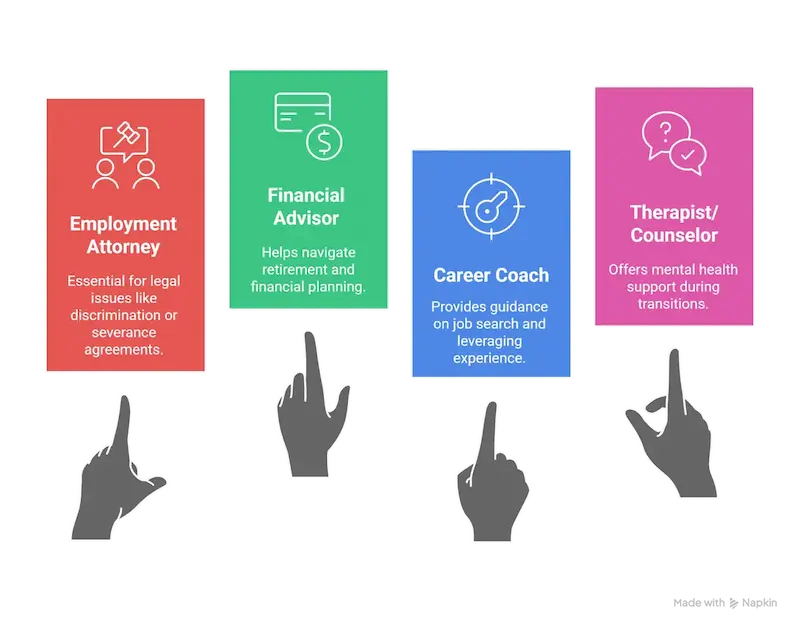
Employment Attorney: Essential if you suspect age discrimination, didn’t receive WARN Act notice, or have a complex severance agreement. Initial consultations are often free.
Financial Advisor: A fee-only fiduciary helps navigate retirement account decisions, Social Security timing, and long-term planning. Advice often pays for itself in avoided mistakes.
Career Coach: These professionals understand age-related job search challenges and position your experience as an asset. Many severance packages include outplacement services—use them.
Therapist or Counselor: Job loss after 50 can trigger depression and anxiety. Professional mental health support protects your wellbeing during major transitions.
Community and Government Resources
State workforce development agencies offer free job search assistance, training programs, and financial support for career transitions. Your state’s dislocated worker unit can connect you with local resources.
Professional associations provide networking events, job boards, and support groups for experienced professionals in transition. Online communities for workers over 50 offer emotional support, practical advice, and job leads.
Networking Strategically
Your professional network is your most valuable asset. Reach out to former colleagues, clients, and industry contacts—not just for job leads, but for conversations and visibility. Many experienced professional positions are filled through relationships, not public postings.
Legal Review of Severance Agreements: What to Sign and What to Negotiate
Severance agreements are negotiable, despite how employers present them. Older workers have specific legal protections strengthening their bargaining position. Understanding what you’re signing empowers better negotiation.
Understanding Release Clauses and OWBPA Requirements
Nearly every severance agreement includes a release waiving your right to sue for discrimination, harassment, wrongful termination, and wage claims. The Older Workers Benefit Protection Act (OWBPA) imposes specific requirements for employees 40 or older:
The waiver must be written in plain language specifically referencing the Age Discrimination in Employment Act. You must be advised in writing to consult an attorney. The agreement must give you at least 21 days to consider it (45 days for group layoffs), plus a 7-day revocation period after signing.
For group layoffs, employers must provide detailed information about the selection process, including job titles and ages of all employees selected for the program and those who weren’t. Never let employers pressure you to waive these statutory periods—time pressure suggests they fear scrutiny of layoff decisions.
Non-Compete and Non-Disparagement Clauses
Non-compete clauses restrict your ability to work for competitors or in your industry for specified periods and geographic areas. Many states restrict or prohibit these, particularly for terminated employees. California generally prohibits non-compete agreements in most circumstances.
Evaluate whether restrictions are reasonable. If asked to refrain from working in your industry for two years with modest severance, the trade-off may not be worthwhile. Negotiate narrower restrictions or higher severance in exchange for broader limitations.
Non-disparagement clauses prohibit negative statements about your employer, potentially preventing you from truthfully answering why you left or discussing your experience with other affected workers.
What You Can Negotiate
Initial severance offers are often opening positions, not final offers. Negotiate: severance amount, health insurance continuation beyond COBRA, outplacement services, positive reference agreements, and restrictive covenant scope.
If you believe you have discrimination claims, your leverage increases substantially. Employers often prefer paying additional severance over litigation risks. An attorney can assess claim strength and use them strategically in negotiations.
Consider asking for legal fee coverage for reviewing the agreement, vesting of unvested stock options, accelerated bonus payments, or retirement benefit enhancements. Timing of payments matters too—lump sum versus periodic payments affects taxes, unemployment benefits, and overall financial situation.
Consult an employment attorney before signing—they can often increase your package significantly, more than offsetting their fees. Many work on contingency or for a percentage of negotiated increases.
[Interactive Element Ideas: Severance package calculator benchmarking tool; “What Should I Negotiate?”; Negotiation script templates]

FAQs
What happens if my employer violated the WARN Act by not giving 60 days notice?
You may be entitled to up to 60 days of back pay and benefits, including wages and medical expenses. You can enforce these rights through federal lawsuit, often as part of a class action with other affected employees. The law may allow recovery of attorney’s fees, so consult a WARN Act specialist attorney promptly as time limits apply.
How can I tell if I experienced age discrimination during a layoff?
Watch for these signs: disproportionate layoffs of workers 40+, manager comments about wanting “fresh perspectives” or “new energy,” and sudden negative reviews after years of positive evaluations. Document everything—ages of laid-off versus retained employees, age-related comments, and your performance history. An employment attorney can help determine if you have grounds for an EEOC complaint.
Should I take COBRA or marketplace insurance after a layoff?
It depends on your health needs and finances. COBRA ($600-$1,500+ monthly) provides continuity with current doctors—valuable if you’re mid-treatment. Marketplace plans may cost less with subsidies but have different networks. Calculate total annual costs including deductibles and out-of-pocket expenses for your specific situation.
Can I access my 401(k) without penalty after being laid off at age 55?
Yes, the Rule of 55 allows penalty-free withdrawals from your current employer’s 401(k) if you’re between 55 and 59½. You’ll owe income taxes but avoid the 10% penalty. This doesn’t apply to IRAs or previous employers’ 401(k)s. Consider long-term retirement impacts before withdrawing, and consult a financial advisor about alternatives.
What’s the most important thing to negotiate in a severance agreement?
Ensure OWBPA compliance—at least 21 days to review (45 for group layoffs), written advice to consult an attorney, and a 7-day revocation period. Beyond the dollar amount, negotiate extended health benefits, outplacement services, positive references, and limited non-compete clauses. If the offer seems low or you suspect discrimination, consult an attorney who may negotiate a better package.
Conclusion
Understanding your layoff rights and protections transforms a disorienting experience into an opportunity to secure what you’ve earned and plan your next chapter strategically. Whether it’s enforcing the WARN Act’s notice requirements, recognizing and fighting age discrimination, making informed decisions about healthcare coverage, protecting your retirement savings, or negotiating a better severance package, knowledge puts you in control.
I’ve been where you are, and I know how overwhelming it feels. But here’s the thing—you don’t have to figure this out alone. At Layoff Lifeline, we help people like you turn job loss into genuine opportunity. Schedule a consultation to talk about your situation and map out a path forward that actually works. Your next chapter is waiting.
Keep Reading
More practical guidance for the financial, career and emotional side of a layoff.


